ExpressionEngine vs WordPress: Long-Term Cost & Scalability
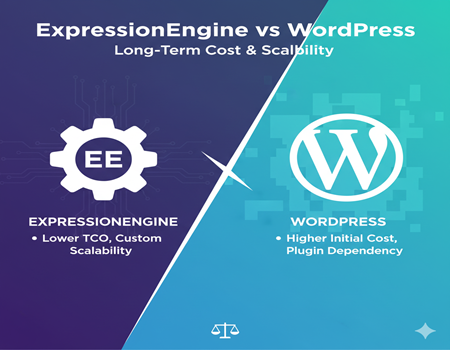
Choosing the right CMS is no longer just a technical decision—it is a long-term business strategy. In 2026, websites must support fast growth, handle high traffic, integrate with modern marketing tools, and remain secure. For businesses that plan to scale, the CMS choice can directly impact costs, performance, and team productivity. This is where the comparison between ExpressionEngine and WordPress becomes crucial.
ExpressionEngine is known for its developer-driven flexibility and strong security, while WordPress dominates the market due to its ease of use, extensive plugin ecosystem, and rapid scalability. Many businesses using ExpressionEngine are now asking whether it still makes sense to maintain their site or switch to a more scalable and cost-effective platform.
This blog explores the long-term costs of using ExpressionEngine versus WordPress, and how each platform supports growth. We will compare development expenses, maintenance, hosting, security, and SEO scalability. By the end, you will understand which CMS is better suited for your business goals and whether it’s time to migrate or stay.
Quick Overview: ExpressionEngine vs WordPress
ExpressionEngine and WordPress are both powerful content management systems, but they serve different purposes and audiences. ExpressionEngine is a developer-centric CMS designed for custom websites that require structured content and advanced customization. It offers high flexibility and control, making it ideal for businesses with complex requirements and in-house technical teams. However, this also means it often requires more technical knowledge and development resources for everyday updates and improvements.
On the other hand, WordPress is the most widely used CMS globally due to its user-friendly interface, extensive plugin ecosystem, and rapid scalability. It is built for easy content management, making it suitable for businesses of all sizes. WordPress allows marketing teams and non-technical users to publish content, manage media, and make site changes without relying heavily on developers.
While ExpressionEngine focuses on custom development and secure environments, WordPress emphasizes speed, flexibility, and accessibility. In 2026, the choice between these platforms often comes down to whether a business values complete customization or needs faster growth with simplified management. Understanding this difference is key to evaluating long-term costs and scalability.
Understanding Long-Term Costs: What You Really Pay For
When comparing ExpressionEngine and WordPress, it’s important to look beyond initial setup costs. Long-term expenses include hosting, maintenance, updates, security, and ongoing development. While ExpressionEngine may seem cost-effective at first, its reliance on custom development can increase expenses over time. Every new feature, design change, or content update may require developer involvement, which adds up quickly.
WordPress often appears cheaper because of its plugin ecosystem and ready-made themes. Many features can be added without custom coding, reducing development time and cost. However, WordPress sites can become expensive if you rely heavily on premium plugins, custom themes, or advanced security tools.
Another long-term cost is the time spent by teams managing the website. ExpressionEngine requires more technical knowledge, which can slow down marketing and content updates. WordPress offers faster workflows for non-technical teams, improving productivity and reducing operational costs.
Ultimately, long-term costs are not just about money—they include time, flexibility, and growth potential. Understanding these hidden costs helps businesses choose a CMS that supports future expansion without unexpected expenses.
Development & Maintenance Costs Comparison
When evaluating long-term costs, development and maintenance are the biggest factors that separate ExpressionEngine and WordPress. ExpressionEngine is highly developer-focused, which means every update or new feature often requires custom coding. This gives businesses full control, but it also increases expenses. Hiring skilled ExpressionEngine developers can be costly, and the time required to build custom modules or templates adds up quickly. As your website grows, ongoing maintenance becomes a continuous expense, especially if you need frequent updates or new functionalities.
WordPress, on the other hand, offers a more cost-effective approach due to its extensive plugin ecosystem. Many features can be implemented quickly using plugins, reducing the need for custom development. This makes WordPress easier to maintain and more budget-friendly for businesses that need frequent updates. Even complex functionalities like eCommerce, booking systems, or membership platforms can be integrated with existing solutions.
However, WordPress does require regular updates for plugins, themes, and core files. These updates are usually straightforward, but if not managed properly, they can cause conflicts and downtime. Overall, WordPress tends to be cheaper and easier to maintain in the long run, while ExpressionEngine requires higher development investment but offers more control for custom projects.
Hosting & Infrastructure Costs
Hosting and infrastructure costs play a major role in long-term scalability. ExpressionEngine typically requires more advanced hosting because it is built for custom environments. Businesses often need dedicated servers or managed hosting to ensure high performance, especially for large sites. This can increase hosting costs significantly, especially as traffic grows. Additionally, custom setups may require specialized server configurations and ongoing monitoring, which adds to the expense.
WordPress, on the other hand, offers more flexible hosting options. From shared hosting to managed WordPress hosting and cloud servers, WordPress sites can scale efficiently based on traffic and performance needs. Many hosting providers also offer built-in caching, CDN integration, and automatic backups, reducing the need for additional infrastructure investment.
While WordPress can still become expensive with heavy traffic or complex sites, the overall infrastructure costs are usually lower due to wider hosting support and optimized solutions. For businesses focused on long-term growth, WordPress provides more affordable scalability without compromising performance.
Ultimately, ExpressionEngine can be powerful, but WordPress offers more cost-effective hosting and easier scalability for growing websites.
Plugin Ecosystem: Impact on Cost & Scalability
One of the biggest factors that affects long-term cost and scalability is the availability of plugins and extensions. ExpressionEngine has a smaller plugin ecosystem compared to WordPress, which limits the options for adding new features quickly. Many requirements—such as advanced SEO tools, marketing integrations, or eCommerce features—often require custom development in ExpressionEngine. This increases costs and slows down project timelines, especially when businesses need rapid updates or new functionalities.
WordPress, however, has a massive plugin library, offering solutions for almost every business need. Whether you need SEO optimization, analytics integration, eCommerce, or membership systems, WordPress provides ready-made plugins that can be implemented quickly. This reduces the need for custom development and significantly lowers long-term costs. Plugins also allow businesses to scale their website by adding features without major development work.
However, it’s important to choose quality plugins and manage updates carefully, as poor plugins can affect site performance. Overall, WordPress’s extensive ecosystem makes it more scalable and cost-effective for businesses looking to grow quickly and adapt to changing digital needs.
Security & Updates: Cost of Staying Secure
Security is a critical long-term cost that affects both ExpressionEngine and WordPress. ExpressionEngine is often considered more secure due to its smaller user base and fewer common vulnerabilities. Its custom development structure also reduces the risk of widely exploited plugins. However, security still requires ongoing attention. Regular updates, server monitoring, and periodic audits are essential, especially for complex sites. These tasks often require skilled developers, which increases long-term costs.
WordPress is more frequently targeted by hackers because of its popularity. While this does not mean WordPress is unsafe, it does require strong security measures. Managed WordPress hosting, security plugins, and regular backups are necessary to protect the site. Many of these tools are available at a low cost, but advanced security setups can become expensive.
Both platforms require updates and maintenance, but WordPress offers more automated solutions. ExpressionEngine may need more manual effort, especially for custom builds. Ultimately, WordPress can be more cost-effective for security when managed properly, while ExpressionEngine offers strong security with higher development dependency.
Performance & Scalability: Which Platform Handles Growth Better?
When a website grows, performance and scalability become the most important factors. ExpressionEngine is built for custom development and can deliver excellent performance when optimized properly. Because it relies on custom coding, developers can design the site for speed and efficiency. However, scaling an ExpressionEngine site often requires technical expertise and custom server configurations. As traffic increases, businesses may need dedicated hosting, caching solutions, and additional development support to maintain performance.
WordPress is designed to scale efficiently, especially with modern hosting solutions. Managed WordPress hosting offers built-in caching, CDN support, and optimized server environments that can handle high traffic without complex setup. WordPress also benefits from a large number of performance plugins and tools that improve speed and reduce server load. This makes it easier to scale a WordPress site quickly as business needs grow.
However, WordPress can become slow if too many plugins are installed or if the site is poorly optimized. It is important to use quality plugins, proper caching, and a reliable hosting provider. Overall, WordPress provides easier and more affordable scalability for growing businesses, while ExpressionEngine can offer strong performance but requires more technical management and higher infrastructure costs.
Content Management & Team Efficiency Costs
Content management and team efficiency significantly affect long-term costs. ExpressionEngine is powerful but more technical, meaning content teams often depend on developers for updates. Adding new pages, editing layouts, or updating templates may require coding knowledge, which slows down workflows. This dependency increases operational costs because businesses must either hire in-house developers or rely on external support. Over time, this can become a major expense, especially for companies that publish content frequently or run marketing campaigns that require quick changes.
WordPress is designed for non-technical users, making content management simple and fast. Marketing teams can create pages, publish blogs, manage media, and update content without needing developer support. This improves productivity and reduces the cost of everyday website management. WordPress also offers user-friendly page builders, which simplify design changes and allow teams to implement updates independently.
For businesses focused on growth, speed matters. WordPress supports fast content publishing, making it easier to run campaigns and update information quickly. ExpressionEngine may be ideal for complex websites, but WordPress is more cost-effective for teams that need efficient content management and rapid scalability.
SEO and Marketing Scalability
SEO and marketing scalability are essential for long-term growth, and this is where WordPress has a clear advantage. WordPress offers a wide range of SEO tools and plugins that make optimization easy and efficient. Marketing teams can add meta titles, descriptions, schema markup, and XML sitemaps without developer support. WordPress also supports content planning and publishing tools that help improve search visibility and user engagement.
ExpressionEngine can still perform well for SEO, but it often requires more manual work and technical expertise. Many SEO features are not built-in and must be developed or customized, which increases costs and slows down optimization. Marketing teams may struggle to implement quick changes or run SEO experiments without developer assistance.
Additionally, WordPress integrates seamlessly with marketing platforms like email tools, CRM systems, analytics, and AI content tools. These integrations help businesses scale marketing efforts and improve conversions. ExpressionEngine has fewer integration options, which limits growth for marketing-driven websites.
Overall, WordPress provides better SEO scalability and marketing efficiency, while ExpressionEngine requires more technical support and higher costs to achieve similar results.
When ExpressionEngine Still Makes Sense (Cost & Scalability)
ExpressionEngine still makes sense for businesses that require highly customized websites and have strong technical resources. If your website is built around complex content structures, custom templates, and unique workflows, ExpressionEngine offers flexibility that is hard to match. It also provides better control over performance and security when handled by experienced developers.
For organizations with in-house technical teams, the cost of development may be manageable, and the ability to build custom features becomes a major advantage. ExpressionEngine is also suitable for websites that do not require frequent updates or marketing-driven changes, where stability and security are more important than quick scalability.
If your business is not focused on rapid growth or frequent content publishing, ExpressionEngine can remain a reliable and secure choice. However, for most companies seeking faster growth, better SEO, and easier management, WordPress is often a more cost-effective and scalable solution.
Signs You Should Migrate to WordPress
If your website is slowing down growth or increasing costs, it may be time to consider migrating to WordPress. One clear sign is rising maintenance expenses. ExpressionEngine often requires custom development for updates, which can become expensive over time. If you’re spending more on developer support for simple changes, it’s a strong indicator to switch.
Another sign is limited integration options. If you struggle to connect marketing tools, CRM systems, or analytics platforms, WordPress offers better integration and automation. ExpressionEngine also lacks many modern SEO tools, making it harder to optimize content quickly.
Slow content updates and limited team efficiency are also red flags. If your marketing team cannot publish content without developer help, your website is costing more than it should.
When these issues appear, it is a good time to Migrate Website From ExpressionEngine to WordPress for better scalability, faster updates, and improved long-term cost efficiency.
How to Convert Without Losing SEO or Performance
Converting a website from ExpressionEngine to WordPress requires careful planning to avoid SEO issues and performance loss. The first step is to create a complete inventory of all pages, posts, and custom content. This helps ensure every URL is mapped correctly and no content is left behind. Next, develop a URL mapping plan to match old ExpressionEngine URLs with the new WordPress structure. This is crucial for preserving SEO value and avoiding broken links.
During migration, implement 301 redirects for every changed URL. This tells search engines that the pages have moved permanently, helping maintain rankings and organic traffic. Also, ensure metadata like titles, descriptions, and image alt text are transferred correctly, as these elements impact SEO directly.
A staging site should be used to test the migrated website before going live. This allows you to check for broken links, missing images, and performance issues. After launch, perform a full SEO audit and monitor traffic, indexing, and rankings to ensure the migration was successful.
If you are ready to make the switch, you can Convert website from ExpressionEngine to WordPress with professional migration support, ensuring your SEO and performance remain intact while improving scalability and ease of management.
Conclusion: Final Verdict on Cost & Scalability
When comparing ExpressionEngine and WordPress, the long-term winner depends on your business goals. ExpressionEngine is best for highly customized websites managed by technical teams, offering strong security and performance. However, it often requires higher development costs and limited scalability for marketing-driven growth.
WordPress provides more affordable long-term management, easier scalability, and better support for SEO and marketing tools. It allows teams to update content quickly without developer dependency, reducing operational costs.
If your goal is fast growth, better marketing performance, and lower long-term expenses, WordPress is the more future-proof choice. For businesses needing custom solutions and full control, ExpressionEngine may still be suitable.
For most companies, it makes sense to Migrate Website From ExpressionEngine to WordPress for better scalability and cost efficiency.