Substack vs WordPress for Long-Term Content Ownership
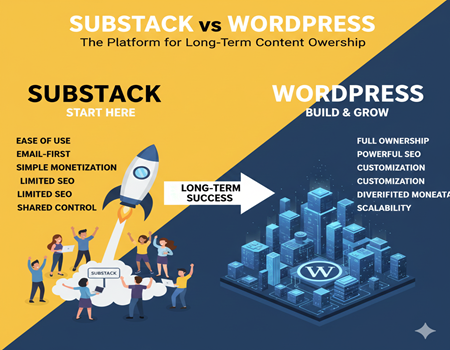
In today’s creator-driven internet, publishing content is easier than ever—but owning that content is a very different story. Platforms like Substack and WordPress have become popular choices for writers, bloggers, and independent creators who want to build an audience online. While both platforms allow creators to publish and monetize content, they differ significantly in how much control and ownership they actually provide.
Many creators begin their journey focused on speed and simplicity. Getting content live, gaining subscribers, and earning early revenue often feel more important than long-term considerations. However, as content libraries grow and audiences become valuable assets, questions around ownership start to matter more. Who controls the content? Who owns the audience data? What happens if platform rules change?
Content ownership is no longer just a technical concern—it is a strategic one. Search visibility, brand identity, monetization flexibility, and platform independence all depend on how much control a creator has over their content. Platforms that limit customization, SEO, or data access can quietly restrict growth over time.
This is where the debate between Substack and WordPress becomes important. Substack offers convenience and built-in tools, while WordPress emphasizes full ownership and long-term scalability. Understanding these differences is essential for creators who want their work to remain accessible, discoverable, and profitable for years to come.
In this comparison, we’ll explore how Substack and WordPress handle content ownership, growth, and control—helping you decide which platform truly supports long-term content success.
Understanding Content Ownership in the Creator Economy
Content ownership in the creator economy goes far beyond simply writing and publishing articles online. True ownership means having full control over where your content lives, how it is distributed, and how it can be used in the future. It also includes ownership of audience data, design, monetization methods, and long-term visibility in search engines.
Many creators confuse access with ownership. When content is published on a hosted platform, the creator may retain authorship, but the platform controls the environment. This includes hosting, URLs, layout, discoverability, and sometimes even monetization rules. If the platform changes policies, features, or algorithms, creators must adapt—often without having a say in the decision.
In the early stages, these limitations are easy to ignore. Hosted platforms remove technical barriers and help creators get started quickly. However, as content grows into a valuable asset, ownership becomes critical. Articles, guides, and resources should continue generating traffic and revenue long after they are published. This long-term value depends heavily on control over SEO, structure, and performance.
Audience ownership is another key element. Email lists, subscriber behavior, and engagement data are essential for building sustainable creator businesses. When this data is partially controlled or restricted by a platform, creators lose flexibility in how they communicate and monetize their audience.
In today’s competitive digital landscape, creators are no longer just writers—they are publishers and business owners. Understanding content ownership helps creators make smarter platform choices that support independence, scalability, and long-term growth rather than short-term convenience.
What Is Substack and How It Handles Content Ownership
Substack is a hosted publishing platform designed primarily for email newsletters. It allows writers to create publications, send content directly to subscribers, and monetize through paid subscriptions. The platform removes most technical barriers, making it easy for creators to start publishing without worrying about hosting, design, or maintenance.
When it comes to content ownership, Substack operates in a shared-control model. Creators retain authorship of their work, but the platform controls where and how that content is published. All posts are hosted on Substack’s infrastructure, using Substack-managed URLs and templates. This means creators do not have full control over site structure, performance optimization, or technical SEO elements.
Substack also controls much of the distribution. While creators can export email lists, discovery and visibility are largely influenced by Substack’s internal recommendation system and ecosystem. Organic search visibility is limited because Substack is optimized for newsletters rather than search engines. As a result, content longevity depends more on email engagement than on evergreen traffic.
Design and customization are intentionally minimal. Substack prioritizes uniformity and simplicity, which benefits early-stage creators but restricts brand differentiation. Custom pages, advanced navigation, and tailored user journeys are not fully supported, limiting how creators can position themselves professionally.
Monetization is another area where Substack sets boundaries. The platform supports subscriptions but offers limited flexibility beyond that model. Platform fees and payment processing costs also apply, which can impact long-term profitability.
Overall, Substack provides convenience and speed, but content ownership is partial rather than complete. For creators focused on long-term control, scalability, and independence, these limitations often become more noticeable as their audience and content library grow.
What Is WordPress and Why Ownership Is Central to It
WordPress is an open-source content management system designed around the idea of full ownership and control. Unlike hosted platforms, self-hosted WordPress allows creators to own their website, files, database, and content without relying on a single company’s rules or infrastructure. This fundamental difference makes WordPress especially attractive for creators thinking long term.
With WordPress, content is hosted on the creator’s own server or hosting provider. This means creators control URLs, site structure, performance optimization, and backups. There is no platform-imposed limitation on how content is organized or presented. Articles, pages, categories, and archives can be structured strategically to support both users and search engines.
Ownership also extends to design and functionality. WordPress offers thousands of themes and plugins that allow creators to customize every aspect of their site. Whether the goal is a personal blog, a professional publication, or a content-driven business, WordPress adapts to the creator’s needs rather than forcing them into a fixed format.
SEO is another area where ownership is central. WordPress gives creators full control over on-page SEO elements, internal linking, site speed, and technical optimization. This makes it easier to build evergreen content that ranks well in Google and continues generating traffic over time.
Audience and data ownership are equally important. Email lists, analytics, and user behavior data belong entirely to the creator. This freedom allows creators to choose their own tools, segment audiences, and build custom monetization strategies without restrictions.
At its core, WordPress treats creators as true publishers. It provides the flexibility, control, and scalability needed to protect content as a long-term asset, making ownership not just a feature, but the foundation of the platform.
Platform Control vs True Ownership: Substack vs WordPress
The core difference between Substack and WordPress becomes clear when you compare platform control with true ownership. Substack operates as a centralized platform. While creators write and publish content, Substack controls the infrastructure, design framework, feature set, and long-term direction of the product. Creators are essentially building their content business on rented digital space.
With Substack, important decisions are outside the creator’s control. Changes to pricing, monetization rules, design layouts, or discovery systems can happen at the platform level. Even if these changes are positive overall, creators must adapt whether the changes align with their individual goals or not. This dependency creates long-term uncertainty, especially for creators whose income relies heavily on their content.
WordPress, on the other hand, is built around true ownership. Creators control their hosting, domain, content structure, and technical setup. There is no central authority dictating how content must be published or monetized. If a creator wants to redesign their site, change monetization strategies, or restructure content for SEO, they can do so freely.
Content portability is another major difference. On Substack, exporting content and rebuilding it elsewhere often requires manual effort and restructuring. On WordPress, content remains portable and flexible from the start. Creators can migrate hosts, change themes, or add new functionality without losing control over their assets.
Visibility and access are also handled differently. Substack relies heavily on its internal ecosystem for discovery, while WordPress content lives on the open web. This means WordPress content is not limited by platform algorithms or internal recommendations. Search engines, backlinks, and direct traffic all work independently of a single platform’s influence.
Ultimately, platform control offers convenience, but true ownership offers security. Serious creators tend to prioritize long-term stability, independence, and flexibility. When content becomes a valuable business asset, owning the foundation it sits on becomes more important than the ease of initial setup.
SEO & Discoverability: Who Wins Long Term?
Search engine optimization is one of the most important factors in long-term content growth, and this is where the difference between Substack and WordPress becomes especially clear. Substack is built primarily as a newsletter-first platform. Its structure, templates, and publishing model are optimized for email delivery rather than search engine visibility. As a result, discoverability through Google is limited.
Substack offers minimal control over essential SEO elements. Creators have little influence over URL structures, meta titles, descriptions, schema, and internal linking. While Substack posts can appear in search results, they rarely compete effectively in competitive niches. Content tends to perform well only for branded searches or very specific queries, which restricts long-term traffic growth.
WordPress, by contrast, is designed with SEO flexibility at its core. Creators can fully customize URLs, optimize on-page elements, and build strong internal linking structures that help search engines understand content relationships. Categories, tags, and content clusters can be strategically planned to build topical authority, which Google increasingly prioritizes.
Evergreen content performs far better on WordPress. Articles published years earlier can continue ranking, attracting organic traffic, and generating revenue with minimal ongoing effort. This compounding effect is difficult to achieve on Substack, where older content quickly disappears into email archives unless actively reshared.
Another key factor is technical SEO. WordPress allows optimization of site speed, mobile performance, indexing control, and structured data. These technical improvements directly impact rankings and user experience. Substack provides little to no access to these optimizations, leaving creators unable to improve performance even when issues are identified.
Long-term discoverability favors platforms built for the open web. While Substack excels at direct audience communication, WordPress excels at search visibility and content longevity. For creators who want their work to be found by new readers consistently, SEO control is not optional—it is essential. Over time, this makes WordPress the clear winner for sustainable, search-driven growth.
Branding, Customization & Professional Identity
Branding is more than visual appeal—it shapes how audiences perceive credibility, authority, and long-term commitment. When comparing Substack and WordPress, the difference in branding and customization is significant. Substack is designed to keep publications simple and uniform. While this consistency benefits usability, it also limits how much creators can visually differentiate themselves.
Substack allows only basic branding options such as logos, accent colors, and simple layout adjustments. All publications follow a similar structure, which makes it harder for creators to establish a strong, recognizable brand identity. For creators building a professional presence or offering premium services, this uniformity can reduce perceived authority.
WordPress offers complete freedom over design and user experience. Creators can choose from thousands of themes or build custom layouts tailored to their niche and audience. Typography, page structure, navigation, and visual hierarchy can all be customized to support brand messaging and usability. This flexibility allows creators to create a consistent and memorable brand across their entire site.
Professional identity also depends on functionality. WordPress supports custom pages such as detailed About sections, resource libraries, landing pages, and service pages. These elements help position creators as experts rather than just newsletter writers. Substack’s limited page structure makes it difficult to present content in a strategic or business-focused way.
Trust is another important factor. A fully branded website with a custom domain signals long-term intent and professionalism to new visitors. While Substack publications can use custom domains, the underlying platform identity remains visible.
For creators focused on long-term growth, branding is a strategic asset. WordPress provides the control needed to build a professional identity that evolves with the creator’s goals, while Substack prioritizes simplicity over differentiation.
Monetization Freedom and Revenue Scalability
Monetization is a critical factor when choosing a long-term publishing platform, and this is where Substack and WordPress differ sharply. Substack is built around a single core revenue model: paid subscriptions. While this approach works well for many creators initially, it limits income diversification as a content business grows.
On Substack, creators rely heavily on monthly or annual subscribers for revenue. The platform takes a percentage of earnings, along with payment processing fees. As income increases, these ongoing costs become more noticeable. More importantly, creators have limited ability to experiment with pricing structures, bundled offers, or alternative revenue streams within the platform.
WordPress offers far greater monetization freedom. Creators can combine multiple income sources such as subscriptions, one-time digital products, online courses, consulting services, affiliate marketing, and sponsored content. This flexibility allows creators to tailor monetization strategies to different audience segments rather than forcing everyone into a subscription model.
Revenue scalability is another key difference. WordPress supports advanced sales funnels, email automation, and customized user journeys through plugins and integrations. Creators can build lead magnets, upsells, and segmented campaigns that increase lifetime customer value. Substack lacks these advanced tools, making it difficult to optimize conversions beyond basic newsletter sign-ups.
Ownership also plays a role in monetization. On WordPress, creators control payment systems, customer data, and pricing rules. There are no mandatory platform fees beyond hosting and chosen tools. This control allows creators to improve profit margins as their business grows.
For serious creators, monetization is not just about earning—it is about sustainability and growth. WordPress enables creators to build flexible, scalable revenue systems that evolve over time, while Substack’s limited monetization structure often becomes a ceiling rather than a foundation.
Data, Analytics & Audience Control
Data and audience control are essential for creators who want to make informed decisions and build sustainable businesses. This is another area where the differences between Substack and WordPress become clear. Substack provides basic analytics such as subscriber counts, email open rates, and click data. While helpful at the beginning, these insights remain surface-level and limit deeper understanding of audience behavior.
Creators on Substack have restricted visibility into how readers interact with content beyond email engagement. Traffic sources, content performance over time, user journeys, and conversion paths are not fully accessible. This makes it difficult to identify what drives growth, optimize content strategy, or improve monetization effectively.
WordPress offers significantly more control over data and analytics. Creators can integrate advanced analytics tools to track page views, traffic sources, user behavior, and conversions in detail. This data helps creators understand which content performs best, how users move through the site, and where improvements are needed.
Audience ownership is another key distinction. With WordPress, email lists, subscriber data, and user information belong entirely to the creator. Creators can segment audiences, personalize communication, and switch email or analytics tools without restrictions. This flexibility supports long-term experimentation and optimization.
Data security and longevity also matter. On WordPress, creators control backups, data storage, and platform integrations. There is no risk of losing access due to platform-level changes. Substack, as a centralized platform, ultimately controls the environment in which data exists.
For creators serious about growth, analytics and audience control are not optional. WordPress provides the transparency and flexibility needed to turn data into strategy, while Substack’s limitations can hold creators back as their audience and ambitions grow.
When Creators Outgrow Substack (Migration Phase)
There comes a point in many creators’ journeys when Substack no longer supports their goals. This usually happens when content volume increases, audiences become more diverse, and income expectations grow. What once felt simple and efficient starts to feel restrictive. At this stage, creators are not failing on Substack—they are outgrowing it.
One of the first signs is content scale. As dozens or hundreds of posts accumulate, creators want better organization, clearer navigation, and stronger internal linking. They want readers to discover older content easily and explore related topics naturally. Substack’s flat structure makes it difficult to manage large content libraries in a strategic way.
SEO limitations also become more visible. Creators begin to realize that high-quality content is not ranking well on Google due to lack of technical and on-page SEO control. Organic traffic remains inconsistent, forcing creators to rely heavily on email distribution and social sharing for every new post.
Monetization needs often trigger migration as well. Subscription-only revenue may no longer be enough. Creators want to introduce courses, digital products, consulting, or affiliate content, but Substack offers limited support for these models. Growth becomes constrained by platform design rather than audience demand.
This is where migration becomes a strategic upgrade. Many creators choose to Migrate website from Substack to WordPress to regain full control over SEO, content structure, branding, and monetization. WordPress allows creators to treat content as a long-term asset rather than a stream of emails.
Outgrowing Substack is a natural progression. Migration marks the shift from platform dependence to platform ownership—an important step for creators who are building sustainable, long-term content businesses.
Common Myths About WordPress
Many creators hesitate to move to WordPress because of common myths that create unnecessary fear. One of the biggest misconceptions is that WordPress is too technical. While WordPress offers advanced capabilities, modern hosting providers, themes, and plugins have made setup and management far more user-friendly than in the past.
Another common myth is that Substack is safer because it handles everything. In reality, relying on a single platform introduces its own risks. Platform policy changes, feature limitations, or account restrictions can affect creators without warning. WordPress, when properly maintained, offers stability through ownership rather than dependence.
Some creators also believe that migrating to WordPress means losing their audience. This is not true when migration is planned correctly. Email subscribers, content, and branding can be transitioned smoothly with minimal disruption. In fact, many creators experience improved engagement once they gain more control over user experience.
There is also a misconception that WordPress is expensive. While there are costs associated with hosting and tools, these are often lower than ongoing platform fees at scale. Creators can choose tools based on their budget and upgrade as they grow.
These myths often prevent creators from making informed decisions. Understanding what WordPress actually offers helps creators evaluate platforms based on facts rather than fear.
Which Platform Is Right for You?
Choosing between Substack and WordPress depends largely on your goals, experience level, and long-term vision. Both platforms serve creators well—but in different stages of the journey. Understanding where you currently stand helps clarify which option aligns best with your needs.
If you are a beginner or testing an idea, Substack can be a practical starting point. It allows you to publish quickly, build an email list, and monetize through subscriptions without technical setup. For creators focused primarily on writing and direct audience communication, this simplicity can be valuable in the early phase.
Growing creators, however, often begin to feel Substack’s limitations. As content libraries expand and traffic goals shift toward search visibility, the lack of SEO control and customization becomes more noticeable. Creators at this stage may want better branding, content organization, and deeper analytics to guide strategy.
For serious long-term publishers, WordPress is usually the stronger choice. It offers full ownership of content and data, advanced SEO capabilities, and unlimited customization. Creators who plan to diversify income streams, build evergreen traffic, or position themselves as authoritative brands benefit most from WordPress’s flexibility.
Ultimately, the right platform supports where you want to go—not just where you are today. Substack prioritizes convenience, while WordPress prioritizes control and scalability. Evaluating your publishing goals honestly will help you choose a platform that grows with your content, protects your work, and supports sustainable success over time.
Final Verdict: Substack vs WordPress for Long-Term Ownership
When comparing Substack and WordPress through the lens of long-term content ownership, the difference is clear. Substack is designed for speed, simplicity, and direct communication with an audience. It works well for creators who want to start quickly, focus on writing, and monetize through subscriptions without technical concerns.
However, long-term ownership requires more than convenience. It requires control over content, data, branding, SEO, and monetization. This is where WordPress consistently outperforms Substack. WordPress treats creators as true owners rather than platform users, allowing them to build independent publishing ecosystems that are not tied to a single company’s rules or limitations.
Substack’s limitations are not flaws—they are trade-offs. The platform intentionally simplifies publishing, but that simplicity comes at the cost of flexibility and scalability. As content libraries grow and business goals expand, these trade-offs become harder to justify.
WordPress, by contrast, is built for growth. It supports evergreen content, search visibility, diversified revenue models, and full customization. While it may require slightly more setup, the long-term benefits often outweigh the initial effort.
For creators who view their content as a lasting asset rather than a temporary project, ownership matters. In the end, Substack is an excellent starting platform, but WordPress is better suited for creators who are committed to building a sustainable, independent, and future-proof content business.