ExpressionEngine Maintenance Costs vs WordPress
Choosing a CMS is not just about features. It’s about long-term cost.
Many businesses focus only on the initial setup price. But the real expense comes later — updates, hosting, developer fees, security, and scaling. That’s why understanding ExpressionEngine Maintenance Costs vs WordPress is so important in 2026.
Both platforms are powerful in their own way. ExpressionEngine is known for flexibility and custom development. WordPress is popular for ease of use and a huge ecosystem. On the surface, they may look similar in capability. But when you break down the ongoing costs, the difference becomes clear.
Maintenance is not a one-time task. Websites need regular updates, security patches, plugin management, performance optimization, and occasional redesigns. If these costs are high, your website becomes a financial burden instead of a business asset.
This guide will help you compare:
- Licensing and core software costs
- Hosting expenses
- Developer and maintenance charges
- Plugin and add-on costs
- Security and update requirements
- Long-term scalability expenses
By the end of this article, you will clearly understand which CMS offers better value for money and which platform fits your business goals.
If you are currently using ExpressionEngine or planning a new website, this cost comparison will help you make a smarter, long-term decision.
Quick Overview: ExpressionEngine vs WordPress
Before comparing costs, it’s important to understand how both platforms work. ExpressionEngine and WordPress are built differently, and that difference directly affects maintenance expenses.
1. What is ExpressionEngine?
ExpressionEngine is a flexible content management system designed mainly for developers. It gives full control over how content is structured and displayed. Many agencies and technical teams prefer it for highly customized websites.
Unlike many open-source platforms, ExpressionEngine uses a paid licensing model for some use cases and offers premium add-ons through its marketplace. While it is powerful, it is not beginner-friendly. Most updates, customizations, and template changes require a skilled developer.
Another important factor is its smaller community. There are fewer developers, fewer extensions, and fewer ready-made solutions compared to other CMS platforms. This often leads to higher development costs and longer project timelines.
ExpressionEngine works well for custom-built projects, but it usually depends heavily on technical expertise.
2. What is WordPress?
WordPress is an open-source CMS that powers more than 40% of websites globally. It is known for being user-friendly, flexible, and scalable.
Unlike ExpressionEngine, WordPress allows non-technical users to manage content easily. You can update pages, publish blogs, and install plugins without coding knowledge. It has a massive ecosystem of themes, plugins, developers, and hosting providers.
Because of its popularity, WordPress offers competitive pricing across hosting, development, and maintenance services. Businesses also benefit from a large talent pool, making it easier to hire developers at reasonable rates.
Understanding these foundational differences is essential before diving deeper into maintenance costs.
Licensing & Core Software Costs
When comparing ExpressionEngine Maintenance Costs vs WordPress, the first major difference appears in licensing and core software pricing. The way each platform is structured financially impacts your long-term budget.
1. ExpressionEngine Licensing Cost
ExpressionEngine offers a core version, but depending on your usage, add-ons and advanced functionality often come at an additional cost. Many essential features require third-party extensions, and most of them are paid.
Businesses using ExpressionEngine often purchase premium add-ons for SEO, eCommerce, memberships, forms, or advanced content management. These costs may look small individually, but they add up over time.
Another factor is renewal and support. While community support exists, dedicated support or advanced troubleshooting may require paid assistance from developers or agencies.
Because ExpressionEngine relies more on custom development, even small feature additions can require paid developer involvement. This increases overall ownership cost compared to plug-and-play systems.
2. WordPress Core Cost
WordPress is completely open-source and free to use. You can download and install it without paying for the core software.
Most essential features like blogging, page creation, user management, and media handling are built in. For additional functionality, you can choose from thousands of free plugins.
Premium plugins and themes are optional. Even when businesses choose paid options, they often cost less compared to custom-built solutions.
The open-source model gives businesses flexibility. You only pay for what you truly need. This makes WordPress more budget-friendly at the core level and easier to scale without heavy licensing expenses.
Licensing may seem small at first, but over time, it significantly influences total maintenance costs.
Hosting Costs Comparison
Hosting is one of the biggest ongoing expenses for any website. The type of CMS you choose directly affects server requirements, performance optimization, and overall hosting cost.
1. ExpressionEngine Hosting Requirements
ExpressionEngine typically requires more careful server configuration. Since many ExpressionEngine websites are custom-built, they often need optimized environments to run smoothly.
Shared hosting can work for small projects, but most businesses prefer VPS or dedicated hosting to ensure stability and performance. This increases monthly expenses.
Another challenge is the limited availability of managed hosting providers that specialize in ExpressionEngine. Unlike WordPress, there are very few hosting companies offering EE-specific optimization, caching, and security layers. This means you may need to hire a developer to manage server performance and troubleshooting.
If your website grows in traffic or complexity, hosting costs can rise quickly because scaling often requires technical intervention.
In short, ExpressionEngine hosting is possible on many servers, but performance tuning and maintenance usually demand extra effort and cost.
2. WordPress Hosting Options
WordPress offers a wide range of hosting choices. You can start with affordable shared hosting, move to managed WordPress hosting, or scale to enterprise-level cloud hosting as your business grows.
Many hosting providers offer WordPress-optimized servers with built-in caching, automatic updates, and security monitoring. This reduces the need for manual technical management.
Because of high competition in the WordPress hosting market, pricing remains competitive. Businesses can easily find cost-effective plans that match their traffic needs.
Scaling is also simpler. Most managed WordPress hosts allow quick upgrades without complex server reconfiguration.
From a cost and flexibility perspective, WordPress hosting gives businesses more options, better support, and easier scalability compared to ExpressionEngine. Over time, this difference significantly impacts total maintenance expenses.
Developer & Maintenance Costs
When analyzing ExpressionEngine Maintenance Costs vs WordPress, developer and ongoing maintenance expenses make the biggest difference. This is where long-term financial impact becomes clear.
1. ExpressionEngine Developer Cost
ExpressionEngine is developer-focused. While this gives flexibility, it also increases dependency on technical experts.
The biggest challenge is the limited developer pool. Compared to WordPress, far fewer professionals specialize in ExpressionEngine. Because of this, hourly rates are generally higher. Finding experienced developers can also take time.
Most ExpressionEngine websites are custom-built. Templates are often coded manually, and new features usually require development work instead of installing a ready-made extension. Even small design changes may require technical involvement.
Routine updates are another cost factor. Although ExpressionEngine releases updates, applying them safely on a custom-built site may require testing and developer supervision. This adds to ongoing maintenance expenses.
If a business does not have an in-house technical team, they usually depend on an agency. Monthly maintenance retainers for ExpressionEngine projects are often higher due to complexity and limited expertise in the market.
In short, ExpressionEngine gives control, but that control comes with higher development dependency and long-term costs.
2. WordPress Developer Cost
WordPress has one of the largest developer communities in the world. This significantly reduces hiring costs.
Because there are millions of WordPress professionals globally, businesses have more pricing flexibility. Freelancers, agencies, and in-house developers are widely available. Competitive rates keep overall development expenses reasonable.
Another major advantage is reduced developer dependency. Many tasks like adding pages, publishing blogs, updating images, or installing plugins can be handled without coding knowledge. Page builders and themes make customization easier for non-technical teams.
WordPress also supports automatic updates for core software, themes, and plugins. With proper maintenance practices, many updates can be handled without heavy developer involvement.
Even when custom development is required, the cost is often lower because of standard coding practices and a large support community.
For small and medium businesses, this difference can save thousands over time. Lower hourly rates, less dependency on custom coding, and easier internal management make WordPress more cost-efficient for ongoing maintenance.
When comparing long-term operational costs, developer expenses are often the deciding factor — and this is where WordPress typically proves more economical.
Plugin / Add-on Ecosystem Cost
The strength of a CMS is not just in its core features. It also depends on how easily you can extend it. Plugins and add-ons play a major role in long-term maintenance costs.
1. ExpressionEngine Add-ons
ExpressionEngine has an add-on marketplace, but it is relatively small compared to other major CMS platforms. While you can find extensions for SEO, forms, memberships, and eCommerce, many of them are paid.
In many cases, businesses need custom-built functionality because a ready-made solution does not exist. This increases development cost and maintenance time. Even when add-ons are available, updates and compatibility may require developer supervision.
Another factor is long-term support. Some third-party ExpressionEngine add-ons may not receive frequent updates. If a developer stops maintaining an extension, businesses might need to rebuild that feature from scratch.
Because the ecosystem is smaller, flexibility often comes with additional cost. You either pay for premium add-ons or invest in custom development.
Over time, this increases total ownership expenses, especially for feature-rich websites.
2. WordPress Plugins
WordPress has one of the largest plugin ecosystems in the world, with over 60,000 plugins available in the official directory alone.
Most common features — SEO optimization, security, caching, forms, eCommerce, analytics integration — can be added using free plugins. Premium plugins are available, but they are optional and competitively priced.
Another advantage is regular updates. Popular WordPress plugins are actively maintained by large communities or professional companies. This reduces the risk of outdated functionality.
Because solutions are easily available, businesses rarely need to build features from scratch. This saves both development time and long-term maintenance costs.
In terms of ecosystem size, flexibility, and pricing options, WordPress offers a more cost-effective and scalable environment compared to ExpressionEngine.
Security & Update Costs
Security and updates are ongoing responsibilities for any website. Ignoring them can lead to data breaches, downtime, or performance issues. When comparing ExpressionEngine Maintenance Costs vs WordPress, it’s important to understand how both platforms handle security and updates.
ExpressionEngine is considered secure by design, mainly because it has a smaller user base. Fewer websites mean it is less frequently targeted by automated attacks. However, updates are usually handled manually. Since many ExpressionEngine sites are custom-built, applying updates may require developer testing to avoid breaking templates or add-ons.
Security monitoring, patch implementation, and compatibility checks often involve technical expertise. If your site relies on multiple paid add-ons, each update needs careful review. This increases maintenance time and cost.
On the other hand, WordPress offers automatic updates for core software. Many hosting providers also include automatic security patches and daily backups. Popular security plugins provide firewall protection, malware scanning, and login monitoring without heavy manual work.
However, because WordPress powers a large percentage of the web, it is a common target for hackers. This does not mean it is insecure — it simply means proper maintenance is essential. With regular updates and quality plugins, WordPress can be extremely secure.
From a cost perspective, WordPress often requires less manual intervention, especially when managed hosting is used. ExpressionEngine may require more developer supervision during updates, which adds to long-term expenses.
In both cases, security is not optional. But the level of effort and developer dependency differs — and that difference impacts overall maintenance cost.
Scalability & Long-Term Growth Cost
When choosing a CMS, you are not just planning for today. You are planning for the next 3 to 5 years. That’s why scalability plays a major role in the overall cost comparison.
ExpressionEngine is highly flexible and allows deep customization. For businesses that require completely unique content structures, this can be a strong advantage. However, scaling often requires developer involvement.
If you want to add new features like eCommerce, membership systems, CRM integrations, advanced search, or multilingual functionality, most of these improvements require custom development or premium add-ons. As your website grows, development hours increase. This leads to higher long-term costs.
Redesigning an ExpressionEngine website can also be expensive. Since many sites are built with custom templates, even layout changes may require significant coding work.
WordPress, on the other hand, is designed for scalability at every level. You can start with a simple blog and later convert it into an eCommerce store, online course platform, membership site, or enterprise portal using plugins.
Integrations with CRM tools, marketing software, payment gateways, and APIs are easier because of the large ecosystem. Many solutions are already available and well-supported.
Scaling a WordPress website usually involves upgrading hosting or installing additional plugins, rather than rebuilding from scratch.
Over the long term, scalability directly impacts total ownership cost. ExpressionEngine offers control but may require higher investment during growth. WordPress offers flexibility with lower expansion costs, making it more budget-friendly for growing businesses.
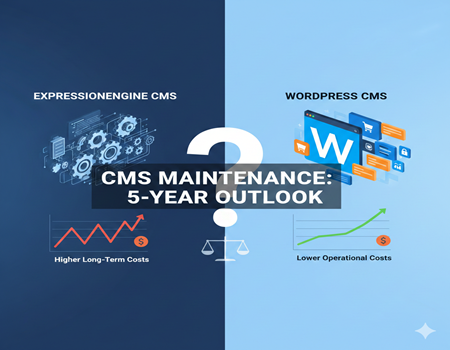
Total Cost of Ownership (5-Year Comparison)
When comparing ExpressionEngine Maintenance Costs vs WordPress, looking at yearly expenses is not enough. The real difference becomes clear when you calculate the total cost of ownership over five years.
For a small business website, ExpressionEngine may involve licensing fees, paid add-ons, higher developer rates, and specialized hosting. Even if the initial setup seems manageable, ongoing updates and feature enhancements often require paid technical support. Over five years, these recurring costs can add up significantly.
For medium-sized businesses, the gap becomes wider. Adding new features, redesigning pages, integrating third-party tools, or improving performance typically requires custom development in ExpressionEngine. Each upgrade increases long-term expenditure.
At the enterprise level, costs may rise even further due to advanced customization and infrastructure management.
With WordPress, the five-year cost structure is usually more flexible. The core software is free, hosting options are competitive, and plugin choices allow businesses to control spending. Developer rates are more affordable due to a larger talent pool.
Many small businesses can manage content internally without heavy developer involvement. Even growing companies often scale using plugins rather than rebuilding functionality.
Over a five-year period, WordPress generally offers lower operational costs, easier upgrades, and better budget predictability.
When evaluating long-term investment rather than short-term setup, WordPress tends to provide stronger financial efficiency for most businesses.
When ExpressionEngine Might Still Make Sense
Although WordPress is often more cost-effective, ExpressionEngine can still be a good choice in certain situations.
If a company already has an established ExpressionEngine infrastructure, migrating may not be immediately necessary. Rebuilding a large, custom website from scratch can require time and budget. In such cases, continuing with ExpressionEngine may be more practical in the short term.
ExpressionEngine is also suitable for projects that demand highly customized content structures. For example, enterprise-level websites with complex data relationships and a dedicated in-house development team may benefit from its flexibility.
Businesses that already employ experienced ExpressionEngine developers may not face the same hiring challenges as others. When technical expertise is available internally, some maintenance costs can be managed more efficiently.
Additionally, organizations that prioritize a tightly controlled development environment over plugin-based expansion may prefer ExpressionEngine’s structured approach.
However, these scenarios are usually specific to technical teams or enterprises with existing systems. For most small and medium businesses focused on cost-efficiency and ease of management, WordPress often remains the more practical option.
Choosing the right CMS ultimately depends on your technical resources, budget, and long-term growth plans.
Why Many Businesses Migrate to WordPress
Over the past few years, many companies have shifted from ExpressionEngine to WordPress. The main reason is long-term cost efficiency and easier management.
WordPress reduces dependency on specialized developers. Businesses can hire from a large global talent pool, often at more competitive rates. This alone lowers ongoing maintenance expenses.
Another major factor is the plugin ecosystem. Instead of building features from scratch, companies can install reliable plugins for SEO, security, eCommerce, and performance optimization. This speeds up growth and reduces development time.
Content management is also simpler. Marketing teams can update pages, publish blogs, and manage media without constant developer support. This improves workflow and reduces operational delays.
Scalability plays an important role as well. WordPress allows businesses to expand into new markets, add new features, and integrate third-party tools without heavy custom coding.
If you are planning to Migrate from ExpressionEngine to WordPress, a proper migration strategy can help you reduce downtime, protect SEO rankings, and control long-term costs.
For many growing businesses, WordPress offers flexibility, affordability, and a future-ready ecosystem — which is why migration has become a common decision.
Final Verdict: Which CMS Is More Cost-Effective?
When comparing ExpressionEngine Maintenance Costs vs WordPress, the long-term financial difference becomes clear.
ExpressionEngine offers strong customization and control. It works well for businesses with dedicated technical teams and complex content requirements. However, higher developer dependency, paid add-ons, and limited hosting flexibility can increase overall maintenance costs over time.
WordPress, on the other hand, provides a more budget-friendly structure for most businesses. The core software is free, hosting options are competitive, and the large plugin ecosystem reduces the need for custom development. Developer hiring is easier and more affordable due to the massive global community.
From a five-year perspective, WordPress usually delivers better cost predictability and lower operational expenses. It allows businesses to scale without rebuilding core functionality and supports marketing teams with easier content management.
That said, the right choice depends on your goals, technical resources, and growth plans.
If cost-efficiency, flexibility, and ease of maintenance are your priorities, WordPress is often the more practical and future-ready solution.
Before making a final decision, evaluate your current infrastructure, expected growth, and internal technical capacity carefully.