Liferay vs WordPress for Public Websites
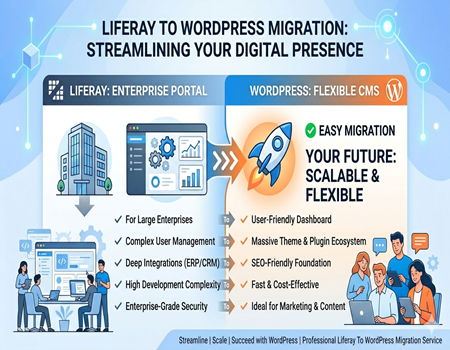
Choosing the right content management system (CMS) is one of the most important decisions when building a public website. Your platform directly affects your website’s performance, SEO, scalability, and overall user experience. A wrong choice can lead to higher costs, slow growth, and technical challenges that are difficult to manage later.
Today, two popular platforms often compared are Liferay and WordPress. Both are powerful in their own ways but serve very different purposes. Liferay is mainly designed for large enterprises and complex portal-based systems, while WordPress is widely used for public-facing websites, blogs, and business platforms due to its simplicity and flexibility.
For businesses planning to build or upgrade their public websites, understanding the difference between these two platforms is essential. The needs of a public website—such as SEO, fast loading, easy content updates, and user-friendly design—are very different from enterprise portal requirements.
In this blog, we will compare Liferay vs WordPress in a simple and clear way. We will look at key factors like ease of use, cost, SEO capabilities, customization, performance, and security. By the end, you will have a clear idea of which platform is better suited for your specific needs and long-term goals.
What is Liferay?
Liferay is an enterprise-level platform mainly used to build complex digital experiences like portals, intranets, and large-scale business applications. It is not a typical website builder but a powerful system designed for organizations that need advanced workflows, integrations, and user management. Because of this, it is commonly used by large enterprises and government bodies.
One of the key strengths of Liferay is its ability to handle complex structures and multiple user roles. It allows businesses to create personalized experiences for different users, manage permissions, and integrate with other enterprise tools like CRM or ERP systems. This makes it suitable for organizations that require high control and customization in their digital platforms.
Liferay also offers strong security features, which is why it is trusted by industries where data protection is critical. It supports enterprise-grade authentication, access control, and compliance standards. However, these advanced capabilities also make the platform more technical and difficult to manage without experienced developers.
When it comes to public websites, Liferay may not always be the first choice. While it can handle large-scale projects, the development process is often time-consuming and expensive. Even small updates or design changes may require technical expertise, which can slow down marketing and content teams.
Overall, Liferay is best suited for organizations that need complex systems rather than simple public websites. It is powerful and reliable but comes with higher costs, technical complexity, and longer development cycles compared to more user-friendly platforms like WordPress.
What is WordPress?
WordPress is one of the most popular content management systems (CMS) in the world, used by millions of websites. It is designed to make website creation simple, fast, and accessible even for non-technical users. From small blogs to large business websites, WordPress can handle a wide range of use cases with ease.
One of the biggest advantages of WordPress is its user-friendly interface. You don’t need coding knowledge to create or manage content. With its dashboard, users can easily add pages, publish blogs, upload images, and make updates in real time. This makes it a great choice for businesses that want full control without depending on developers.
WordPress also offers a huge ecosystem of themes and plugins. Themes help design your website quickly, while plugins add extra features like SEO tools, contact forms, speed optimization, and e-commerce functionality. This flexibility allows businesses to build custom websites without starting from scratch or investing heavily in development.
Another strong point of WordPress is its SEO-friendly nature. It is built with clean code and supports popular SEO plugins like Yoast SEO and Rank Math. These tools help optimize content, improve rankings, and drive organic traffic, which is essential for public-facing websites.
Overall, WordPress is ideal for businesses that want a fast, cost-effective, and scalable solution for public websites. It balances ease of use with powerful features, making it suitable for startups, small businesses, and even large enterprises looking for flexibility and growth.
Liferay vs WordPress: Quick Comparison Table
When comparing Liferay and WordPress, it’s important to look at key factors that directly impact public websites. Both platforms are powerful, but they differ significantly in terms of usability, cost, and flexibility. The table below gives a quick and clear comparison to help you understand the core differences.
| Feature | Liferay | WordPress |
|---|---|---|
| Ease of Use | Complex, developer-dependent | Beginner-friendly, easy to use |
| Cost | High (licensing + development) | Low (free + hosting/plugins) |
| SEO | Limited, requires manual setup | Strong with built-in tools/plugins |
| Customization | Advanced but complex | Flexible with themes & plugins |
| Performance | Strong for enterprise systems | Scalable with proper hosting |
| Security | Enterprise-grade security | Secure with best practices |
From this comparison, it is clear that Liferay is designed for complex enterprise environments, while WordPress focuses on simplicity and flexibility. For public websites that require fast updates, better SEO, and lower costs, WordPress is often the more practical and efficient choice for most businesses.
Ease of Use: Which is Simpler?
When it comes to ease of use, WordPress clearly stands out as a beginner-friendly platform. Its dashboard is simple and intuitive, allowing users to create pages, publish blogs, and update content without any technical knowledge. Even non-developers like marketers or business owners can manage the website easily without depending on a technical team.
On the other hand, Liferay is not designed for beginners. It is a complex platform that requires technical expertise to manage and operate. Most tasks, including content updates or layout changes, often need developer support. This makes it less suitable for teams that want quick updates or full control over their website content.
For example, if you want to publish a blog or update a landing page on WordPress, it can be done within minutes using its built-in editor. But in Liferay, the same task may involve multiple steps, permissions, and technical processes, which can slow down the workflow and reduce efficiency.
This difference becomes even more important for businesses that rely on regular content updates for SEO and marketing. A platform that is easy to use allows faster execution, better content management, and improved team productivity without unnecessary delays.
Overall, WordPress is the better choice for simplicity and ease of use, especially for public websites. Liferay may offer advanced capabilities, but its complexity can become a major challenge for businesses that need speed, flexibility, and ease in daily operations.
Cost Comparison
Cost is a major factor when choosing between Liferay and WordPress, especially for businesses building public websites. Liferay is generally considered an expensive platform because it often involves licensing fees, enterprise setup costs, and ongoing maintenance expenses. In most cases, businesses also need a dedicated development team to manage and customize the platform.
In addition to licensing, Liferay projects usually require custom development, which increases the overall budget. Even small changes or feature updates may involve developer time, making it costly in the long run. This makes Liferay more suitable for large organizations that already have the budget and technical resources to support such systems.
On the other hand, WordPress is a much more cost-effective solution. It is open-source and free to use, which means businesses only need to pay for hosting, themes, and plugins if required. Many high-quality themes and plugins are available at affordable prices, allowing businesses to build professional websites without heavy investment.
Another advantage of WordPress is its low maintenance cost. Since it is easy to use, businesses do not always need developers for everyday updates. This reduces dependency on technical teams and helps save money over time.
Overall, WordPress offers a budget-friendly and scalable option for public websites, while Liferay comes with higher upfront and ongoing costs. For most businesses looking for value and flexibility, WordPress is the more practical choice.
SEO Capabilities
Search engine optimization (SEO) plays a crucial role in the success of any public website. A platform that supports SEO can help your website rank higher on search engines, drive organic traffic, and generate leads. When comparing Liferay and WordPress, there is a clear difference in how both platforms handle SEO.
WordPress is widely known for its strong SEO capabilities. It is built with clean code and SEO-friendly structure, making it easier for search engines to crawl and index content. In addition, plugins like Yoast SEO and Rank Math allow users to optimize titles, meta descriptions, keywords, and readability without needing technical expertise.
Another advantage of WordPress is how easily you can manage on-page SEO elements. You can quickly update URLs, add alt text to images, improve internal linking, and optimize content in real time. This flexibility is very useful for businesses that regularly publish blogs or landing pages to improve their search rankings.
On the other hand, Liferay does not offer the same level of built-in SEO support. While it does provide basic SEO features, most advanced optimizations require manual setup or developer involvement. This makes it more time-consuming and less efficient for teams that want to focus on content marketing and organic growth.
For public websites, where SEO is a major growth channel, this difference becomes very important. A platform that simplifies SEO can help businesses grow faster and compete effectively in search results.
Overall, WordPress is a better choice for SEO due to its ease of use, powerful plugins, and flexibility. Liferay may support SEO at a technical level, but it lacks the simplicity and efficiency needed for consistent optimization.
Customization & Flexibility
Customization is an important factor when choosing a platform for your public website. Every business has different needs, and the ability to design and modify your website easily can make a big difference. When comparing Liferay and WordPress, both offer customization, but the approach and effort required are very different.
WordPress provides a highly flexible system through its wide range of themes and plugins. You can quickly change the design of your website, add new features, or modify layouts without starting from scratch. Even non-technical users can customize pages using drag-and-drop builders, which makes the process fast and efficient.
Another advantage of WordPress is its large ecosystem. There are thousands of plugins available for almost every requirement, such as SEO, security, performance, and e-commerce. This means you can extend your website’s functionality without heavy development work, saving both time and cost.
On the other hand, Liferay offers deep customization but requires significant technical expertise. Most changes need to be done through custom development, which can be time-consuming and expensive. While this level of control is useful for complex systems, it may not be practical for businesses that need quick updates and flexibility.
For example, adding a new feature in WordPress can often be done by installing a plugin, while in Liferay, it may require custom coding and testing. This slows down the process and increases dependency on developers.
Overall, WordPress provides a better balance of flexibility and ease of customization for public websites. Liferay is powerful but complex, making it more suitable for enterprise-level applications rather than dynamic, content-driven websites.
Performance & Scalability
Performance and scalability are important factors for any public website, especially as traffic grows over time. A good platform should handle increasing users without slowing down. Both Liferay and WordPress offer scalability, but they approach it in different ways based on their core design and use cases.
Liferay is built for enterprise environments, so it naturally supports large-scale systems with complex structures. It can handle high traffic, multiple users, and heavy data processing efficiently. However, achieving this level of performance often requires strong infrastructure, proper configuration, and technical expertise, which can increase overall complexity and cost.
WordPress, on the other hand, is lightweight and performs well for most public websites. With the right hosting, caching, and optimization techniques, WordPress can handle high traffic smoothly. Many large websites and media platforms successfully use WordPress, proving that it can scale effectively when managed properly.
Another advantage of WordPress is its flexibility in performance optimization. You can easily use plugins for caching, image optimization, and speed improvements without needing deep technical knowledge. This makes it easier for businesses to maintain fast loading times and a smooth user experience.
For most public websites, speed and user experience are more important than complex backend systems. A fast-loading website helps improve SEO rankings and keeps visitors engaged, which directly impacts business growth.
Overall, while Liferay is strong in enterprise scalability, WordPress offers a more practical and efficient solution for performance and scalability in public websites when properly optimized.
Security Comparison
Security is a critical factor when choosing a platform for your public website. Businesses need to protect user data, prevent attacks, and ensure smooth website operation. Both Liferay and WordPress offer strong security, but they differ in how security is managed and implemented.
Liferay is known for its enterprise-grade security features. It provides advanced authentication, role-based access control, and compliance support for industries with strict data regulations. This makes it a reliable choice for large organizations that require high-level security and structured access management.
However, this level of security also comes with complexity. Managing security in Liferay often requires technical expertise, and configurations need to be handled carefully. This makes it less convenient for businesses that do not have dedicated technical teams.
WordPress, on the other hand, is secure when proper best practices are followed. While it is often targeted due to its popularity, most security issues arise from outdated plugins or poor configurations. With regular updates, secure hosting, and trusted plugins, WordPress can be highly secure for public websites.
Another advantage of WordPress is the availability of security plugins that help protect websites from common threats like malware, brute force attacks, and spam. These tools make it easier for non-technical users to maintain website security without deep technical knowledge.
Overall, Liferay offers built-in enterprise security, while WordPress provides flexible and manageable security. For most public websites, WordPress offers a secure and practical solution when maintained properly.
When Should You Choose Liferay?
Liferay is a strong choice when your business needs go beyond a simple public website. It is best suited for organizations that require complex systems, advanced workflows, and deep integrations with other enterprise tools. If your platform involves multiple user roles, permissions, and personalized experiences, Liferay can handle these requirements effectively.
One of the main use cases for Liferay is building internal portals such as employee dashboards, partner platforms, or customer portals. These systems often require secure login access, data sharing, and structured workflows, which Liferay is designed to manage efficiently. Its ability to integrate with CRM, ERP, and other enterprise systems makes it valuable for large organizations.
Liferay is also a good option for government websites or institutions that need strict security and compliance. It supports advanced authentication and access control, making it suitable for environments where data protection is a top priority. In such cases, the complexity of the platform becomes an advantage rather than a limitation.
However, choosing Liferay makes sense only when you have the technical resources and budget to support it. Since it requires developers for setup and maintenance, businesses must be prepared for higher costs and longer development timelines.
Overall, you should choose Liferay when your project demands enterprise-level capabilities, complex workflows, and high security. For simpler public websites or marketing-focused platforms, it may not be the most practical option.
When Should You Choose WordPress?
WordPress is the best choice when you want to build a public website that is easy to manage, cost-effective, and optimized for growth. It is ideal for businesses that focus on marketing, content creation, and generating leads through their website. You don’t need technical expertise to get started, which makes it accessible for almost everyone.
If your goal is to launch a website quickly, WordPress is a great option. You can choose from ready-made themes, customize layouts, and add features using plugins without long development cycles. This helps businesses go live faster and start generating traffic and conversions in less time.
WordPress is also perfect for SEO-focused websites. If your strategy involves blogging, landing pages, and regular content updates, WordPress provides the tools needed to optimize and rank on search engines. This makes it highly suitable for startups, small businesses, and even growing enterprises.
Another important scenario where WordPress works well is when you want flexibility without high costs. You can scale your website as your business grows by adding new features, pages, or integrations without rebuilding everything from scratch. This ensures long-term sustainability and growth.
For businesses that want full control over their website without depending heavily on developers, WordPress offers the right balance. It empowers teams to manage content, make updates, and experiment with marketing strategies easily.
Overall, WordPress is the right choice for public websites that require simplicity, speed, SEO, and scalability in a cost-effective way.
Why Businesses Are Moving from Liferay to WordPress
In recent years, many businesses have started shifting from Liferay to WordPress, especially for public-facing websites. One of the main reasons behind this shift is the high cost associated with Liferay. From licensing to development and maintenance, the overall investment can be quite heavy, making it less practical for businesses focused on growth and marketing.
Another major factor is complexity. Liferay is designed for enterprise-level systems, which makes it difficult to manage for everyday website needs. Even small updates or content changes often require technical support, slowing down marketing efforts and reducing overall efficiency. Businesses today prefer platforms that allow faster execution and better control.
SEO is also a key reason for this transition. WordPress offers built-in SEO advantages along with powerful plugins that make optimization easier. In contrast, Liferay requires manual setup and technical involvement for many SEO tasks, which can limit organic growth opportunities for businesses relying on search traffic.
Flexibility and speed are equally important in today’s digital environment. WordPress allows businesses to quickly create pages, test campaigns, and make updates without long development cycles. This agility helps companies adapt faster to market changes and customer needs.
Because of these benefits, many organizations are now switching using a professional Liferay To WordPress Migration Service to simplify their website management and reduce long-term costs. Migration not only improves performance but also gives businesses better control over content and SEO strategies.
Overall, the shift from Liferay to WordPress is driven by the need for simplicity, cost efficiency, and faster growth. WordPress provides a more practical solution for modern public websites that require flexibility and continuous optimization.
Liferay vs WordPress: Final Verdict
Choosing between Liferay and WordPress depends on your business needs, goals, and the type of website you want to build. Both platforms are powerful, but they are designed for different purposes. Understanding this difference is key to making the right decision for your long-term success.
Liferay is best suited for large enterprises that require complex systems, advanced workflows, and high-level security. It works well for internal portals, government platforms, and applications that need deep integrations. However, its complexity and high cost make it less practical for typical public websites.
WordPress, on the other hand, is designed for simplicity, flexibility, and growth. It is ideal for public-facing websites where SEO, content marketing, and user experience play a major role. Businesses can easily manage their website, make updates quickly, and scale without heavy technical dependency.
For most businesses building public websites, WordPress is the more efficient and cost-effective choice. It offers the right balance of performance, customization, and ease of use, making it suitable for both small businesses and growing enterprises.
In simple terms, if your focus is on marketing, SEO, and fast growth, WordPress is the better option. If you need complex enterprise solutions, Liferay may be the right fit.