MODX vs WordPress for Marketing Teams
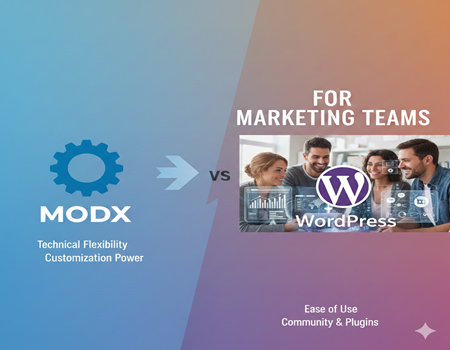
For modern marketing teams, a content management system is more than just a platform to publish pages. It directly impacts how quickly campaigns go live, how easily content is optimized for search engines, and how effectively teams can test and improve performance. The right CMS empowers marketers to work independently, move fast, and focus on growth rather than technical limitations.
As digital marketing has become more data-driven, the expectations from a CMS have changed. Marketing teams now manage blogs, landing pages, lead forms, SEO optimizations, and conversion tracking on a daily basis. When these tasks require constant developer support, productivity slows down and opportunities are missed. This is why the CMS choice matters just as much to marketers as it does to developers.
MODX and WordPress are two popular platforms, but they are built with very different priorities in mind. MODX focuses heavily on developer control and customization, while WordPress emphasizes usability, flexibility, and a rich ecosystem of marketing tools. These differences significantly affect how marketing teams operate on a day-to-day basis.
Understanding how MODX and WordPress perform from a marketing perspective helps businesses make informed decisions. This comparison highlights which platform truly supports marketing efficiency, scalability, and long-term growth in today’s competitive digital landscape.
Understanding MODX and WordPress at a High Level
MODX and WordPress are both powerful content management systems, but they are designed with different users and priorities in mind. MODX is a developer-focused CMS known for its flexibility and clean code structure. It allows complete control over templates, content modeling, and backend functionality, making it suitable for highly customized websites. Businesses with strong technical teams often choose MODX for projects that require complex logic or unique designs.
WordPress, on the other hand, is built for accessibility and scalability. Originally launched as a blogging platform, it has evolved into a full-featured CMS powering a large portion of the web. WordPress focuses on ease of use, enabling non-technical users to manage content without coding knowledge. Its intuitive dashboard allows marketing teams to create pages, publish blogs, and optimize content quickly.
Another key difference lies in ecosystem strength. MODX relies more on custom development, while WordPress offers thousands of plugins and integrations for SEO, analytics, CRM, and marketing automation. This fundamental difference shapes how each platform supports marketing activities. At a high level, MODX prioritizes control and customization, whereas WordPress prioritizes speed, usability, and growth-driven functionality for marketing teams.
Ease of Use for Marketing Teams
Ease of use is one of the most important factors for marketing teams when choosing a content management system. Marketers need to publish content quickly, update landing pages, adjust messaging, and optimize pages without relying on developers for every small change. This is where the difference between MODX and WordPress becomes very clear.
MODX is powerful, but it is not designed with non-technical users in mind. Marketing teams often struggle with its interface, as basic tasks may require understanding templates, chunks, or backend configurations. Even simple content updates can feel complex, leading to frequent dependence on developers. This dependency slows down campaigns and limits experimentation.
WordPress, by contrast, is built for usability. Its intuitive dashboard allows marketers to create and edit content easily using visual editors. Tasks like updating text, adding images, embedding videos, or publishing blogs can be done in minutes. This independence enables marketing teams to move faster and respond quickly to market changes.
Another advantage of WordPress is role-based access control. Marketers, editors, and contributors can work simultaneously without interfering with site structure. Training new team members is also easier due to WordPress’s widespread familiarity and extensive documentation.
For marketing teams focused on agility and efficiency, WordPress offers a smoother day-to-day experience. MODX may suit developer-led environments, but its learning curve often becomes a barrier for marketing-driven organizations aiming to scale content and campaigns efficiently.
Content Marketing & Publishing Capabilities
Content marketing is at the core of most digital strategies, and the CMS plays a crucial role in how efficiently teams can plan, create, and publish content. With MODX, content publishing often depends on how the site was originally structured by developers. While this allows flexibility, it can limit marketers when they want to launch blogs, landing pages, or campaign content quickly without technical support.
Managing media assets, formatting content, and maintaining consistency across pages can also be challenging in MODX. Content scheduling, revisions, and previews may require additional setup or custom development. For marketing teams running frequent campaigns, these extra steps slow down execution and reduce agility.
WordPress excels in content marketing and publishing. It offers built-in tools for blogging, page creation, media management, and scheduling. Marketing teams can easily draft content, preview changes, schedule posts, and update pages in real time. Visual editors make it simple to design landing pages without coding, enabling faster campaign launches.
WordPress also supports content organization through categories, tags, and custom post types. This makes it easier to manage large content libraries and scale publishing efforts. Collaboration features such as drafts, revisions, and editorial workflows further streamline content production.
For marketing teams focused on consistent publishing and rapid execution, WordPress provides a more efficient and flexible environment. MODX may support custom content structures, but WordPress better aligns with modern content marketing demands.
SEO Capabilities: MODX vs WordPress
SEO is a critical priority for marketing teams, and the CMS plays a major role in how effectively optimization strategies can be executed. MODX provides basic SEO control, allowing developers to manage URLs, meta tags, and page structure manually. While this offers flexibility, it often requires technical knowledge to implement and maintain SEO best practices across a growing website.
Advanced SEO tasks in MODX, such as schema markup, XML sitemap generation, and internal linking optimization, typically require custom development or third-party solutions. This adds complexity and slows down marketing efforts, especially when frequent updates are needed to respond to algorithm changes or content opportunities. As a result, SEO initiatives often depend heavily on developers rather than being driven directly by marketing teams.
WordPress, in contrast, is highly SEO-friendly and built to support ongoing optimization. Powerful SEO plugins allow marketers to manage meta data, optimize content, generate sitemaps, and monitor SEO performance from a single dashboard. Internal linking suggestions, readability analysis, and structured data support make it easier to follow SEO best practices without technical barriers.
WordPress also integrates seamlessly with analytics and search tools, enabling data-driven decisions. Page speed optimization, mobile responsiveness, and core web vitals improvements are easier to manage through plugins and themes.
For marketing teams focused on organic growth, WordPress offers greater control, automation, and scalability. MODX may support SEO at a technical level, but WordPress empowers marketers to execute and refine SEO strategies more efficiently and consistently.
Plugin, Integration & Marketing Tool Ecosystem
A strong plugin and integration ecosystem is essential for marketing teams that rely on multiple tools to run campaigns, track performance, and nurture leads. MODX offers limited built-in integrations, and most advanced marketing features require custom development. Connecting CRMs, email marketing platforms, analytics tools, or automation systems often involves manual configuration and ongoing technical support.
This dependency can slow down marketing execution. When teams want to test new tools or adopt emerging platforms, implementation time increases. Custom-built integrations also require regular maintenance, adding to long-term costs and technical complexity.
WordPress stands out because of its extensive plugin ecosystem. Marketing teams can easily integrate CRM systems, email marketing tools, analytics platforms, chatbots, and automation software with minimal effort. Most integrations are plug-and-play, allowing marketers to launch campaigns faster and experiment without developer involvement.
WordPress also supports marketing automation, lead capture, and personalization tools. Features such as form builders, pop-ups, tracking pixels, and conversion analytics can be added quickly through trusted plugins. This flexibility enables marketing teams to adapt their tech stack as strategies evolve.
For growing businesses, scalability matters. WordPress allows teams to expand functionality as marketing needs grow without rebuilding the website. MODX may offer control through custom solutions, but WordPress provides speed, flexibility, and access to a wider range of proven marketing tools. This ecosystem advantage makes WordPress a more practical choice for marketing-driven organizations.
Conversion Optimization & Performance
For marketing teams, driving traffic is only half the goal. Converting visitors into leads or customers is equally important, and the CMS plays a key role in conversion optimization and performance. MODX can be optimized for speed and performance, but conversion-focused features often require custom development. A/B testing, dynamic content, advanced form tracking, and behavioral targeting are not readily available without technical effort.
Because many conversion tools in MODX are custom-built, testing and iteration become slower. Marketing teams may need developer support to create new landing page variations, adjust call-to-action placements, or implement tracking changes. This limits the ability to quickly experiment and improve conversion rates.
WordPress offers a clear advantage in conversion optimization. Marketing teams can use a wide range of tools for A/B testing, heatmaps, form optimization, and call-to-action management. Landing pages can be built and adjusted quickly using visual editors, allowing rapid experimentation without coding. Performance optimization is also easier through caching, image optimization, and performance plugins.
Page speed and user experience are critical ranking and conversion factors. WordPress provides flexible hosting options and optimization tools to improve load times and core web vitals. For marketing teams focused on maximizing conversions and performance, WordPress enables faster testing, better insights, and more consistent results compared to MODX.
Collaboration, Workflow & Team Scalability
Effective collaboration is essential for marketing teams managing multiple campaigns, content calendars, and stakeholders. MODX can support multi-user access, but collaborative workflows often depend on how the system is custom-built. Role management, content approvals, and editorial workflows may require additional configuration or development, making collaboration less intuitive for growing teams.
As marketing teams expand, the need for structured workflows becomes more important. Coordinating between writers, editors, designers, and external agencies can be challenging in MODX, especially when permissions and content responsibilities are not clearly defined. This can slow down production and increase the risk of errors or content inconsistencies.
WordPress is designed with collaboration and scalability in mind. It offers built-in user roles such as administrators, editors, authors, and contributors, making it easy to manage responsibilities. Marketing teams can collaborate on drafts, review revisions, and schedule content without interfering with live pages. Approval workflows can also be enhanced using plugins, streamlining content production.
WordPress also scales well as teams grow. Adding new users, onboarding agencies, or managing multiple contributors is straightforward. For marketing teams focused on efficiency, clear workflows, and scalable collaboration, WordPress provides a more structured and marketer-friendly environment than MODX.
When Marketing Teams Decide to Migrate Website from MODX to WordPress
Marketing teams usually decide to migrate a website from MODX to WordPress when the CMS begins to limit speed, flexibility, and growth. While MODX offers technical control, it often creates bottlenecks for marketers who need to launch campaigns, update content, or implement SEO changes quickly. Dependence on developers for routine tasks can slow execution and reduce the ability to experiment.
As marketing strategies evolve, teams require tools that support content scaling, SEO automation, and performance tracking. WordPress meets these needs by providing an intuitive interface and access to a wide range of marketing-focused plugins. This allows teams to manage content, optimize pages, and integrate analytics or CRM tools without constant technical support.
Another major reason for migration is cost efficiency. Maintaining a MODX site with custom-built features can become expensive over time. WordPress reduces long-term costs by offering ready-made solutions and access to a larger pool of developers and agencies. This makes ongoing improvements more predictable and budget-friendly.
Migration is also driven by growth goals. Businesses expanding into content marketing, lead generation, or multi-channel campaigns often find WordPress better suited for scaling efforts. When marketing teams need autonomy, faster execution, and measurable results, choosing to migrate a website from MODX to WordPress becomes a strategic step toward building a more agile and growth-focused digital platform.
Cost, Maintenance & Long-Term ROI
Cost and return on investment are key considerations for marketing teams when choosing a CMS. MODX websites often require ongoing custom development, which can increase both short-term and long-term costs. Even small updates, integrations, or performance improvements may need developer involvement, adding to maintenance expenses over time.
Because MODX has a smaller developer ecosystem, finding skilled professionals can be more expensive and time-consuming. This can lead to higher hourly rates and slower turnaround times, directly affecting marketing budgets and campaign timelines. As the website grows, the cost of maintaining custom-built features and ensuring compatibility with updates also increases.
WordPress offers a more cost-efficient model. Its large ecosystem of plugins reduces the need for custom development, allowing marketing teams to implement features quickly at a predictable cost. Routine updates, security patches, and enhancements are easier to manage, lowering ongoing maintenance expenses.
From an ROI perspective, WordPress enables marketing teams to work faster, launch campaigns sooner, and optimize performance continuously. Reduced dependency on developers allows budgets to be allocated toward strategy, content creation, and promotion rather than technical upkeep. Over the long term, this efficiency translates into better returns and makes WordPress a more sustainable choice for growth-focused marketing teams.
Which Platform Is Better for Different Marketing Goals?
Choosing between MODX and WordPress often depends on the specific goals of a marketing team. For content-heavy brands that prioritize frequent blogging, landing pages, and rapid campaign execution, WordPress clearly offers an advantage. Its intuitive interface, visual editors, and robust plugin ecosystem allow marketers to create, publish, and optimize content without relying on developers. Features like SEO automation, analytics integrations, and lead capture tools make WordPress ideal for teams focused on growth and engagement.
MODX may be suitable for businesses with highly customized technical requirements, complex data structures, or unique workflows that standard CMS features cannot easily accommodate. For small developer-led teams, MODX offers flexibility and control over site architecture, security, and performance. However, these advantages come with increased dependency on developers, slower campaign execution, and a steeper learning curve for non-technical users.
For lead generation-focused businesses, eCommerce platforms, or multi-channel marketing campaigns, WordPress provides scalability and ease of integration with CRM, email marketing, and conversion optimization tools. MODX, while technically flexible, is less efficient for marketing teams needing speed and independence.
Ultimately, businesses should align their CMS choice with team capabilities, campaign frequency, and growth goals. WordPress generally excels for marketing-driven organizations, whereas MODX suits developer-centric, highly customized projects.
Final Verdict: MODX vs WordPress for Marketing Teams
For marketing teams, the choice between MODX and WordPress comes down to usability, scalability, and growth potential. MODX offers technical flexibility and control, making it suitable for highly customized projects managed by developer-heavy teams. It allows precise control over templates, content structure, and backend functionality, which can be valuable for unique or complex websites.
However, for marketing teams focused on speed, efficiency, and autonomy, WordPress is the superior choice. Its intuitive interface, robust plugin ecosystem, and built-in SEO and content management tools enable marketers to create campaigns, optimize content, and launch landing pages without constant developer support. WordPress also integrates seamlessly with analytics, CRM, and marketing automation tools, supporting data-driven strategies and long-term growth.
Ultimately, businesses that prioritize marketing agility, faster execution, and scalability will find WordPress better suited to their needs. MODX may still make sense for highly technical projects, but for most marketing-driven organizations, WordPress provides a future-ready, cost-effective, and growth-focused solution that empowers teams to focus on strategy and results rather than technical constraints.