SEO Limitations of Substack (And How to Fix Them)
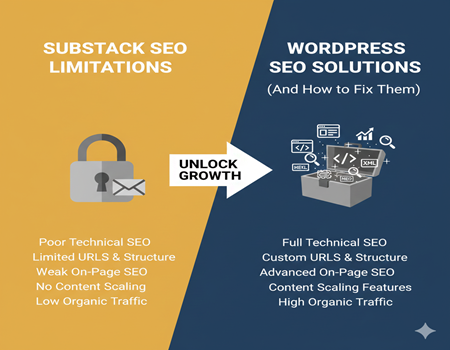
Substack has become a popular platform for writers, founders, and creators who want to launch newsletters quickly without worrying about technical setup. It allows you to focus on writing and building an email audience, which is great in the early stages. However, when it comes to long-term organic growth, SEO plays a critical role—and this is where many Substack users start facing challenges.
Search engine optimization helps your content appear in Google search results, bringing consistent, free traffic over time. Unlike email subscribers, search traffic does not depend on constant promotion. Once your content ranks well, it can attract readers for months or even years. This makes SEO especially important for creators who want to grow beyond their existing subscriber list.
The problem is that Substack is designed primarily as a newsletter platform, not as a full-featured blogging or SEO-focused system. While Google can index Substack posts, the platform offers limited control over key SEO elements. As a result, many high-quality articles published on Substack struggle to rank well in competitive search results.
In this blog, we will explore the major SEO limitations of Substack and explain how you can fix or overcome them. If your goal is sustainable traffic, better visibility, and long-term growth through Google, understanding these limitations is the first step toward making the right platform decision.
How Substack Works From an SEO Perspective
From an SEO perspective, Substack operates as a fully hosted platform where most technical decisions are controlled by the system rather than the user. When you publish content on Substack, your posts live under a Substack-managed structure, which limits how much control you have over important SEO elements. While Google is able to crawl and index Substack content, the platform is not built to maximize search engine visibility.
Substack automatically generates URLs, page layouts, and site architecture. This simplicity is helpful for beginners, but it creates challenges for SEO. You cannot fully customize your URL structure, create advanced content silos, or build strong topical clusters. These elements are important signals that help Google understand what your website is about and how authoritative it is within a niche.
Another key aspect is metadata control. Substack provides very limited options for editing meta titles, meta descriptions, and structured data. These are crucial for improving click-through rates and helping search engines interpret your content correctly. Without proper control, even high-quality articles may fail to compete in search results.
Substack also lacks advanced SEO tools such as XML sitemap management, schema markup, and crawl optimization. As a result, Google treats most Substack publications as simple content feeds rather than authoritative websites. This makes it difficult to scale SEO over time.
In short, Substack is optimized for email delivery and reader subscriptions, not for search engine performance. Understanding this structural limitation is essential before relying on Substack as a long-term SEO strategy.
Limitation #1: Poor Control Over Technical SEO
One of the biggest SEO limitations of Substack is the lack of control over technical SEO. Technical SEO focuses on how search engines crawl, index, and understand your website. On Substack, most of these elements are managed by the platform, leaving creators with very limited flexibility.
Substack does not allow full control over meta titles and meta descriptions. While it may auto-generate them, you cannot properly optimize these elements for specific keywords or search intent. This reduces your ability to improve click-through rates from Google search results. Similarly, you have no access to robots.txt or advanced crawl settings, which means you cannot guide search engines on how to prioritize or exclude certain pages.
Another major issue is the absence of structured data and schema markup. Schema helps Google understand content types such as articles, authors, and FAQs. Without it, your content may miss out on rich search features like enhanced snippets. Substack also offers no control over XML sitemaps, making it harder to manage how frequently your content is discovered and indexed.
Page speed and core web performance are also outside your control. Since Substack is a shared platform, you cannot optimize hosting, caching, or code-level performance improvements that directly impact SEO rankings.
While there are minor workarounds, such as optimizing content quality and internal linking manually, these solutions are limited. If technical SEO is a core part of your growth strategy, Substack cannot fully support it. This is why many SEO-focused creators eventually look toward more flexible platforms that allow complete technical optimization.
Limitation #2: Limited Customization of URLs & Site Structure
URL structure and site architecture play a crucial role in how Google understands and ranks content. Unfortunately, Substack offers very limited customization in this area, which becomes a serious drawback for SEO-focused creators. When you publish on Substack, URLs are generated automatically with little to no control over optimization, keyword placement, or structural hierarchy.
In a strong SEO setup, websites use clean, descriptive URLs along with categories and subcategories to create clear topic silos. This helps search engines recognize topical authority and relationships between content pieces. Substack does not support advanced category systems or hierarchical page structures. As a result, all posts exist at a similar level, making it harder for Google to understand which topics are most important.
Breadcrumb navigation is another missing element. Breadcrumbs improve user experience and provide search engines with additional context about site structure. Since Substack does not allow breadcrumb customization, both usability and SEO value are reduced. This also affects internal linking, as you cannot naturally link content through category pages or structured hubs.
There are some basic best practices you can follow within Substack, such as writing keyword-focused post titles and manually linking related articles. However, these are only partial solutions and do not replace a well-organized website architecture.
For creators who want to build long-term SEO authority, a flexible CMS with full URL and structure control performs far better. Without the ability to design a logical content hierarchy, scaling organic traffic on Substack becomes increasingly difficult as your content library grows.
Limitation #3: Weak On-Page SEO Capabilities
On-page SEO is one of the most important factors for ranking content in Google, and this is another area where Substack falls short. On-page SEO includes elements such as heading structure, internal linking, image optimization, and keyword placement. While Substack allows basic formatting, it lacks the advanced controls needed for consistent and scalable optimization.
Substack offers limited control over heading tags. Although you can format text visually, you cannot always ensure proper use of H1, H2, and H3 tags in a structured way. This makes it harder for search engines to understand content hierarchy and main topic focus. Over time, this can weaken your ability to rank for competitive keywords.
Image SEO is also very limited on Substack. You have minimal control over image compression, file naming, and alt text optimization. Images often load without proper SEO signals, which affects both accessibility and search visibility. In contrast, SEO-friendly platforms allow detailed image optimization for better performance and rankings.
Internal linking is another challenge. Substack does not provide tools to easily manage or track internal links. As your content grows, building topic clusters and linking related posts becomes manual and inefficient. This limits your ability to distribute link equity across important pages.
While it is possible to manually optimize content by writing high-quality, keyword-focused articles, these efforts are not scalable. Without SEO plugins, content analysis tools, or optimization recommendations, Substack makes it difficult to consistently apply on-page SEO best practices. For creators aiming for serious organic growth, this limitation becomes more noticeable over time.
Limitation #4: No Advanced Blogging & Content Scaling Features
Substack is built with a newsletter-first approach, not as a full-scale blogging or content management system. This design works well for sending regular emails to subscribers, but it creates limitations when you try to scale content for SEO and long-term organic traffic. As your content library grows, these limitations become more visible.
Advanced blogging strategies rely on organizing content into pillar pages, supporting articles, and topic clusters. These structures help Google understand your expertise in a specific niche and improve rankings across multiple related keywords. Substack does not support pillar page creation, custom landing pages, or content hubs in a structured way. All posts follow the same format, regardless of their importance or purpose.
Evergreen content management is another challenge. On SEO-focused platforms, you can easily update, repurpose, and optimize older articles to maintain rankings. Substack lacks tools for content audits, performance tracking, and optimization workflows, making it harder to maintain long-term SEO value.
Substack also does not support advanced content types such as service pages, comparison pages, or SEO-focused landing pages. This limits your ability to target high-intent search queries and expand beyond informational content.
While Substack is excellent for consistent publishing and audience engagement, it is not designed for scalable SEO growth. If your goal is to build a content-driven website that attracts traffic continuously through Google, the absence of advanced blogging and content scaling features becomes a major SEO limitation.
Limitation #5: Poor Performance for Long-Term Organic Traffic
One of the most critical SEO limitations of Substack is its weak performance when it comes to generating long-term organic traffic. Substack is primarily designed to grow through email subscriptions, not through search engines. As a result, most content relies heavily on direct traffic, social sharing, or existing subscribers rather than consistent Google visibility.
While Google can index Substack posts, they often struggle to rank for competitive keywords. This is because Substack publications lack strong technical SEO, structured site architecture, and advanced on-page optimization. Over time, this leads to limited organic growth, even if you publish high-quality and informative content regularly.
Another issue is content discoverability. Older posts tend to get buried as new newsletters are published, making it difficult for users and search engines to find evergreen content. On SEO-focused platforms, internal linking, category pages, and updated content help keep older articles relevant and visible. Substack does not provide these capabilities at scale.
Substack’s growth model also depends heavily on audience notifications and email engagement. If a subscriber does not open emails regularly, your content visibility drops. In contrast, SEO-driven platforms allow content to attract new users continuously through search, regardless of subscriber behavior.
For creators who want predictable, long-term traffic from Google, this dependency becomes risky. Without strong organic foundations, growth can plateau once subscriber acquisition slows down. This is often the point where creators start exploring SEO-friendly platforms or combining Substack with a dedicated website to support sustainable organic traffic growth.
Why WordPress Is Better for SEO Than Substack
When it comes to search engine optimization, WordPress offers a level of flexibility and control that Substack simply cannot match. WordPress is a full-featured content management system built specifically to support websites, blogs, and long-term organic growth. This makes it a much stronger choice for creators who want to rank consistently on Google.
One of the biggest advantages of WordPress is complete control over technical SEO. You can customize meta titles, meta descriptions, URLs, robots.txt files, and XML sitemaps exactly the way search engines prefer. WordPress also supports schema markup and structured data, which helps Google better understand your content and display rich results in search listings.
On-page SEO is another area where WordPress excels. With the help of SEO plugins, you can optimize headings, keywords, internal links, images, and readability with precision. These tools provide real-time suggestions, making it easier to follow best practices across every piece of content. This level of guidance is missing on Substack.
WordPress also allows you to create a strong site structure using categories, tags, pillar pages, and topic clusters. This structure helps build topical authority, which is a key ranking factor for competitive keywords. You can also create custom landing pages, service pages, and evergreen content that continues to drive traffic over time.
Performance and scalability are additional benefits. WordPress gives you control over hosting, speed optimization, caching, and core web vitals, all of which directly impact SEO rankings. As your content grows, the platform scales with you.
Because of these advantages, many creators eventually choose to Convert website from Substack to WordPress when SEO becomes a priority. WordPress provides the foundation needed for sustainable organic traffic, better visibility, and long-term content growth.
When You Should Convert Website from Substack to WordPress
Not every Substack creator needs to migrate immediately, but there are clear signs that indicate when Substack is holding back your SEO growth. If your content is high quality, well-researched, and useful, yet still not attracting organic traffic from Google, platform limitations may be the reason.
One strong signal is when your goals shift from “newsletter growth” to “search-driven growth.” If you want your articles to rank for competitive keywords, attract new audiences daily, and generate traffic beyond your email list, Substack becomes restrictive. Creators who plan to publish evergreen blogs, guides, or educational content often feel these limitations early.
Another sign is content scaling. As your content library grows, managing internal links, updating older posts, and building topic clusters becomes difficult on Substack. If you find yourself unable to organize content strategically or create SEO-focused pages such as pillars, categories, or landing pages, it may be time to move.
Businesses and professionals also benefit from migration. If your Substack is evolving into a brand asset, lead-generation tool, or authority website, you need better control over SEO, design, and performance. Substack is not designed for service pages, conversion funnels, or advanced analytics.
This is why many creators choose to Convert website from Substack to WordPress once they outgrow newsletter-only publishing. Migrating earlier often makes the transition smoother and helps preserve SEO value. The sooner you align your platform with your long-term growth goals, the easier it becomes to build sustainable organic traffic through search engines.
How to Migrate From Substack to WordPress Without Losing SEO
Migrating from Substack to WordPress requires careful planning to ensure that your existing content and SEO value are preserved. A poorly executed migration can lead to traffic loss, broken links, and indexing issues. However, when done correctly, it can significantly improve your long-term organic performance.
The first step is exporting your content from Substack and importing it into WordPress in a clean, structured format. Each article should be reviewed to ensure proper heading hierarchy, optimized URLs, and improved on-page SEO elements such as meta titles and descriptions. This is also the right time to enhance internal linking and image optimization.
URL mapping is critical. If your Substack URLs change after migration, you must set up proper 301 redirects. These redirects tell Google that your content has permanently moved, helping preserve rankings and link equity. Without redirects, search engines may treat the content as new, causing ranking drops.
Subscriber preservation is another important factor. Many creators worry about losing their email audience during migration. By integrating email tools with WordPress, you can continue sending newsletters while gaining SEO benefits from a full website.
You should also submit updated XML sitemaps to Google Search Console after migration. This helps search engines discover and index your new pages faster. Monitoring performance during the first few weeks is essential to identify and fix crawl errors or indexing issues.
When handled strategically, choosing to Convert website from Substack to WordPress can unlock full SEO control without sacrificing existing visibility. A well-planned migration ensures a smooth transition while setting the foundation for stronger organic growth, better rankings, and long-term search success.
Final Verdict: Is Substack Bad for SEO?
Substack is not inherently bad for SEO, but it is not built to support advanced or long-term search engine growth. As a newsletter-first platform, it excels at helping creators publish quickly and build direct relationships with subscribers. For early-stage writers or those focused mainly on email engagement, Substack can work reasonably well.
However, when SEO becomes a priority, Substack’s limitations become clear. Limited control over technical SEO, weak site structure, restricted on-page optimization, and poor scalability make it difficult to compete in search results. Even well-written, high-quality content may struggle to rank simply because the platform does not provide the tools needed to optimize properly.
For creators who want consistent organic traffic, better discoverability, and content that continues to perform over time, a more flexible platform is required. This is where WordPress stands out, offering full SEO control, advanced customization, and the ability to scale content strategically.
The right choice ultimately depends on your goals. If your focus is newsletters and community building, Substack is a solid option. But if you aim to grow through Google, build authority, and create a long-term content asset, Substack alone may not be enough. Choosing the right platform early can save time, effort, and missed growth opportunities later.