Why Marketing Teams Struggle with MODX
Content management systems (CMS) play an important role in modern digital marketing. Businesses today rely heavily on websites to publish content, generate leads, and communicate with their audience. Marketing teams constantly update website pages, publish blogs, optimize content for search engines, and launch landing pages for campaigns. Because of this, the CMS used by a company must be easy to manage, flexible, and marketing-friendly.
Over the past few years, marketing teams have started demanding more control over website content. They want to publish articles quickly, update landing pages without technical help, and optimize pages for SEO without waiting for developers. Speed and flexibility are very important in digital marketing because campaigns often need quick changes and updates.
MODX is a content management system that is known for its flexibility and customization capabilities. Many developers appreciate MODX because it allows them to build highly customized websites. It provides a powerful framework that can be tailored to different business needs. However, while this flexibility benefits developers, it can create challenges for marketing teams who may not have technical knowledge.
Marketing professionals usually prefer systems that allow them to easily edit content, manage SEO settings, install marketing tools, and track performance without complex configurations. When a CMS requires too much technical involvement, it slows down marketing workflows and reduces productivity.
This is where many organizations begin to face problems. Marketing teams working with MODX often find it difficult to perform everyday tasks like updating content, managing SEO settings, or launching new campaign pages quickly. Instead of working independently, they frequently need assistance from developers for even small changes.
As a result, many businesses start exploring alternative CMS platforms that are easier for marketing teams to manage. In many cases, companies decide to Migrate website from MODX to WordPress to gain better control over their content and marketing activities.
Understanding MODX as a Content Management System
MODX is a flexible content management system that gives developers strong control over how websites are built and managed. Unlike many popular CMS platforms that rely heavily on ready-made themes and plugins, MODX focuses on customization and flexibility.
This approach allows developers to design websites exactly the way they want. However, this same flexibility can sometimes make the system harder for non-technical users to manage.
MODX was originally launched in 2005 as a fork of the Etomite CMS. Over time, it developed into a platform known for its developer-friendly architecture. Many development agencies choose MODX because it allows them to create fully customized websites without the limitations often found in other CMS platforms.
The system provides tools such as templates, snippets, and chunks that help control how content appears on a website. Developers use these elements to build unique page structures and advanced features.
One of the biggest advantages of MODX is its ability to separate content, design, and functionality. This separation allows developers to build complex websites with custom layouts and special features.
For businesses that need unique digital experiences, this level of flexibility can be very valuable. Developers can design highly tailored solutions without relying too much on third-party plugins.
However, this developer-focused structure can create challenges for marketing teams. Many tasks that marketers expect to handle easily may require technical adjustments in MODX.
For example, editing certain page layouts, modifying templates, or adding new functional elements may require developer involvement. Marketing teams that are used to visual editors and drag-and-drop tools may find this process difficult.
Another challenge is the limited ecosystem of ready-to-use marketing tools. Platforms like WordPress offer thousands of plugins for SEO, analytics, lead generation, and campaign management.
In comparison, MODX often requires custom development to achieve similar functionality. This means marketing teams cannot always implement new tools quickly.
Because of these limitations, many businesses eventually look for platforms that are easier for marketers to use. In many cases, companies decide to Migrate website from MODX to WordPress to simplify website management and improve marketing efficiency.
The Role of Marketing Teams in Modern Digital Strategy
Marketing teams play a critical role in driving business growth in today’s digital environment. They are responsible for promoting products, building brand awareness, and generating leads through online channels. Websites are one of the most important tools they use to achieve these goals.
Modern marketing teams are heavily involved in managing website content. They regularly publish blog posts, update landing pages, optimize content for search engines, and create new pages for campaigns. Because of this, the CMS they use must allow them to work quickly and efficiently.
Speed has become a major requirement in digital marketing. Campaigns often need fast updates, new content, or landing pages within a short time. If marketing teams have to wait for developers every time they want to make a change, it can slow down the entire campaign.
Search engine optimization is another major responsibility for marketing teams. Marketers need to optimize titles, meta descriptions, headings, internal links, and images to improve search visibility. To do this effectively, they require CMS platforms that provide easy SEO tools and clear content editing options.
Marketing teams also focus on creating high-quality content to attract visitors and engage audiences. Blog articles, case studies, product pages, and guides are regularly published to support content marketing strategies. A CMS should make it simple to create, edit, and organize this content without technical complications.
Another key responsibility is managing landing pages for marketing campaigns. These pages are often created for paid advertising, email marketing, and product promotions. Marketing teams prefer systems that allow them to quickly build and modify landing pages without coding knowledge.
Because marketing work moves quickly, teams need tools that allow collaboration and fast publishing. When a CMS is complex or developer-focused, marketers may struggle to manage their work efficiently.
This is why many companies eventually evaluate alternative platforms that give marketing teams greater control. In many situations, businesses choose to Migrate website from MODX to WordPress so marketing teams can manage content and campaigns more easily.
Complex Interface and Learning Curve in MODX
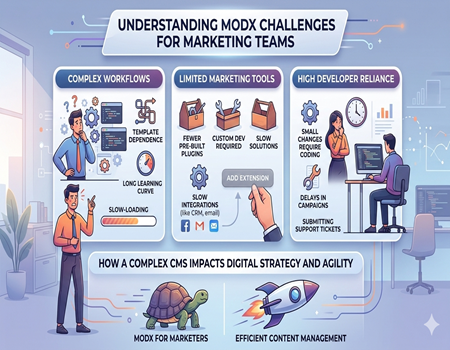
One of the biggest challenges marketing teams face with MODX is its complex interface. The platform is designed mainly for developers who understand website structures and coding concepts. For marketing professionals who focus on content and campaigns, the dashboard can feel difficult to navigate.
Many modern CMS platforms provide simple and clean dashboards. These systems allow users to easily edit pages, update content, and publish blogs. In contrast, MODX often requires users to understand how different technical elements work together.
The content editing experience in MODX can also be confusing for non-technical users. Instead of simple visual editors, marketers often deal with templates, chunks, and snippets that control how content is displayed. While these features are powerful, they are not always easy to understand.
Because of this structure, making simple content updates can feel complicated. Marketing teams may need to locate the correct template or content field before making changes. Without proper understanding, they may worry about accidentally breaking the layout of the page.
Another issue is the steep learning curve associated with MODX. New team members usually require additional training before they become comfortable using the platform. Compared to more user-friendly CMS systems, the onboarding process can take much longer.
This learning curve affects marketing productivity. Instead of focusing on strategy, content creation, or campaign planning, marketers spend valuable time trying to understand the CMS. This slows down daily marketing activities and creates unnecessary frustration.
Dependence on developers is another major problem. When marketers cannot confidently make updates themselves, they must ask developers for help. Even small changes such as modifying page sections or adjusting layouts may require technical assistance.
Developers are usually busy working on multiple projects. Because of this, marketing requests may not always be handled quickly. As a result, marketing campaigns, blog publishing, and landing page updates may get delayed.
Over time, these challenges reduce efficiency for marketing teams. To simplify content management and give marketers more control, many companies eventually choose to Migrate website from MODX to WordPress where the interface is easier to manage.
Limited Marketing Tools and Plugin Ecosystem
Another major challenge marketing teams face with MODX is the limited availability of marketing tools and plugins. Modern marketing strategies depend heavily on various tools for SEO, lead generation, analytics, and automation. Many CMS platforms provide built-in features or large plugin libraries to support these needs.
MODX, however, has a much smaller ecosystem compared to popular CMS platforms. While it does offer extensions called “Extras,” the overall number of available tools is limited. This makes it harder for marketing teams to quickly install and use the tools they need.
Marketing teams often rely on plugins to improve website functionality. For example, they may need tools for contact forms, pop-ups, email subscriptions, social media integration, or marketing automation. In platforms with large plugin libraries, these features can be added in just a few minutes.
In MODX, implementing similar features may require custom development. Instead of simply installing a plugin, developers may need to configure or build certain functionalities manually. This adds extra time and complexity to marketing operations.
Another issue is integration with popular marketing platforms. Businesses today use tools like email marketing software, CRM systems, and marketing automation platforms. Easy integration with these tools is important for running effective campaigns and tracking performance.
Many CMS platforms provide direct integrations or ready-made plugins for these services. MODX may require additional development work to connect with some of these systems. This creates extra work for developers and slows down marketing teams.
Analytics and performance tracking can also become more complicated. Marketing teams need quick insights into website traffic, user behavior, and campaign results. While MODX can support analytics tools, the setup process may not always be as simple as marketers expect.
The limited ecosystem can make experimentation more difficult. Marketing teams often like to test new tools such as A/B testing plugins, conversion optimization tools, or advanced SEO plugins. In MODX, finding and implementing these solutions may require more effort.
Because modern marketing relies heavily on flexible tools and integrations, these limitations can become frustrating over time. Marketing teams prefer systems where they can easily add new tools without technical barriers.
For this reason, many businesses eventually consider moving to platforms with stronger ecosystems. A common solution is to Migrate website from MODX to WordPress, where thousands of marketing plugins and integrations are available to support digital marketing strategies.
SEO Challenges Marketing Teams Face with MODX
Search engine optimization plays a very important role in modern digital marketing. Marketing teams work continuously to improve website visibility in search engines. They optimize pages, blogs, and landing pages to attract more organic traffic. For this reason, the CMS used by a company must provide easy and accessible SEO tools.
Many marketing-friendly platforms provide built-in SEO features that help marketers optimize content quickly. These tools allow users to edit meta titles, descriptions, URLs, headings, and image alt text easily. With the right tools, marketing teams can manage SEO tasks without technical support.
In MODX, however, SEO management can sometimes be more complicated. While the platform is flexible, many SEO features require manual setup or additional configuration. Marketing teams may need developer assistance to properly implement certain SEO settings.
For example, managing meta tags or structured data may require custom templates or snippets. These technical elements are useful for developers but may be confusing for marketing teams. Without technical knowledge, marketers may struggle to optimize pages effectively.
Redirect management can also become difficult. When marketers update URLs or remove pages, they often need to create redirects to avoid broken links. Some CMS platforms provide simple redirect management tools, but in MODX this process may require technical adjustments.
Another challenge is the lack of widely used SEO plugins. Popular CMS platforms often offer advanced SEO tools that guide users during content creation. These plugins provide suggestions for keywords, readability, internal links, and metadata optimization.
Because MODX has a smaller ecosystem, marketing teams may not have access to such powerful SEO assistants. As a result, they must rely more on manual optimization and developer support.
Site structure and internal linking are also important for SEO. Marketing teams regularly update internal links between pages to improve search engine visibility. When managing links becomes technically complex, it can slow down content optimization efforts.
Tracking SEO performance is another essential task. Marketing teams need to monitor keyword rankings, organic traffic, and page performance. While MODX can integrate with analytics tools, the setup may not always be simple for non-technical users.
Over time, these challenges can make SEO management more difficult for marketing teams. Since organic search traffic is a major growth channel, businesses often prefer CMS platforms that make SEO easier.
Because of this, many companies eventually decide to Migrate website from MODX to WordPress, where SEO tools, plugins, and optimization features are easier for marketing teams to manage.
Content Publishing and Workflow Limitations
Content publishing is one of the most important tasks for marketing teams. Businesses regularly publish blog posts, landing pages, product updates, and guides to attract visitors and build authority online. To manage this efficiently, marketing teams need a CMS that allows quick and smooth content publishing.
In many modern CMS platforms, content creation is designed to be simple and user-friendly. Marketers can easily create new pages, format content, add images, and publish articles without technical knowledge. These tools help teams focus more on content strategy rather than technical processes.
In MODX, however, the publishing process can sometimes feel more complicated. Since the system is highly customizable, content structures are often controlled by templates created by developers. Marketing teams may need to understand how these templates work before making certain updates.
This can create confusion when marketers try to modify page layouts or add new sections to a page. Instead of simply dragging and dropping elements, they may need to locate specific content fields or settings. For non-technical users, this process can be time-consuming.
Managing a large content library can also become challenging. As websites grow, marketing teams need efficient ways to organize and manage many pages and blog posts. If the CMS interface is not intuitive, finding and updating content can take longer than expected.
Content scheduling is another important part of marketing workflows. Many teams plan content calendars and schedule posts in advance. Some CMS platforms provide easy scheduling tools that allow marketers to automate publishing.
In MODX, scheduling content may require additional setup or configuration depending on how the website is built. This can make the publishing process less convenient for marketing teams.
Collaboration between team members is also essential for content marketing. Writers, editors, and marketers often work together on the same content. A CMS should support smooth collaboration and review processes.
When the workflow tools are limited or complicated, it can slow down teamwork. Content approval, updates, and revisions may take longer than necessary.
Because efficient publishing and collaboration are essential for content marketing success, many organizations eventually explore other CMS options. In many cases, businesses decide to Migrate website from MODX to WordPress to simplify content workflows and improve publishing efficiency for marketing teams.
High Dependence on Developers for Small Changes
One of the biggest frustrations marketing teams experience with MODX is the heavy dependence on developers. While the platform offers great flexibility, many tasks require technical knowledge. Marketing teams often cannot make certain updates on their own.
In modern marketing environments, speed is very important. Teams frequently need to update landing pages, change website content, or launch new campaign pages quickly. When these tasks require developer involvement, the process becomes slower.
For example, marketers may want to adjust a section of a landing page or add a new content block. In many CMS platforms, this can be done easily through visual editors. In MODX, however, such changes may involve editing templates or modifying code.
Because of this, marketing teams often need to submit requests to developers for even small changes. These requests may include updating page layouts, modifying design elements, or adding new website sections.
Developers usually manage multiple projects and technical tasks at the same time. As a result, marketing requests may not always be handled immediately. This delay can slow down marketing campaigns and content updates.
Another common issue is campaign management. Marketing teams often run time-sensitive promotions that require quick website changes. If marketers cannot update pages instantly, the campaign launch may get delayed.
This dependence also increases operational costs. Businesses may need ongoing developer support just to maintain website updates. Over time, the cost of managing frequent small changes can become significant.
Marketing teams generally prefer systems that allow them to work independently. When they have control over content and page updates, they can respond quickly to market opportunities.
Platforms with visual builders and simple editing tools give marketers this freedom. These systems reduce the need for constant developer involvement and allow marketing teams to move faster.
Because of these challenges, many organizations begin searching for CMS platforms that empower marketing teams. Businesses want systems where content updates, landing page creation, and campaign adjustments can be handled easily.
For this reason, many companies eventually decide to Migrate website from MODX to WordPress so marketing teams can manage website updates without relying heavily on developers.
Why Many Businesses Move from MODX to WordPress
As digital marketing becomes more important, businesses need CMS platforms that support fast content creation and easy management. Marketing teams want tools that allow them to publish blogs, update pages, and manage campaigns quickly.
When the CMS makes these tasks difficult, it slows down marketing operations. This is one of the main reasons many companies start exploring alternatives to MODX.
One of the biggest reasons businesses move away from MODX is usability. While the platform is powerful for developers, it may feel complicated for marketing teams.
Marketers usually prefer systems where they can easily update content without technical knowledge. Platforms with simple dashboards and visual editors make daily tasks much easier.
WordPress is one of the most popular CMS platforms for this reason. It provides a user-friendly interface that allows marketing teams to manage websites without relying heavily on developers.
Creating blog posts, editing pages, and updating website content can be done quickly. This helps marketing teams work more efficiently.
Another major advantage of WordPress is its large plugin ecosystem. Thousands of plugins are available for SEO, marketing automation, analytics, security, and lead generation.
Marketing teams can install these plugins easily to improve website performance. They do not need custom development for most features.
SEO management is also much easier in WordPress. Many popular SEO plugins provide clear guidance while creating content.
These tools help marketers optimize meta titles, descriptions, keywords, and internal links. This improves the chances of ranking higher in search engines.
WordPress also offers many drag-and-drop page builders. These tools allow marketing teams to create landing pages quickly without coding.
Campaign pages, promotional pages, and product pages can be designed easily using visual editing tools.
Another important benefit is integration with marketing platforms. WordPress connects easily with email marketing tools, CRM systems, and analytics software.
This allows marketing teams to track performance and manage campaigns more effectively.
Because of these advantages, many businesses eventually decide to Migrate website from MODX to WordPress to give marketing teams better control and flexibility.
Conclusion – Choosing a CMS That Empowers Marketing Teams
Marketing teams play a major role in driving online growth for businesses. They manage website content, publish blogs, run campaigns, and improve search engine visibility.
Because of these responsibilities, the CMS used by a company must support fast and easy content management. A system that slows down updates can affect overall marketing performance.
MODX is a powerful and flexible CMS. Many developers like it because it allows deep customization and control over website design and functionality.
However, the same flexibility can create challenges for marketing teams. Tasks like editing layouts, managing SEO settings, or adding new features may require technical knowledge.
When marketing teams cannot make changes independently, they often need help from developers. This dependency can slow down content updates and campaign launches.
In fast-moving digital marketing environments, delays can affect results. Teams need systems that allow them to react quickly and update websites whenever necessary.
Modern CMS platforms focus on simplicity and marketing efficiency. Easy dashboards, visual editors, and ready-to-use plugins help marketing teams manage websites without technical barriers.
WordPress has become a popular solution because it offers these advantages. Marketing teams can easily publish content, optimize pages, and integrate marketing tools.
For businesses that want faster workflows and better control over website content, moving to a more marketing-friendly CMS becomes important.
Because of this, many companies choose to Migrate website from MODX to WordPress to simplify website management and support modern marketing strategies.