Why Serious Creators Eventually Leave Substack
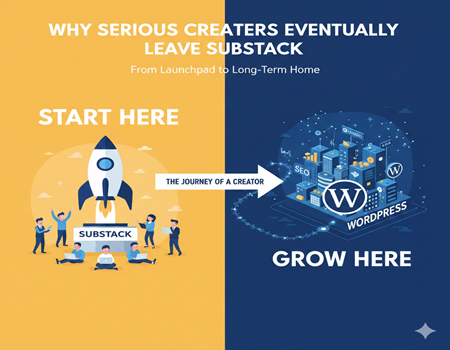
Over the past few years, Substack has emerged as one of the most talked-about platforms in the creator economy. Journalists, writers, educators, and niche experts rushed to Substack because it promised something simple yet powerful: publish your ideas, build an email list, and get paid directly by your audience. With no complex setup, no hosting worries, and built-in monetization, Substack felt like the fastest way to turn writing into income.
For many creators, this promise worked—at least in the beginning. Substack lowered the barrier to entry and made publishing accessible to anyone with a voice and a point of view. It removed the technical friction that often stops creators from launching their own websites, allowing them to focus purely on content and community. This ease of use explains why Substack continues to attract thousands of new creators every month.
However, as creators grow more consistent, more strategic, and more serious about their long-term goals, a different reality starts to appear. Questions around content ownership, discoverability on Google, branding flexibility, and scalable monetization begin to matter more than convenience. What once felt like freedom can start to feel restrictive. This is where many serious creators reach a turning point—realizing that while Substack is an excellent starting platform, it may not be the ideal foundation for sustainable, long-term growth.
Why Substack Attracts Creators in the First Place
Substack became popular because it solves many problems that new and independent creators face at the start of their journey. The biggest attraction is simplicity. Creators can sign up, start writing, and publish within minutes without worrying about domains, hosting, themes, or technical setup. This ease of entry makes Substack especially appealing to writers who want to focus on content rather than website management.
Another major reason creators choose Substack is its built-in email newsletter system. Email remains one of the most reliable ways to reach an audience directly, and Substack removes the need for third-party email tools. Every post automatically becomes a newsletter, helping creators build a subscriber list from day one without any additional configuration. This direct connection with readers creates a sense of ownership and community early on.
Monetization is also a strong pull. Substack allows creators to launch paid subscriptions instantly, without setting up payment gateways or complex pricing structures. For many writers, this creates a clear path to earning from their work much faster than traditional blogging platforms. The platform also benefits from network effects, where readers already familiar with Substack are more likely to subscribe to new writers within the ecosystem.
Finally, Substack’s clean, distraction-free writing experience resonates with creators who value minimalism. The platform emphasizes words over design, which feels refreshing in a noisy digital space. For early-stage creators, this combination of simplicity, built-in tools, and fast monetization makes Substack an attractive and logical place to begin.
What Defines a “Serious Creator”?
A serious creator is not defined by follower count or short-term income, but by long-term intent. These creators view content as a sustainable asset, not just a stream of posts or newsletters. They think beyond weekly publishing and focus on building a brand that can grow, adapt, and generate value over time. Consistency, strategy, and scalability are central to how they approach their work.
Unlike hobbyists, serious creators care deeply about ownership and control. They want full authority over their content, audience data, and distribution channels. Search visibility on Google, content organization, and evergreen traffic matter just as much as email engagement. Their goal is to create content that continues to attract readers months or even years after publication.
Monetization for serious creators also goes beyond simple subscriptions. They often explore multiple revenue streams such as courses, consulting, digital products, sponsorships, and affiliate income. To support this, they need flexible tools, advanced analytics, and the ability to design custom user journeys.
Most importantly, serious creators think in terms of growth and resilience. They want platforms that support expansion without forcing them to rebuild later. When a platform starts limiting SEO, branding, or monetization options, serious creators recognize it as a long-term risk rather than a short-term convenience.
Limited Ownership: You Don’t Truly Own the Platform
One of the biggest reasons serious creators eventually leave Substack is the issue of platform ownership. While creators own their content in theory, they do not own the platform on which that content lives. Substack controls the infrastructure, policies, design framework, and distribution mechanics. This creates a dependency that can become risky as a creator’s business grows.
Platform dependency means that any change in Substack’s terms, algorithms, or monetization rules can directly affect a creator’s income and visibility. Features can be added, removed, or restricted without a creator’s consent. For someone treating content creation as a long-term business, this lack of control introduces uncertainty. Serious creators prefer stability and predictability, especially when their livelihood depends on their work.
Another concern is audience ownership. While creators can export email lists, the overall relationship with readers is still mediated by Substack. Discovery, recommendations, and visibility often depend on Substack’s internal systems rather than the open web. This limits how creators can independently grow and engage their audience outside the platform’s ecosystem.
There is also the risk of account-level decisions. Like any centralized platform, Substack has the authority to suspend or restrict accounts if policies are violated or interpreted differently over time. Even unintentional issues can result in reduced reach or lost access. For serious creators who invest years into building their audience, this level of vulnerability is unsettling.
True ownership means controlling your content, your audience, and your distribution without relying on a single platform’s rules. As creators mature and think strategically, many realize that building on rented digital space limits their independence. This realization often becomes the first major push toward seeking platforms that offer full ownership and long-term security.
Poor SEO & Discoverability Limit Long-Term Growth
Search engine optimization plays a critical role in long-term content growth, yet this is one of Substack’s weakest areas for serious creators. Substack is built primarily as a newsletter platform, not a search-first publishing system. As a result, content is optimized for email delivery rather than for organic discovery on Google. This creates a major limitation for creators who want their work to reach new audiences consistently over time.
Substack offers minimal control over on-page SEO elements. Creators have limited ability to customize title tags, meta descriptions, URL structures, and internal linking. These elements are essential for helping search engines understand content relevance and hierarchy. Without them, even high-quality articles struggle to rank competitively in search results, especially in crowded niches.
Another issue is content structure. Substack posts function as standalone pieces rather than part of a broader, interconnected content system. There is no strong support for content silos, categories, or strategic internal linking that helps search engines crawl and index content efficiently. This limits the ability to build topical authority, which Google increasingly values when ranking content.
Discoverability is also restricted by Substack’s closed ecosystem. While Substack may promote content internally through recommendations, this exposure is inconsistent and not a reliable growth strategy. Organic search traffic, on the other hand, compounds over time and brings in readers who are actively searching for answers. Serious creators understand that search-driven traffic is more sustainable than platform-driven visibility.
Over time, creators begin to notice that their best work receives little to no search traffic, even months after publication. This forces them to rely heavily on email opens and social sharing for every post. For creators aiming to build a lasting digital presence, poor SEO becomes a growth ceiling. Without strong search visibility, content fails to reach its full potential, making Substack less suitable for long-term, scalable growth.
Branding & Customization Constraints
Brand identity plays a major role in how serious creators differentiate themselves online, yet Substack offers very limited branding and customization options. While the platform maintains a clean and minimal design, this uniformity makes it difficult for creators to establish a distinct visual identity. Most Substack publications look and feel similar, which reduces brand recognition over time.
Substack allows only basic customization, such as logo uploads, accent colors, and simple layout adjustments. There is no full control over themes, typography, page structure, or user experience. For creators who want their website to reflect their personality, niche, or professional positioning, these restrictions can feel confining. As a creator’s audience grows, so does the need for a more polished and unique presentation.
Another limitation is the inability to design strategic pages beyond standard posts. Serious creators often need custom landing pages, detailed about sections, resource hubs, or conversion-focused pages for products and services. Substack does not support advanced page creation or flexible navigation, which limits how content and offers can be organized.
Branding also extends to trust and credibility. A fully customized website signals professionalism and long-term commitment, especially for creators offering premium products or services. When everything is hosted under a Substack subdomain with a familiar template, it can feel less authoritative to new visitors who discover the content outside the platform.
Over time, creators begin to realize that branding is not just about aesthetics but about control and positioning. The inability to shape the user journey, highlight important content, or create a consistent brand experience becomes a serious drawback. For creators focused on long-term growth, Substack’s branding limitations often become a key reason to look for more flexible publishing platforms.
Monetization Ceiling: Substack Works—Until It Doesn’t
Substack’s monetization model is one of its biggest selling points, but it also becomes one of its biggest limitations for serious creators. The platform is built almost entirely around paid subscriptions. While this works well in the early stages, it creates a ceiling once a creator wants to diversify income streams. Relying on a single monetization method can restrict growth and increase financial risk.
Substack takes a percentage of subscription revenue, along with payment processing fees. As earnings increase, these fees become more noticeable. For creators generating consistent income, paying ongoing platform fees for basic functionality can feel inefficient, especially when alternative platforms offer more control with lower long-term costs.
Another challenge is the lack of advanced sales funnels. Serious creators often use lead magnets, tiered pricing, upsells, and automated email sequences to maximize revenue from their audience. Substack does not support complex funnel building or audience segmentation, making it difficult to guide readers through a personalized buying journey.
Substack also limits monetization beyond newsletters. There is no native support for selling courses, digital downloads, memberships, or bundled products. Affiliate marketing and sponsored content options are basic and not optimized for conversion. As a result, creators must either accept these limitations or use external tools, which adds friction and complexity.
Over time, many creators realize that subscriptions alone cannot support all business goals. Some audience segments prefer one-time purchases, others want premium content bundles, and some engage better with educational products. Substack’s narrow monetization structure forces creators into a one-size-fits-all approach.
For serious creators thinking long term, monetization flexibility is essential. When income potential is capped by platform limitations rather than audience demand, it becomes clear that Substack is not designed to support scalable, diversified creator businesses.
Lack of Advanced Features Serious Creators Need
As creators grow more experienced and strategic, their technical needs evolve. This is where Substack begins to feel limiting. While it works well for basic publishing and email distribution, it lacks many advanced features that serious creators rely on to scale content and operations efficiently.
One major limitation is analytics. Substack provides only surface-level data such as opens, clicks, and subscriber counts. Serious creators need deeper insights, including content performance over time, traffic sources, user behavior, and conversion tracking. Without advanced analytics, it becomes difficult to understand what truly drives growth or revenue.
Integration is another challenge. Substack offers very limited compatibility with third-party tools. Serious creators often depend on CRM systems, advanced email automation tools, SEO platforms, and marketing software to manage and grow their audience. The lack of seamless integrations forces creators to rely on manual workarounds or external solutions that don’t fully connect.
Substack also falls short as a content management system. There is no robust way to organize content into categories, topic clusters, or content hubs. As a content library grows, this lack of structure hurts both user experience and search engine understanding. Readers may struggle to find relevant past content, reducing engagement and retention.
Customization of workflows is another missing piece. Serious creators often need custom forms, gated content, member-only areas, or role-based access. Substack does not support these features natively, limiting how creators can experiment with new content formats or engagement models.
Over time, these gaps create friction. What once felt simple begins to feel restrictive. For creators treating content as a long-term business asset, the absence of advanced features becomes a clear sign that Substack is not built for sustainable, scalable growth.
Migration Becomes Inevitable as Content Grows
As a creator’s content library expands, the limitations of hosted platforms become increasingly difficult to ignore. What once worked for publishing a few newsletters starts to break down when dozens or hundreds of articles are involved. Managing older content, improving structure, and optimizing performance becomes a challenge when the platform is not designed for scale.
Content growth naturally brings new priorities. Creators want better organization, clearer navigation, and the ability to group related articles into meaningful sections. They also need stronger SEO foundations so older content continues to attract traffic over time. On restricted platforms, restructuring content or improving internal linking is either difficult or impossible, which limits long-term performance.
Another major factor is control over data and performance. As traffic grows, creators want faster load times, advanced analytics, and the ability to experiment with layouts, content formats, and monetization strategies. When a platform cannot support these needs, growth begins to plateau—not because the content lacks quality, but because the system can no longer support it.
This is usually the point where migration becomes a strategic decision rather than a technical one. Serious creators start evaluating platforms that offer full content management, SEO flexibility, and ownership. Many creators at this stage also reassess earlier platform choices and decide to Migrate website from Substack to WordPress or move from similar hosted solutions to gain long-term control.
Migration is not about abandoning success; it is about protecting it. As content becomes a valuable asset, creators recognize the need for a platform that can evolve alongside their goals. The decision to migrate often marks the transition from casual publishing to building a sustainable, scalable content business designed for long-term growth and independence.
Why WordPress Is the Long-Term Choice for Serious Creators
When serious creators look beyond short-term convenience and focus on long-term growth, WordPress consistently emerges as the preferred platform. The primary reason is ownership. With WordPress, creators fully own their website, content, and audience data. There is no dependency on a third-party platform’s policies, algorithms, or revenue rules, which creates stability and confidence for long-term planning.
SEO is another major advantage. WordPress is built with search engines in mind and allows complete control over technical and on-page SEO elements. Creators can optimize URLs, meta titles, descriptions, internal links, site structure, and performance. This flexibility makes it easier to build topical authority and generate consistent organic traffic from Google, which compounds over time.
Customization is where WordPress truly stands out. Creators can design their websites exactly how they want, using themes, custom layouts, and plugins. Whether the goal is a personal brand, a publication-style site, or a content-driven business, WordPress adapts to the creator’s vision rather than forcing them into a fixed template. This level of control helps creators build a recognizable and professional brand.
Monetization flexibility is another key reason creators choose WordPress. Beyond subscriptions, creators can sell courses, digital products, memberships, consulting services, and affiliate content. They can build advanced funnels, integrate email marketing tools, and experiment with different revenue models without platform restrictions.
Most importantly, WordPress scales with growth. As content libraries expand and audiences increase, the platform continues to support advanced features, integrations, and performance needs. For serious creators thinking years ahead, WordPress is not just a publishing tool—it is a long-term foundation for building a sustainable and independent content business.
Common Mistakes Creators Make When Leaving Substack
Leaving Substack is a strategic move, but many creators make avoidable mistakes during the transition. One of the most common errors is migrating content without an SEO plan. When URLs, headings, and internal links are not handled carefully, creators risk losing search visibility and breaking existing links, which can damage long-term traffic potential.
Another frequent mistake is failing to protect the email audience. Some creators focus entirely on moving content and forget to properly transition subscribers. Without clear communication and a smooth opt-in process on the new platform, valuable subscribers may disengage or get lost during the move.
Creators also underestimate the importance of redirects. Old Substack links often continue to circulate through social media, emails, and bookmarks. Without proper redirection, these links lead to dead pages, creating a poor user experience and harming credibility with both readers and search engines.
Poor content restructuring is another issue. Simply copying posts without organizing them into categories or topic clusters misses an opportunity to improve usability and SEO. Migration should enhance content structure, not just replicate it.
Finally, many creators rush the process. A successful transition requires planning, testing, and optimization. Treating migration as a quick technical task instead of a strategic upgrade often leads to missed growth opportunities and unnecessary setbacks.
Final Thoughts: Substack Is a Starting Point, Not the Destination
Substack has played an important role in lowering the barrier to entry for creators. It allows writers to publish quickly, build an email list, and earn directly from their audience without technical complexity. For beginners and early-stage creators, this simplicity can be empowering and effective.
However, as creators grow more intentional about their work, priorities naturally change. Long-term visibility on Google, brand ownership, content structure, and diversified monetization become more important than speed and convenience. At this stage, the limitations of a hosted platform become clearer. What once felt freeing may start to feel restrictive.
Serious creators understand that content is a long-term asset. Articles, essays, and resources should continue to generate value well into the future, not disappear into an email archive. Achieving this requires control over SEO, design, performance, and distribution—elements that are difficult to manage on closed platforms.
Leaving Substack is not a sign of failure or dissatisfaction. In many cases, it reflects growth and clarity. Creators who make this transition are often moving toward platforms that better support sustainability and independence. Substack works well as a launchpad, but it is not designed to be a permanent home for every creator.
In the end, the most successful creators choose platforms that grow with them. They invest in systems that protect their work, strengthen their brand, and support long-term goals rather than short-term convenience.