Why Businesses Eventually Move Away from MODX
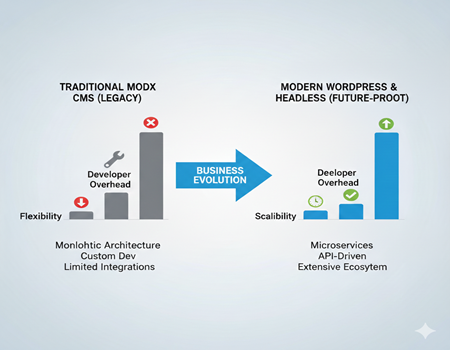
MODX gained popularity as a powerful and flexible content management system, especially among developers who wanted full control over website structure and functionality. Unlike many out-of-the-box CMS platforms, MODX allowed businesses to build highly customized websites without being restricted by rigid templates. This freedom made it an attractive choice for companies with unique design requirements or complex backend needs.
In its early days, MODX was seen as a future-ready platform. It offered strong security, clean code output, and the ability to manage content in a structured way. Many businesses adopted MODX believing it would scale smoothly as their digital presence grew. For developer-led teams, this approach worked well and delivered reliable performance.
However, as businesses evolved, so did their expectations from a CMS. Marketing teams needed faster content updates, SEO became more data-driven, and websites turned into growth engines rather than static platforms. Over time, MODX began to feel restrictive for non-technical users. Simple changes often required developer support, slowing down daily operations and increasing costs.
This shift in business priorities marks the beginning of why many organizations start rethinking their reliance on MODX and explore more user-friendly, scalable alternatives.
What MODX Does Well (Before We Talk About the Problems)
Before discussing why businesses move away from MODX, it is important to acknowledge what the platform does well. MODX is known for its high level of flexibility, allowing developers to build completely custom websites without being tied to predefined themes or layouts. This makes it a strong choice for projects that require unique designs or complex content structures.
Another major strength of MODX is its clean and secure codebase. The platform does not rely heavily on third-party plugins, which reduces the risk of security vulnerabilities and performance issues. Businesses that prioritize stability and controlled development often appreciate this approach.
MODX also offers powerful content modeling capabilities. Developers can structure content exactly how a business needs, which is useful for large or data-heavy websites. For technically skilled teams, this level of control can result in highly optimized and well-organized websites.
These advantages explain why MODX remains relevant for certain use cases. However, as business needs shift toward speed, scalability, and ease of use, these strengths alone may no longer be enough.
Steep Learning Curve for Non-Technical Teams
One of the biggest challenges businesses face with MODX is its steep learning curve, especially for non-technical teams. While developers may appreciate the control and flexibility MODX offers, content editors, marketers, and business owners often find the interface difficult to navigate. Tasks that should be simple, such as updating page content, adding new sections, or managing media, can feel complex and unintuitive.
Unlike more user-friendly content management systems, MODX requires a deeper understanding of templates, chunks, and snippets. For non-technical users, these concepts can be confusing and intimidating. As a result, teams become heavily dependent on developers even for minor updates. This dependency slows down workflows and reduces the ability to respond quickly to marketing or content opportunities.
Over time, this lack of independence becomes a serious operational issue. Marketing teams want to publish blogs, optimize pages, and test new ideas without waiting for technical support. With MODX, these routine tasks often involve back-and-forth communication with developers, increasing turnaround time and costs.
As businesses grow and content demands increase, the need for a CMS that empowers non-technical users becomes critical. This is often the point where organizations start questioning whether MODX still aligns with their long-term digital goals.
Limited Plugin & Extension Ecosystem
A major limitation of MODX is its relatively small plugin and extension ecosystem. Compared to more widely adopted content management systems, MODX offers fewer ready-made solutions for common business requirements. Features such as advanced SEO tools, marketing automation, analytics integrations, and performance optimization often require custom development rather than simple installations.
This lack of a rich extension marketplace directly impacts speed and scalability. When businesses want to add new functionality, developers frequently need to build it from scratch. While this provides control, it also increases development time, project complexity, and overall costs. For growing companies, this becomes a recurring challenge as digital needs continue to evolve.
Another issue is long-term maintenance. Custom-built solutions must be regularly updated, tested, and maintained to remain compatible with system updates. If the original developer is unavailable, maintaining these custom features can become risky and expensive. This creates dependency on specific technical resources rather than on a broader ecosystem.
In contrast, businesses today expect flexibility without friction. They want the ability to experiment, integrate tools quickly, and adapt to new trends. The limited plugin ecosystem in MODX often slows innovation, making it harder for businesses to keep pace with competitors in fast-moving digital environments. Over time, this restriction forces decision-makers to reconsider whether the platform can truly support sustainable, long-term digital growth for modern businesses.
Higher Development and Maintenance Costs Over Time
One of the most practical reasons businesses move away from MODX is the rising cost of development and maintenance over time. While initial builds may seem manageable, long-term expenses often increase due to the platform’s reliance on custom development. Even small changes, feature upgrades, or layout adjustments usually require developer involvement.
MODX has a smaller talent pool compared to mainstream CMS platforms. Finding experienced MODX developers can be difficult and expensive, especially for businesses operating at scale. This limited availability often leads to higher hourly rates and longer project timelines, which directly impacts operational budgets.
Maintenance is another ongoing challenge. Custom-coded features must be manually reviewed, updated, and tested to ensure compatibility with new versions and server environments. Unlike plugin-based systems, there are fewer standardized update paths, increasing the risk of technical debt.
As websites grow, businesses also invest more in SEO, content marketing, and performance optimization. With MODX, these improvements frequently require additional development work rather than simple tool integrations. Over time, decision-makers realize that the total cost of ownership outweighs the benefits. This financial pressure becomes a strong motivator for businesses to evaluate more cost-efficient, scalable CMS solutions that support growth without constant technical dependency and allow teams to focus on strategy instead of repetitive technical maintenance tasks and long-term innovation.
SEO and Marketing Limitations in MODX
SEO and digital marketing have become central to business growth, but MODX often falls short in supporting modern, data-driven marketing strategies. While basic SEO configurations are possible, many advanced optimizations require manual setup or custom development. Tasks such as managing meta data at scale, implementing schema markup, or optimizing pages for evolving search engine guidelines are not as streamlined as businesses expect today.
MODX lacks a strong ecosystem of built-in SEO and marketing tools. Features that marketers rely on—such as content optimization suggestions, internal linking insights, XML sitemap automation, and SEO performance tracking—are either limited or require third-party solutions with manual integration. This creates friction for marketing teams that want to move fast and experiment with content strategies.
Content marketing is another challenge. Publishing blogs, landing pages, and campaign content efficiently is harder when workflows are not designed for non-technical users. A/B testing, conversion tracking, and marketing automation integrations often demand developer support, slowing down execution.
As competition increases, businesses need agility. They want to optimize content quickly, respond to algorithm updates, and scale organic traffic without technical bottlenecks. MODX’s marketing limitations make this difficult, especially for content-heavy or SEO-driven websites. Over time, organizations realize that growth-focused digital strategies require a CMS that actively supports SEO and marketing teams, not one that restricts them with manual processes and technical dependencies that delay results and reduce overall campaign effectiveness.
Community, Support, and Future-Proofing Concerns
A strong community and reliable support system play a critical role in the long-term success of any content management platform. In the case of MODX, the community is comparatively smaller, which can limit access to shared knowledge, tutorials, and real-world solutions. Businesses often struggle to find up-to-date resources or quick answers when technical issues arise.
Because fewer developers actively work with MODX, innovation and feature expansion tend to move at a slower pace. Updates are less frequent, and new functionalities often lag behind industry trends. This creates uncertainty for businesses that rely on their website as a core growth channel and need assurance that their CMS will evolve alongside digital standards.
Support availability is another concern. Unlike platforms with large ecosystems, MODX does not offer an extensive network of agencies, freelancers, and third-party service providers. This increases dependency on a limited number of experts, making long-term maintenance and scalability risky.
From a future-proofing perspective, businesses must consider adaptability. Search engines, user behavior, and digital marketing practices change rapidly. A CMS with limited community backing and slower innovation can become a bottleneck. These concerns often push decision-makers to rethink whether MODX can support sustainable growth and technological relevance in the long run.
Why WordPress Becomes the Natural Next Step
As businesses outgrow the limitations of MODX, WordPress often emerges as the most practical and scalable alternative. One of the biggest reasons is ease of use. WordPress is designed to empower non-technical users, allowing content teams to create, edit, and publish pages without relying on developers. This shift alone significantly improves workflow speed and operational efficiency.
Another major advantage is WordPress’s massive plugin ecosystem. Businesses can add advanced SEO tools, performance optimization features, security enhancements, and marketing integrations with minimal effort. Instead of building everything from scratch, teams can implement proven solutions that are regularly updated and widely supported. This flexibility allows companies to adapt quickly to changing digital needs.
WordPress also excels in SEO and content marketing. Built-in features combined with powerful SEO plugins make it easier to optimize pages, manage internal linking, generate XML sitemaps, and track performance. For content-driven businesses, this creates a strong foundation for organic growth and long-term visibility.
Scalability is another key factor. WordPress is no longer just a blogging platform; it supports enterprise-level websites, eCommerce stores, and high-traffic platforms. With the right hosting and optimization, it can handle complex requirements without compromising performance.
Most importantly, WordPress is future-ready. Its large global community ensures constant innovation, security updates, and compatibility with modern technologies. For businesses seeking flexibility, growth, and long-term stability, WordPress naturally becomes the next step forward.
When Businesses Decide to Migrate Website from MODX to WordPress
The decision to migrate a website from MODX to WordPress usually comes after businesses encounter limitations that affect growth, efficiency, or scalability. While MODX offers customization and control, these advantages often come at the cost of usability and speed. Marketing teams may struggle with content updates, SEO implementation can be cumbersome, and new features require ongoing developer support. Over time, these challenges create operational bottlenecks that prompt businesses to explore more user-friendly and versatile platforms.
WordPress becomes an attractive option because it balances flexibility with ease of use. Teams can manage content independently, implement advanced SEO strategies, and integrate marketing tools without constant technical assistance. Businesses with expanding digital needs, such as multi-location operations, high-volume content, or complex eCommerce requirements, find WordPress better suited for scaling their online presence.
The migration is also driven by cost considerations. Maintaining MODX websites with custom solutions and limited developer availability can become expensive over time. WordPress, with its extensive plugin ecosystem and a larger pool of developers, offers a more cost-effective approach for ongoing maintenance and feature upgrades.
Ultimately, organizations decide to migrate a website from MODX to WordPress when they seek a platform that supports growth, reduces dependency on developers, and enables faster execution of marketing and content strategies. This transition allows businesses to focus on achieving their digital goals rather than managing technical complexities, making it a strategic move for long-term success.
Key Challenges During MODX to WordPress Migration
Migrating a website from MODX to WordPress is a strategic move, but it comes with its own set of challenges that businesses need to plan for carefully. One of the primary obstacles is content and data structure differences. MODX often uses custom templates, snippets, and chunks, which don’t directly translate to WordPress’s post, page, and block system. This requires careful mapping to ensure content is preserved accurately.
SEO preservation is another critical concern. Websites built on MODX may have custom URLs, metadata, and internal linking structures that need to be maintained to prevent traffic loss. Properly planning redirects and ensuring SEO continuity is essential during migration.
Functionality replacement is also a challenge. Features handled by MODX custom code or add-ons often need WordPress plugins or custom development to replicate the same behavior. This requires identifying the right tools and sometimes building custom solutions to match functionality.
Lastly, testing is crucial. Post-migration, every page, form, and interactive element must be verified to ensure the website works as intended. Staging environments are recommended to catch issues before going live.
While these challenges may seem complex, careful planning, experienced developers, and the right tools can make the migration smooth. Addressing these issues upfront ensures the transition to WordPress is efficient, preserves SEO value, and sets the foundation for future scalability and ease of use.
Best Practices for a Smooth MODX to WordPress Migration
Migrating a website from MODX to WordPress can be a seamless process if approached strategically. The first step is conducting a thorough pre-migration audit. This involves reviewing the existing website’s content, structure, URLs, and SEO elements. Identifying which pages, media files, and custom features need to be preserved ensures nothing is lost during the transition.
Next, content and SEO mapping is essential. Each MODX page should be mapped to a corresponding WordPress page or post type, maintaining URLs wherever possible. Metadata, alt tags, internal links, and SEO-friendly slugs should be carefully transferred to prevent any negative impact on search engine rankings. Implementing 301 redirects for any URL changes is crucial to preserve traffic and avoid broken links.
Using a staging environment is highly recommended. This allows businesses to test functionality, design, and performance before going live. Forms, interactive elements, and plugins should be thoroughly checked to ensure they work as intended.
Post-migration monitoring is equally important. Analytics tracking, site speed, and SEO performance should be reviewed after launch to identify any issues early. Regular backups and maintenance practices should also be established for long-term stability.
By following these best practices, businesses can ensure that the process to migrate a website from MODX to WordPress is smooth, secure, and preserves both SEO value and website functionality. This sets the foundation for scalable growth and easier management in the long term.
Final Thoughts: Is Moving Away from MODX the Right Decision?
Deciding to move away from MODX is a strategic choice that depends on a business’s long-term goals and operational needs. MODX offers flexibility, customization, and control, which can be ideal for highly technical teams or niche projects. However, as businesses grow, the limitations of MODX—such as a steep learning curve, limited plugin ecosystem, higher maintenance costs, and SEO challenges—become more apparent.
For companies looking to scale, improve marketing efficiency, and empower non-technical teams, WordPress often emerges as the preferred alternative. Its user-friendly interface, extensive plugin library, strong SEO capabilities, and large developer community make it easier to manage content, implement new features, and optimize digital growth strategies.
The decision to migrate a website from MODX to WordPress should be guided by careful evaluation of current and future requirements. Businesses must weigh the technical advantages of MODX against operational efficiency, scalability, and growth potential. For many organizations, WordPress provides a more sustainable, cost-effective, and future-ready solution, allowing teams to focus on strategy, content, and marketing rather than technical constraints.