Why Enterprises Are Moving Away from Sitecore
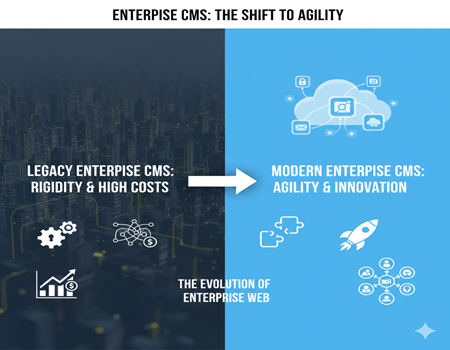
Enterprise content management has changed dramatically over the last decade. What once worked for large organizations—complex systems designed to handle massive websites and deep personalization—no longer fits the pace at which modern digital teams operate. Today, enterprises are expected to publish faster, integrate seamlessly with multiple tools, and adapt quickly to changing customer expectations.
For many years, platforms like Sitecore were seen as the gold standard for enterprise websites. They offered powerful features, advanced personalization, and a level of control that large organizations required. For a long time, that model made sense. Enterprises were willing to invest heavily in technology that promised stability, scale, and robust customer experiences.
However, the digital landscape has shifted. Marketing teams now need more autonomy, development cycles need to be shorter, and budgets are under greater scrutiny. Enterprises are no longer asking only what a platform can do—they are asking how quickly it can deliver value, how easily teams can use it, and how well it fits into a modern, flexible technology stack.
As a result, many enterprises are re-evaluating their long-term CMS strategy. This doesn’t mean Sitecore has suddenly become irrelevant. Instead, it reflects a broader change in priorities. Organizations are looking for platforms that balance power with simplicity, flexibility with control, and innovation with cost efficiency. Understanding this shift is the first step to understanding why so many enterprises are moving away from Sitecore today.
What Is Sitecore and Why Enterprises Chose It
Sitecore is an enterprise-level content management system designed to deliver highly personalized digital experiences. It goes beyond basic content publishing by combining CMS capabilities with customer experience management, analytics, and marketing automation. For large organizations with complex digital needs, this made Sitecore a compelling choice.
Enterprises initially adopted Sitecore because it offered strong control and scalability. It could manage large volumes of content across multiple websites, regions, and languages from a single platform. Its personalization engine allowed businesses to tailor content based on user behavior, demographics, and engagement history, helping brands deliver more relevant experiences to their audiences.
Another major reason enterprises trusted Sitecore was its robustness. The platform was built to handle high traffic, strict security requirements, and complex approval workflows. This made it particularly attractive to industries like finance, healthcare, and global enterprises where compliance and governance were critical.
Sitecore also appealed to organizations with dedicated development teams and larger budgets. Its flexibility at the architectural level allowed deep customization and integration with other enterprise systems. At the time, enterprises were willing to accept higher costs and complexity in exchange for control, stability, and advanced experience management—making Sitecore a logical choice for many large organizations.
The Modern Enterprise CMS Expectations Have Changed
Enterprise expectations from a CMS have evolved significantly in recent years. Earlier, the primary focus was on stability, control, and advanced customization—even if that meant longer development cycles and higher costs. Today, speed, flexibility, and usability have become just as important as technical power.
Modern marketing teams need the ability to publish and update content quickly without relying heavily on developers. Campaigns move faster, customer behavior changes rapidly, and content must adapt in real time. A CMS that slows teams down or requires technical intervention for routine updates no longer fits the way enterprises operate.
Another major shift is the move toward omnichannel experiences. Enterprises now manage websites, landing pages, mobile experiences, and integrations with multiple third-party tools. This requires a CMS that works smoothly within a broader digital ecosystem rather than operating as a closed, complex system.
Cost efficiency is also under greater scrutiny. Leadership teams want platforms that deliver measurable ROI without excessive licensing, infrastructure, or maintenance expenses. Flexibility to scale up or down, integrate new tools, and adjust strategies quickly has become essential.
Finally, enterprises now prioritize adaptability. Technology stacks are expected to evolve, not remain static for years. Open systems, easier integrations, and future-ready architectures are preferred over rigid platforms. These changing expectations don’t mean traditional enterprise CMS platforms are obsolete—but they do explain why many organizations are rethinking whether their current CMS truly supports modern business goals.
High Total Cost of Ownership (TCO)
One of the primary reasons enterprises begin reconsidering Sitecore is its high total cost of ownership. While the platform itself is powerful, the overall financial commitment extends far beyond the initial implementation. Over time, these costs can become difficult to justify, especially when compared to more flexible alternatives.
Licensing is often the largest expense. Sitecore’s licensing model is complex and typically involves significant annual fees that increase as usage grows. For enterprises managing multiple sites, regions, or advanced personalization features, these costs can escalate quickly. Renewal fees also place ongoing pressure on budgets, even if the platform’s usage remains the same.
Infrastructure is another major contributor to high ownership costs. Sitecore often requires robust hosting environments, performance optimization, and dedicated infrastructure to operate smoothly at scale. Whether hosted on-premises or in the cloud, these setups demand continuous investment in monitoring, upgrades, and security.
Development and maintenance costs further increase the burden. Sitecore is not a plug-and-play platform; it requires skilled developers for implementation, customization, and ongoing updates. Even simple changes can involve development cycles, testing, and deployment, making routine updates more expensive than expected. Enterprises often rely on specialized Sitecore partners or in-house experts, both of which add to long-term expenses.
Finally, there is the hidden cost of operational inefficiency. When marketing teams depend heavily on developers for content updates, campaign launches slow down. Delays translate into missed opportunities and reduced agility. Over time, enterprises begin to question whether the value they receive from Sitecore justifies the cumulative cost. This financial reality is a major driver behind the decision to explore alternative CMS platforms.
Complexity That Slows Teams Down
Another major reason enterprises move away from Sitecore is the level of complexity involved in using and maintaining the platform. While Sitecore is designed to handle advanced use cases, that power often comes at the cost of usability, especially for non-technical teams.
For marketing and content teams, the learning curve can be steep. The interface, workflows, and publishing processes require training and ongoing support. New team members often take significant time to become comfortable with the system, which slows productivity and increases dependency on internal experts. Instead of empowering teams, the platform can unintentionally create bottlenecks.
Development dependency is another challenge. Many tasks that seem simple—such as creating new templates, modifying layouts, or adding functionality—require developer involvement. This adds time, cost, and coordination to everyday work. Marketing teams often have to wait for development sprints just to implement small changes, which can be frustrating in fast-moving environments.
Complexity also affects deployment and updates. Sitecore environments typically require careful planning, staging, and testing before changes go live. While this level of control is valuable in some contexts, it can slow down innovation and experimentation. Enterprises aiming for agile marketing often find this approach restrictive.
Over time, this complexity impacts overall efficiency. Teams spend more energy managing the platform than executing strategies. When speed, collaboration, and autonomy become priorities, enterprises start questioning whether such a complex system still supports their goals. For many organizations, simplifying workflows becomes a key motivation to explore alternatives that allow teams to move faster without sacrificing quality.
Vendor Lock-In and Limited Flexibility
Vendor lock-in is another critical factor pushing enterprises to reconsider their reliance on Sitecore. While the platform offers deep capabilities, it often ties organizations closely to Sitecore’s ecosystem, making change difficult and costly over time. This dependency can limit strategic flexibility, especially as business and technology needs evolve.
One challenge is the reliance on proprietary architecture and tools. Customizations, integrations, and workflows built within Sitecore are often tightly coupled to the platform. As a result, adapting to new technologies or switching vendors can require significant redevelopment effort. This makes enterprises hesitant to innovate or experiment, knowing that changes may increase long-term dependency.
Flexibility is also constrained by the need for specialized expertise. Sitecore development requires specific skills that are not as widely available as those for open platforms. This can limit hiring options, increase costs, and create reliance on a small pool of developers or external partners. Over time, this dependency can slow progress and increase risk.
Another concern is the pace of adaptation. Enterprises want the freedom to integrate new marketing tools, analytics platforms, or customer data systems quickly. When a CMS limits how easily it can connect with modern tools, it becomes a barrier rather than an enabler. Vendor-driven roadmaps may not always align with an organization’s priorities, reducing control over future direction.
For enterprises planning long-term digital strategies, this lack of flexibility becomes a serious concern. The ability to adapt, evolve, and choose technologies freely is now seen as essential. Vendor lock-in shifts the balance of control away from the organization—prompting many enterprises to explore more open and adaptable CMS solutions.
Why WordPress Is Gaining Enterprise Trust
For a long time, WordPress was viewed mainly as a blogging platform or a solution for small to mid-sized websites. That perception has changed significantly. Today, WordPress has evolved into a mature, enterprise-ready content management system that many large organizations trust for complex digital experiences.
One of the biggest reasons enterprises are embracing WordPress is flexibility. As an open-source platform, it allows organizations to build and customize their digital presence without being locked into a single vendor. Enterprises can choose their hosting, development partners, and integrations, giving them full control over their technology stack.
Scalability is another key factor. Modern WordPress implementations can handle high traffic volumes, large content libraries, and multi-site setups with ease. When paired with enterprise-grade hosting, security tools, and performance optimization, WordPress can meet the same reliability standards expected from traditional enterprise platforms.
Security and compliance have also improved dramatically. With proper configuration, regular updates, and professional maintenance, WordPress can meet enterprise security requirements. Many global organizations now use WordPress while adhering to strict compliance standards, proving that security concerns are no longer a barrier.
WordPress also empowers marketing teams. Its intuitive interface allows non-technical users to create, edit, and publish content quickly. This reduces reliance on developers and enables faster campaign execution. Additionally, the vast ecosystem of plugins and integrations makes it easy to connect with analytics tools, CRMs, marketing automation platforms, and other systems enterprises rely on.
Finally, talent availability plays a major role. WordPress developers are widely available, making it easier and more cost-effective to build and maintain teams. Together, these advantages explain why WordPress is increasingly seen as a trusted, future-ready CMS for enterprises.
When Enterprises Decide to Leave Sitecore
Enterprises rarely move away from Sitecore on impulse. The decision usually comes after repeated challenges and a growing sense that the platform no longer aligns with business priorities. One of the most common triggers is the need for greater agility. As marketing cycles shorten and digital initiatives increase, enterprises begin to feel constrained by long development timelines and complex workflows.
Cost is another major factor. Over time, licensing fees, infrastructure expenses, and ongoing development costs can outweigh the perceived value of the platform. When leadership teams compare these costs with newer, more flexible CMS options, the return on investment becomes harder to justify.
Organizational change often accelerates the decision. Mergers, acquisitions, rebranding efforts, or global expansions frequently require faster site updates, new content structures, and better integration with modern tools. In these moments, the limitations of a rigid CMS become more visible.
Enterprises also reach a tipping point when marketing teams seek greater independence. Dependence on developers for routine updates slows execution and limits experimentation. As businesses become more data-driven, they want platforms that support rapid testing, optimization, and iteration.
Finally, long-term digital strategy plays a role. Enterprises planning for the future want platforms that can evolve alongside their goals. When Sitecore starts to feel like a constraint rather than an enabler, organizations begin exploring alternatives. This decision is less about abandoning a legacy platform and more about choosing a CMS that supports modern growth, flexibility, and sustainability.
Sitecore to WordPress Migration: What Enterprises Should Know
Enterprises considering a move away from Sitecore often worry that migration will be risky, disruptive, or damaging to performance. In reality, a well-planned migration can be controlled, secure, and strategically beneficial. The key is understanding what needs to be addressed before any transition begins.
Content is usually the first concern. Enterprise websites built on Sitecore often contain years of structured content, media assets, and complex templates. A successful migration involves auditing this content, mapping it to a new structure, and deciding what should be migrated, archived, or improved. This is also an opportunity to clean up outdated pages and improve content quality.
SEO is another critical consideration. Enterprises fear losing rankings, traffic, or authority during a platform change. With proper URL mapping, redirects, and on-page optimization, SEO can be preserved—and often improved. WordPress provides greater control over metadata, site structure, and internal linking, which helps strengthen long-term organic visibility.
Security and performance planning are equally important. Enterprises must ensure the new platform meets compliance, data protection, and performance standards. With enterprise-grade hosting, caching, and security tools, WordPress can meet these requirements effectively.
Migration impacts marketing, IT, compliance, and leadership teams. Clear governance, timelines, and success metrics help ensure the transition supports business goals rather than creating internal friction. Planning integrations with analytics, CRM, and marketing automation tools should also happen early to avoid disruptions.
Testing and validation should continue after launch. Monitoring traffic, performance, user behavior, and conversion paths ensures the new platform delivers measurable improvements and stability over time.
Proper documentation and training further help teams adapt quickly and use the new system effectively from day one long term success.
This is why many organizations choose to Migrate website from Sitecore to WordPress with a phased, strategic approach rather than a rushed rebuild. A phased migration reduces risk by allowing teams to test, optimize, and validate performance before fully switching platforms.
Ultimately, migration is not just a technical task—it is a strategic transformation. When handled correctly, it enables enterprises to simplify operations, reduce costs, and build a more flexible digital foundation for the future.
Key Benefits Enterprises Experience After Migration
Once enterprises complete a successful move away from Sitecore, the benefits often become clear very quickly. One of the most immediate advantages is cost reduction. By eliminating high licensing fees and reducing dependence on specialized development resources, organizations gain better control over their digital budgets. These savings can be redirected toward growth initiatives rather than platform maintenance.
Speed and efficiency also improve significantly. Marketing and content teams are able to publish updates, launch campaigns, and test ideas without long development cycles. This autonomy allows enterprises to respond faster to market changes and customer needs, creating a more agile digital presence.
Another major benefit is flexibility. After migration, enterprises can integrate their CMS more easily with analytics platforms, CRMs, marketing automation tools, and other systems in their technology stack. This creates a more connected and adaptable digital ecosystem that supports long-term strategy rather than limiting it.
SEO and performance improvements are also common. With greater control over site structure, metadata, and optimization, enterprises can strengthen organic visibility and improve page performance. Over time, this leads to more sustainable traffic growth and better user experiences.
Brand control is another key outcome. Enterprises can design unique, scalable websites that align closely with their identity and business goals. Custom layouts, landing pages, and content types allow teams to create experiences that stand out rather than conform to rigid templates.
Overall, enterprises experience a shift from managing a complex platform to leveraging a flexible one. The CMS becomes an enabler of growth, efficiency, and innovation—supporting modern digital goals instead of restricting them.
How to Decide If Moving Away from Sitecore Is Right for You
Deciding whether to move away from Sitecore requires more than comparing features. It’s about understanding how well your current platform supports your business goals today—and where it may fall short tomorrow. A thoughtful evaluation can help enterprises avoid unnecessary disruption while making confident, future-ready decisions.
Start by assessing your costs. Look beyond licensing fees and consider infrastructure, development, and ongoing maintenance expenses. If a large portion of your digital budget goes into simply keeping the platform running, it may be worth exploring alternatives that offer better value.
Next, evaluate how efficiently your teams work. If marketing and content teams rely heavily on developers for routine updates or campaign launches, this dependency may be slowing growth. Modern enterprises benefit from platforms that empower non-technical users while still supporting advanced use cases.
Consider flexibility and long-term adaptability. Ask whether your CMS easily integrates with your current and future technology stack. If adding new tools or channels feels complex or restrictive, your platform may be limiting innovation rather than enabling it.
Security, compliance, and scalability should also be part of the decision. Ensure any alternative can meet enterprise requirements without adding unnecessary complexity. Finally, think about your long-term digital strategy. If your organization values agility, cost efficiency, and ownership, moving away from Sitecore may align better with your future goals.
Final Thoughts: CMS Should Enable Growth, Not Restrict It
Sitecore has played an important role in shaping enterprise digital experiences, and for many organizations, it delivered exactly what was needed at the time. However, enterprise needs are not static. As markets, teams, and customer expectations evolve, the technology that supports them must evolve as well.
Moving away from Sitecore does not mean the platform has failed. In many cases, it simply means the organization’s priorities have shifted. Enterprises today value speed, flexibility, and cost efficiency alongside power and security. When a CMS begins to slow teams down, limit innovation, or strain budgets, it becomes a barrier rather than a strategic asset.
The most successful enterprises approach CMS decisions with a long-term mindset. They choose platforms that allow teams to work independently, integrate easily with modern tools, and adapt as strategies change. Ownership, scalability, and control are no longer optional—they are essential for sustainable growth.
Ultimately, the right CMS is one that supports your business vision, not one that forces you to work around its limitations. By evaluating platforms based on how well they enable growth, enterprises can build digital foundations that remain strong, flexible, and future-ready.