Sitecore vs WordPress: Cost, Flexibility & Time-to-Market
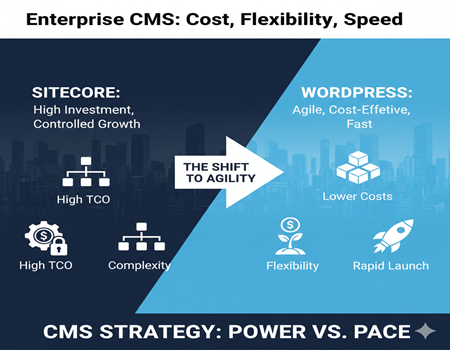
Choosing the right content management system (CMS) is one of the most important digital decisions a business can make today. Your CMS directly impacts how quickly you can launch campaigns, how easily your team can manage content, and how effectively your website supports long-term growth. With customer expectations evolving and competition increasing across industries, businesses need a platform that balances cost, flexibility, and speed without compromising performance.
Among the many CMS options available, Sitecore and WordPress stand out for very different reasons. Sitecore is widely known as an enterprise-level digital experience platform, designed for organizations that require advanced personalization, automation, and complex integrations. WordPress, on the other hand, is the world’s most widely used CMS, valued for its simplicity, flexibility, and ability to adapt to businesses of all sizes.
For decision-makers, the challenge is not just choosing a powerful platform but selecting one that aligns with business goals, internal capabilities, and budget realities. Factors such as total cost of ownership, ease of customization, and time-to-market play a critical role in this decision. In this blog, we’ll compare Sitecore vs WordPress across these key areas, helping you understand which CMS is better suited for your current needs and future growth.
What Is Sitecore? Enterprise-Level CMS Explained
Sitecore is a powerful enterprise-level content management system designed for large organizations that need more than just basic content publishing. Often referred to as a Digital Experience Platform (DXP), Sitecore combines content management with advanced personalization, customer data management, and marketing automation in a single ecosystem. This makes it a popular choice for global enterprises managing complex digital experiences across multiple channels.
One of Sitecore’s biggest strengths is its ability to deliver highly personalized content. Using customer data, behavioral tracking, and analytics, businesses can tailor experiences for different audience segments in real time. This level of personalization is especially valuable for enterprises operating in industries such as finance, healthcare, and large-scale eCommerce, where user journeys are complex and highly targeted.
Sitecore is also known for its scalability and robust architecture. It can support high traffic volumes, multi-site environments, and multilingual websites with ease. Integration capabilities are another strong point, as Sitecore connects well with CRMs, ERPs, marketing automation tools, and other enterprise systems. However, these benefits come with increased complexity. Sitecore implementations typically require specialized developers, longer development cycles, and ongoing technical support.
From a cost perspective, Sitecore operates on a licensed model, which includes licensing fees, hosting, implementation, and maintenance costs. While this investment can be justified for large organizations with advanced digital needs, it may be excessive for businesses focused on speed, flexibility, and cost efficiency. Understanding these strengths and limitations is essential when comparing Sitecore with more agile CMS options like WordPress.
What Is WordPress? The World’s Most Flexible CMS
WordPress is the world’s most widely used content management system, powering over 40% of all websites globally. Originally launched as a blogging platform, WordPress has evolved into a highly flexible, open-source CMS capable of supporting everything from small business websites to large-scale enterprise portals and eCommerce stores.
One of the biggest advantages of WordPress is its ease of use. The intuitive admin dashboard allows non-technical users to create, edit, and publish content without relying heavily on developers. This makes WordPress especially popular among marketing teams, startups, and growing businesses that want more control over their content and faster execution of ideas.
Flexibility is another major reason for WordPress’s popularity. With thousands of themes and plugins available, businesses can customize design, functionality, SEO, performance, and security based on their specific needs. Whether it’s adding lead generation forms, integrating analytics tools, or building an online store, WordPress offers solutions that can be implemented quickly and cost-effectively. For more advanced requirements, WordPress also supports custom development and headless architectures, giving enterprises room to scale.
Unlike licensed platforms, WordPress is free to use, which significantly reduces upfront costs. Businesses only pay for hosting, premium themes or plugins, and development support if needed. This makes WordPress an attractive option for organizations looking to balance performance with budget efficiency. Overall, WordPress stands out as a CMS that prioritizes flexibility, speed, and accessibility, making it a strong alternative to enterprise-focused platforms like Sitecore.
Sitecore vs WordPress: Cost Comparison (Detailed Breakdown)
When comparing **Sitecore vs WordPress, cost is often the biggest deciding factor for businesses. The two platforms follow very different pricing models, which directly impacts total cost of ownership.
Sitecore operates on an enterprise licensing model. Businesses must pay an annual licensing fee that can range from tens of thousands to several lakhs per year, depending on features and usage. In addition to licensing, Sitecore typically requires enterprise-grade hosting, often on cloud platforms like Azure, which adds to infrastructure costs. Implementation is another major expense, as Sitecore projects usually involve certified developers, solution architects, and longer development timelines. Ongoing maintenance, upgrades, and support further increase long-term costs. For large enterprises, this investment can be justified, but for many organizations, it becomes a heavy financial commitment.
WordPress, on the other hand, is free and open-source, which significantly lowers the entry barrier. There are no licensing fees, and businesses only pay for hosting, premium themes or plugins, and development support if required. Hosting costs can range from very affordable shared hosting to high-performance managed WordPress hosting, depending on traffic and performance needs. Development and customization costs are also flexible, as WordPress has a large global developer community, making skilled resources more accessible and cost-effective.
Another important aspect is hidden costs. With Sitecore, businesses often face unexpected expenses related to upgrades, third-party integrations, or additional modules. WordPress may involve plugin subscriptions or security enhancements, but these costs are generally predictable and easier to control.
Overall, Sitecore represents a high-investment, enterprise-focused solution, while WordPress offers a more budget-friendly and scalable cost structure. For businesses prioritizing cost efficiency, faster ROI, and financial flexibility, WordPress clearly has a strong advantage in the cost comparison.
Flexibility & Customization: Which CMS Gives You More Control?
Flexibility and customization play a crucial role when choosing between Sitecore and WordPress, especially for businesses that want their website to evolve with changing market needs. While both platforms allow customization, the level of control and ease of implementation differs significantly.
Sitecore is highly customizable at an enterprise level. It allows developers to build complex, tailored digital experiences using its powerful framework, APIs, and personalization engines. Businesses can create advanced workflows, integrate deeply with CRMs and marketing tools, and manage multi-site, multi-language environments from a single platform. However, this flexibility comes with complexity. Most customizations in Sitecore require experienced developers and certified partners, which can slow down changes and increase dependency on technical teams. Even small updates may involve development cycles and testing processes.
WordPress, in contrast, offers flexibility that is accessible to both developers and non-technical users. With thousands of plugins and themes available, businesses can add new features or modify design without starting from scratch. From SEO tools and performance optimization to form builders and eCommerce functionality, WordPress makes customization faster and more cost-effective. For advanced requirements, custom themes, plugins, and even headless WordPress setups provide enterprise-level control without sacrificing ease of use.
Another key difference lies in content editing. Sitecore offers structured content and advanced personalization, but the interface can feel complex for everyday users. WordPress provides a more intuitive editing experience, allowing marketing teams to make changes independently without relying heavily on developers.
In terms of overall control, Sitecore excels in managing complex enterprise ecosystems, while WordPress shines in agility and ease of customization. For businesses that value speed, autonomy, and continuous experimentation, WordPress generally offers greater practical flexibility.
Time-to-Market: Speed of Development & Launch
Time-to-market is a critical factor for businesses that want to stay competitive, launch campaigns quickly, and respond to changing customer demands. When comparing Sitecore and WordPress, the difference in development speed and launch timelines is quite significant.
Sitecore projects are typically large-scale and complex. Implementing Sitecore often involves detailed planning, solution architecture, custom development, and extensive testing. Because of its enterprise nature, businesses usually work with certified partners and dedicated development teams. As a result, Sitecore websites can take several months to design, build, and launch. While this structured approach ensures stability and scalability, it can slow down go-to-market efforts, especially for businesses that need to move quickly.
WordPress, on the other hand, is built for speed and agility. With ready-made themes, plugins, and a user-friendly interface, WordPress websites can be launched in weeks or even days, depending on the project scope. Businesses can start with a basic setup and continuously improve the site over time, rather than waiting for a perfect, fully built solution. This rapid deployment model allows marketing teams to test ideas, publish content, and launch campaigns without long development cycles.
Another advantage of WordPress is the ease of ongoing updates. New landing pages, content sections, or features can be added quickly without disrupting the entire website. In contrast, changes in Sitecore often require development support and quality assurance processes.
Overall, for businesses prioritizing faster launches, frequent updates, and shorter feedback loops, WordPress offers a clear advantage in time-to-market. Sitecore remains suitable for long-term enterprise projects, but it may not be ideal when speed is a top priority.
SEO Capabilities: Sitecore vs WordPress
Search engine optimization is a key consideration when evaluating Sitecore and WordPress, as your CMS directly affects how easily your content can be discovered online. Both platforms support SEO, but they approach it in very different ways.
Sitecore offers enterprise-grade SEO capabilities that work well within complex digital ecosystems. It allows control over metadata, URL structures, redirects, and multilingual SEO for global websites. Sitecore’s strength lies in its ability to combine SEO with personalization, enabling businesses to deliver tailored content experiences based on user behavior. However, many SEO-related configurations in Sitecore require developer involvement. Marketers often depend on technical teams to implement changes, which can slow down optimization efforts and limit experimentation.
WordPress is widely regarded as one of the most SEO-friendly CMS platforms available. Its clean code structure, customizable URLs, and strong content management features make it easy for search engines to crawl and index pages. One of WordPress’s biggest advantages is its plugin ecosystem. SEO plugins allow marketers to manage on-page optimization, XML sitemaps, schema markup, and internal linking without technical expertise. This empowers content teams to make quick SEO improvements and adapt strategies based on performance data.
Content scalability is another important factor. WordPress makes it easy to publish, update, and optimize large volumes of content regularly, which is essential for long-term organic growth. Sitecore can handle large content environments, but publishing workflows are often more structured and time-consuming.
In summary, Sitecore is well-suited for enterprises with complex SEO and personalization needs, while WordPress provides greater agility and marketer-friendly SEO control. For businesses focused on content-driven growth and faster optimization cycles, WordPress often delivers better SEO efficiency.
Scalability, Performance & Security Comparison
When evaluating Sitecore and WordPress, scalability, performance, and security are critical factors—especially for businesses planning long-term growth. Both platforms are capable, but they achieve these outcomes in different ways.
Sitecore is built with enterprise scalability in mind. It is designed to handle high traffic volumes, complex content structures, and multi-site, multi-language environments without performance degradation. When deployed on enterprise cloud infrastructure, Sitecore offers strong performance and reliability. Security is also a key strength, as Sitecore provides built-in security features, role-based access controls, and compliance-ready frameworks that are important for regulated industries. However, maintaining optimal performance and security often requires dedicated infrastructure and specialized technical teams.
WordPress is sometimes perceived as less scalable, but modern WordPress implementations can easily support high-traffic websites when paired with the right hosting and optimization strategies. Managed WordPress hosting, caching, content delivery networks (CDNs), and optimized themes allow WordPress sites to perform at enterprise levels. Scalability in WordPress is flexible, as businesses can start small and scale infrastructure as traffic grows, without major platform changes.
In terms of security, WordPress follows a shared responsibility model. The core platform is secure and regularly updated, but site owners are responsible for managing updates, plugins, and hosting security. With best practices such as regular updates, security plugins, and secure hosting, WordPress can be highly secure.
Overall, Sitecore offers a controlled, enterprise-grade environment for scalability and security, while WordPress provides adaptable performance and scalable security at a lower cost. The right choice depends on business complexity, budget, and internal technical resources.
Content Management & Editorial Experience
The day-to-day content management experience is a major factor when comparing Sitecore and WordPress, especially for marketing and content teams. A CMS should empower users to create, update, and manage content efficiently without constant technical support.
Sitecore offers a highly structured content management environment. It supports advanced workflows, role-based permissions, and approval processes that are useful for large organizations with strict governance requirements. Content teams can manage multiple sites, regions, and languages from a centralized system. However, this structure can also make the editorial experience more complex. Non-technical users often require training, and routine content updates may involve dependencies on developers or administrators.
WordPress is known for its simplicity and user-friendly editorial interface. The intuitive dashboard allows content creators to publish and edit content with minimal learning curve. Features like visual editors make it easy for marketers to build pages, update layouts, and optimize content without coding knowledge. This flexibility encourages faster content publishing and greater experimentation.
Another key difference is collaboration. WordPress supports role-based access and editorial workflows, but in a more lightweight and flexible way. Teams can collaborate easily while maintaining control over publishing permissions. For organizations that rely heavily on frequent content updates, blogs, landing pages, and campaigns, this ease of use becomes a significant advantage.
In summary, Sitecore is well-suited for organizations that require strict content governance and complex workflows. WordPress excels in providing a smooth, accessible editorial experience that enables marketing teams to work faster and more independently.
When Does It Make Sense to Move from Sitecore to WordPress?
For many businesses, the decision to move away from Sitecore is not about the platform being inadequate, but about changing business priorities. As organizations evolve, their needs around cost efficiency, agility, and marketing speed often shift—making WordPress a more practical choice.
One of the most common reasons for moving from Sitecore to WordPress is cost optimization. Sitecore’s licensing, hosting, and maintenance expenses can become difficult to justify, especially for mid-sized businesses or companies that no longer require advanced enterprise personalization. WordPress offers a significantly lower total cost of ownership while still supporting high-quality digital experiences.
Another key driver is the need for faster content publishing and marketing agility. Businesses that rely heavily on content marketing, SEO, and frequent campaign launches often find Sitecore’s development-heavy workflows restrictive. WordPress allows marketing teams to create landing pages, publish blogs, and test ideas quickly—without waiting on long development cycles.
Many organizations also reassess their CMS when technical dependency becomes a challenge. If everyday updates require developers or external partners, productivity slows down. WordPress empowers non-technical users, reducing reliance on engineering teams and improving operational efficiency.
Scalability without complexity is another factor. Modern WordPress setups can handle enterprise traffic and integrations without the overhead of a full DXP. As a result, businesses focused on growth, content performance, and speed often explore Sitecore to WordPress Migration Services to transition smoothly while preserving SEO, content structure, and functionality.
In short, moving from Sitecore to WordPress makes sense when businesses prioritize flexibility, faster time-to-market, lower costs, and marketing-led growth over heavy enterprise infrastructure.
Sitecore vs WordPress: Quick Comparison Table
When comparing Sitecore and WordPress, the key differences become clear when viewed side by side. Sitecore is an enterprise-focused platform built for complex digital ecosystems, while WordPress emphasizes flexibility and speed.
From a cost perspective, Sitecore involves high licensing, hosting, and maintenance expenses, making it suitable mainly for large enterprises. WordPress is free to use and offers a much lower total cost of ownership. In terms of flexibility, Sitecore supports deep customization but requires developer involvement, whereas WordPress allows faster customization through plugins and themes.
When it comes to time-to-market, WordPress enables quicker launches and frequent updates, while Sitecore projects often take longer to implement. For SEO and content management, WordPress provides more marketer-friendly tools and ease of use. Overall, Sitecore fits complex enterprise needs, while WordPress suits businesses seeking agility, cost efficiency, and faster growth.
Final Verdict: Which CMS Is Right for You?
Choosing between Sitecore and WordPress ultimately depends on your business goals, budget, and internal capabilities. There is no one-size-fits-all answer, but understanding your priorities makes the decision much clearer.
Sitecore is a strong choice for large enterprises that require advanced personalization, complex integrations, strict governance, and a centralized digital experience platform. Organizations with dedicated technical teams and long-term digital roadmaps may find Sitecore’s capabilities worth the investment. However, the higher costs, longer implementation timelines, and ongoing technical dependency can be limiting for businesses that need to move quickly.
WordPress stands out for its flexibility, affordability, and speed. It empowers marketing teams to manage content independently, launch campaigns faster, and adapt to SEO and performance needs without heavy development support. With modern hosting and best practices, WordPress can scale effectively while maintaining strong security and performance.
If your business values faster time-to-market, lower total cost of ownership, and content-driven growth, WordPress is often the more practical option. For organizations reassessing their current CMS strategy, evaluating long-term needs rather than legacy decisions is key to choosing the platform that best supports sustainable digital growth.