DNN SEO Limitations for Marketing Teams
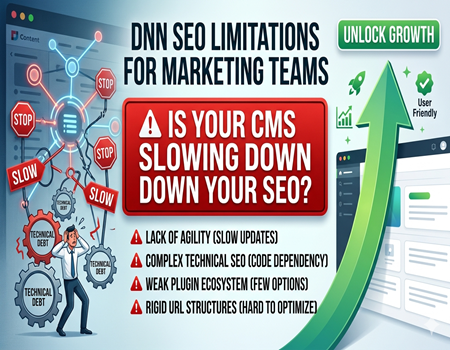
In today’s digital landscape, SEO has become one of the most important drivers of online growth. Businesses are constantly trying to improve their visibility on search engines like Google Search, and for that, they need a CMS that supports fast and flexible optimization. Many organizations still rely on DotNetNuke (DNN) CMS, especially those built on the .NET ecosystem.
While DNN has served businesses well for years, marketing teams are now facing challenges when it comes to SEO. Modern SEO is no longer just about adding keywords—it involves page speed, mobile experience, technical optimization, and content agility. These are areas where DNN often creates friction.
Because of these challenges, many companies are exploring alternatives like WordPress CMS, which is widely known for its SEO-friendly features and ease of use.
This raises an important question: Is your CMS helping your SEO strategy—or slowing it down?
In this blog, we’ll explore the key SEO limitations of DNN and how they directly impact marketing teams.
Understanding DNN: A Quick Overview
DotNetNuke (DNN) CMS is a web content management system built on Microsoft’s .NET framework. It is commonly used by enterprises, government bodies, and organizations that require a secure and structured environment for managing their websites.
One of the main reasons companies choose DNN is its strong integration with Microsoft technologies and its reputation for security. It works well for complex business websites and applications where stability and control are important.
However, as digital marketing has evolved, the expectations from a CMS have changed significantly. Marketing teams now need platforms that are easy to manage, quick to update, and fully optimized for SEO. While DNN handles structure well, it struggles to keep up with these modern requirements.
Why SEO Matters More for Marketing Teams Today
SEO today is not just a marketing tactic—it is a long-term growth strategy. Organic traffic is often the most valuable source of visitors because it brings users who are actively searching for solutions.
Marketing teams rely on SEO to generate leads, improve brand visibility, and reduce dependency on paid advertising. But to achieve this, they need a CMS that allows them to quickly create, update, and optimize content without technical barriers.
Modern SEO also involves multiple factors such as page speed, mobile responsiveness, structured data, and user experience. If a CMS does not support these elements effectively, it becomes difficult for marketing teams to compete.
This is where many DNN users begin to face problems, as the platform does not provide the level of flexibility and control required for today’s SEO strategies.
Key DNN SEO Limitations for Marketing Teams
Limited Control Over URL Structure
One of the most basic yet important aspects of SEO is having clean and user-friendly URLs. Search engines prefer URLs that are simple, readable, and keyword-rich. In DNN, managing URL structures is not always straightforward.
Marketing teams often find it difficult to create customized URLs without technical assistance. This not only slows down the optimization process but also affects how search engines understand the content of a page. Over time, poorly structured URLs can impact rankings and reduce click-through rates.
Complex Content Management for Non-Technical Users
For marketing teams, speed is everything. Whether it’s publishing a blog or updating a landing page, delays can affect campaign performance. Unfortunately, DNN is not very user-friendly for non-technical users.
The interface can feel complex, and even simple tasks may require developer involvement. This creates dependency and slows down execution. Instead of focusing on strategy and creativity, marketing teams often get stuck waiting for technical support.
Weak Plugin and Extension Ecosystem
A strong plugin ecosystem can make a huge difference in SEO performance. Platforms like WordPress CMS offer thousands of plugins that help with optimization, analytics, and performance improvements.
DNN, on the other hand, has a limited number of extensions. Many advanced SEO features are either missing or require custom development. This not only increases cost but also makes it harder for marketing teams to experiment and improve their strategies quickly.
Technical SEO Challenges
Technical SEO plays a critical role in how well a website performs on search engines. In DNN, handling technical elements such as meta tags, schema markup, and XML sitemaps can be challenging.
Even small updates often require backend changes, which means marketing teams cannot make quick improvements on their own. This lack of control can lead to missed opportunities and slower SEO progress.
Page Speed and Performance Issues
Website speed is a major ranking factor, and users expect pages to load quickly. DNN websites can sometimes be heavy and slower to load, especially if not optimized properly.
This affects important metrics like Core Web Vitals, which directly influence search rankings. Slow websites also lead to higher bounce rates, meaning users leave before engaging with the content. For marketing teams, this translates into lost traffic and lower conversions.
Mobile Optimization Limitations
With the majority of users browsing on mobile devices, having a mobile-friendly website is essential. While DNN supports responsive design, achieving smooth mobile optimization is not always easy.
Inconsistent mobile performance can hurt both user experience and SEO rankings. Marketing teams need platforms that make mobile optimization simple and effective, without requiring constant technical adjustments.
Limited Integration with Modern Marketing Tools
Modern marketing relies heavily on tools for analytics, automation, and customer management. DNN offers limited integration options compared to more flexible platforms.
This makes it harder to track user behavior, run targeted campaigns, and measure performance accurately. Without proper insights, marketing teams cannot make data-driven decisions, which affects overall results.
High Maintenance and Development Dependency
One of the biggest drawbacks of DNN is the ongoing dependency on developers. Marketing teams often cannot make even small changes without technical help.
This leads to delays, increased costs, and reduced efficiency. In a fast-paced digital environment, this lack of independence can significantly impact marketing performance.
How These Limitations Impact Marketing Teams
When a CMS creates barriers instead of enabling flexibility, marketing teams struggle to perform at their best. Tasks that should take minutes end up taking days due to technical dependencies.
As a result, campaigns are delayed, content updates are slow, and SEO improvements are limited. This directly affects organic traffic and lead generation. Over time, businesses start losing opportunities to competitors who are using more flexible platforms.
Marketing teams need speed, control, and the ability to adapt quickly. Without these, even the best strategies can fail.
Why Many Businesses Are Moving Away from DNN
As digital marketing continues to evolve, businesses are realizing that their CMS plays a crucial role in success. Many organizations are now moving away from DNN because it does not meet modern SEO and marketing requirements.
They are choosing platforms that offer better usability, faster performance, and stronger SEO capabilities. This shift is driven by the need to stay competitive and achieve better results with less effort.
While DNN still has its place in certain use cases, it is no longer the preferred choice for marketing-driven websites.
Why WordPress is Preferred for SEO
WordPress CMS has become the go-to platform for businesses that prioritize SEO and content marketing. One of its biggest advantages is its simplicity. Marketing teams can easily create and update content without needing technical expertise.
The platform also offers powerful SEO plugins that simplify tasks like meta tag optimization, keyword targeting, and sitemap generation. This gives marketing teams full control over their SEO strategy.
Another major benefit is flexibility. WordPress allows quick changes, better performance optimization, and seamless integration with marketing tools. This makes it easier to adapt to changing SEO trends and improve results over time.
Because of these advantages, many businesses are now opting for Dot Net Nuke (DNN) to WordPress Migration Services to overcome the limitations of DNN and create a more SEO-friendly website.
When Should You Consider Migrating from DNN?
If your marketing team is struggling with slow updates, poor SEO performance, or high dependency on developers, it may be time to consider migrating.
A few clear signs include:
- Difficulty in optimizing content
- Delays in launching campaigns
- Limited control over SEO elements
Switching to a more flexible CMS can help improve efficiency and unlock better growth opportunities.
Conclusion
DNN has been a reliable CMS for many years, especially for enterprise applications. However, modern SEO demands more flexibility, speed, and control than DNN can easily provide.
Marketing teams need tools that allow them to work independently, optimize content quickly, and adapt to changes in search engine algorithms. When a CMS fails to support these needs, it becomes a limitation rather than an asset.
Choosing the right platform can make a significant difference in SEO performance and overall business growth. For many organizations, moving to a more SEO-friendly CMS like WordPress is a step in the right direction.