Headless Sitecore vs WordPress Headless
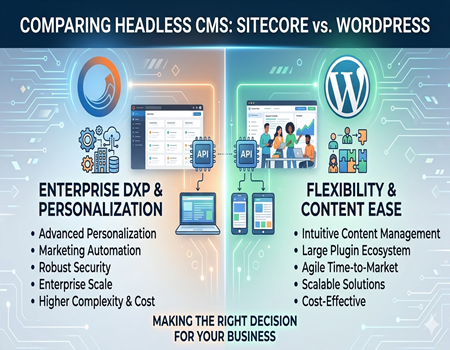
In today’s digital world, a website is no longer just an online presence—it is a complete user experience. Businesses now need fast, flexible, and scalable solutions that can deliver content across multiple platforms like websites, mobile apps, and other digital channels. This is one of the main reasons why headless CMS architecture is becoming increasingly popular.
In simple terms, a headless CMS separates the backend (where content is managed) from the frontend (how content is displayed). This separation gives developers more freedom to build modern interfaces while allowing businesses to manage content efficiently. As a result, many organizations are moving away from traditional CMS platforms toward headless solutions.
In this blog, we will compare two widely used platforms: Sitecore Headless and WordPress Headless. Both are powerful in their own way, but they differ significantly in terms of cost, complexity, flexibility, and ideal use cases. Choosing the right platform depends on your business goals, technical resources, and budget.
Selecting the wrong CMS can lead to long-term issues such as high development costs, limited scalability, and poor performance. That’s why it is important to understand the strengths and limitations of each option before making a decision.
This guide will help you clearly understand both platforms with a detailed comparison, so you can choose the best solution for your business needs.
What is Headless CMS?
A headless CMS is a content management system where the backend (content storage and management) is completely separated from the frontend (design and presentation). Instead of controlling how content looks, it focuses only on storing and delivering content through APIs to different platforms.
In a traditional CMS, both backend and frontend are tightly connected, which limits flexibility. But in a headless CMS, developers can use any technology like React, Next.js, or Angular to build the frontend. This gives more freedom to create faster, modern, and highly customized digital experiences.
The main working process of a headless CMS is simple. Content is created and stored in the backend, and then delivered via APIs to different devices such as websites, mobile apps, smart devices, or even digital kiosks. This makes it ideal for businesses that want to maintain consistency across multiple channels.
Headless CMS is becoming more popular because of its flexibility and performance benefits. Since the frontend is decoupled, websites can load faster and handle high traffic more efficiently. It also allows teams to work independently, where developers and content creators can focus on their own tasks without dependency.
Another key benefit is omnichannel delivery. Businesses can reuse the same content across multiple platforms without creating it again. This saves time and ensures consistency in branding and messaging.
Overall, a headless CMS is a future-ready solution for businesses that need speed, scalability, and flexibility in their digital presence.
Overview of Sitecore Headless
What is Sitecore Headless
Sitecore is an enterprise-level digital experience platform used by large organizations to manage content, customer data, and marketing activities in one place. With the evolution of modern web architecture, Sitecore introduced headless solutions like XM Cloud and Sitecore JSS to provide more flexibility and performance.
In a headless setup, Sitecore separates content management from the frontend presentation layer. Content is stored in the backend and delivered through APIs to any frontend technology. This allows developers to use frameworks like React or Next.js while content teams continue working in a familiar environment.
Key Features and Capabilities
One of the biggest strengths of Sitecore Headless is its advanced personalization. It allows businesses to deliver content based on user behavior, preferences, and journey. This helps create highly targeted experiences, which can improve engagement and conversions, especially for enterprise-level websites.
Sitecore also provides strong analytics and marketing automation tools. Businesses can track user interactions, measure campaign performance, and make data-driven decisions. These built-in tools reduce the need for multiple third-party platforms, making it a complete solution for large organizations.
Who Should Use Sitecore Headless
Sitecore Headless is best suited for large enterprises that need scalability, personalization, and integration with complex systems. It works well for businesses with multiple websites, regions, or customer segments where advanced marketing capabilities are required.
However, it comes with high licensing and development costs. It also requires experienced developers to manage and maintain the system. Because of this, Sitecore is generally not ideal for small businesses or startups looking for a simple and cost-effective solution.
Overview of WordPress Headless
What is WordPress Headless
WordPress Headless is a modern approach where WordPress is used only as a backend content management system, while the frontend is built using advanced frameworks like React or Next.js. Instead of using traditional themes, content is delivered through APIs such as REST API or GraphQL.
This separation allows developers to create faster and more flexible user interfaces. At the same time, content creators can continue using the familiar WordPress dashboard, making it easy to manage and publish content without technical complexity.
Key Features and Capabilities
One of the biggest advantages of WordPress Headless is its flexibility. Developers can build highly customized frontends without being limited by WordPress themes. This results in better performance, improved user experience, and the ability to create modern web applications.
Another strong feature is its large plugin ecosystem. WordPress offers thousands of plugins for SEO, security, and performance optimization. Even in a headless setup, many of these tools can still be integrated, giving businesses more control over their website functionality.
Who Should Use WordPress Headless
WordPress Headless is ideal for startups, small to medium businesses, and growing brands that want a balance between flexibility and cost. It allows faster development and easier content management without requiring heavy investment in licensing or infrastructure.
It is also a great choice for content-heavy websites such as blogs, media platforms, and marketing websites. Businesses can scale gradually as their needs grow, without facing the complexity of enterprise-level systems.
However, setting up a headless WordPress environment requires some technical knowledge. While it is more affordable than enterprise solutions, businesses still need skilled developers to fully utilize its capabilities and ensure smooth performance.
Headless Sitecore vs WordPress Headless (Detailed Comparison)
Comparison Table
| Factor | Sitecore Headless | WordPress Headless |
|---|---|---|
| Ease of Use | Complex, requires training | Easy for content teams |
| Cost | Very high (licensing + development) | Low to moderate |
| Flexibility | High but structured | Very flexible |
| Performance | Excellent for enterprise | Fast with proper setup |
| Scalability | Enterprise-level | Scalable but depends on setup |
| Customization | Advanced but complex | Easy and wide options |
| SEO Capabilities | Strong but technical | Very strong with plugins |
| Security | Enterprise-grade | Depends on configuration |
| Time to Market | Slow | Faster |
Ease of Use and Flexibility
When it comes to ease of use, WordPress Headless has a clear advantage. Content teams are already familiar with the WordPress dashboard, making it easy to manage and publish content. On the other hand, Sitecore requires proper training and technical understanding, which can slow down adoption for new teams.
In terms of flexibility, both platforms offer strong capabilities, but in different ways. WordPress allows developers to experiment freely with frontend technologies, while Sitecore provides a more structured environment. This structure is useful for large organizations but can feel restrictive for smaller teams.
Cost and Time to Market
Cost is one of the biggest differences between these two platforms. Sitecore comes with high licensing fees, along with significant development and maintenance costs. This makes it suitable mainly for enterprises with large budgets and long-term digital strategies.
WordPress Headless is much more cost-effective. There are no licensing fees, and development costs are generally lower. Because of its simplicity and wide community support, projects can be launched faster, making it ideal for businesses that want quick results.
Performance and Scalability
Both platforms offer good performance when implemented correctly. Sitecore is designed for enterprise-level performance and can handle large volumes of traffic and content without issues. It is often used by global brands that require high availability and stability.
WordPress Headless can also deliver excellent performance, especially when combined with modern frameworks and CDN services. However, scalability depends on how well the system is configured. With the right setup, it can handle growing traffic efficiently.
SEO, Security, and Customization
WordPress has a strong advantage in SEO due to plugins like Yoast SEO and Rank Math, which make optimization easier even for non-technical users. Sitecore also supports SEO, but it often requires more manual configuration and developer involvement.
In terms of security, Sitecore offers enterprise-grade protection with built-in features. WordPress security depends on hosting, plugins, and proper configuration. While it can be secure, it requires active management and monitoring.
Customization is possible in both platforms, but WordPress makes it easier with its large ecosystem. Sitecore offers deeper customization but requires skilled developers, making it more complex and time-consuming to implement.
Pros and Cons of Sitecore Headless
Sitecore Headless offers powerful capabilities that are specifically designed for enterprise-level businesses. One of its biggest advantages is advanced personalization. It allows companies to deliver highly targeted content based on user behavior, preferences, and journey. This helps improve customer engagement and increases conversion rates for large-scale digital platforms.
Another major benefit is its strong analytics and marketing automation features. Sitecore provides detailed insights into user interactions, campaign performance, and customer journeys. This makes it easier for businesses to make data-driven decisions without relying heavily on third-party tools. It also integrates well with other enterprise systems.
Sitecore is also known for its high scalability and performance. It is built to handle large volumes of traffic, multiple websites, and complex digital ecosystems. This makes it a reliable choice for global brands that operate in different regions and require consistent performance across all platforms.
However, Sitecore Headless comes with some significant drawbacks. The biggest challenge is its high cost. Licensing fees, development, and maintenance can be very expensive, making it difficult for small or medium businesses to afford. It is generally suitable only for companies with large budgets.
Another limitation is its complexity. Setting up and managing Sitecore requires experienced developers and technical expertise. The learning curve can be steep for new teams, which may slow down implementation and increase dependency on skilled professionals.
Overall, while Sitecore Headless is powerful and feature-rich, it is best suited for enterprises that can handle its cost and complexity.
Pros and Cons of WordPress Headless
WordPress Headless is a flexible and cost-effective solution that works well for many types of businesses. One of its biggest advantages is affordability. Unlike enterprise platforms, WordPress does not require expensive licensing, which makes it accessible for startups and small to medium-sized businesses with limited budgets.
Another key benefit is ease of content management. The WordPress dashboard is user-friendly and widely known, allowing content teams to create, edit, and publish content without technical difficulty. This reduces dependency on developers and helps teams work more efficiently on a daily basis.
WordPress also offers a large ecosystem of plugins and integrations. Businesses can easily add features for SEO, security, performance, and analytics. This flexibility makes it easier to customize the platform based on specific needs without building everything from scratch.
However, WordPress Headless also has some limitations. Setting up a headless architecture requires technical knowledge, especially when integrating APIs and frontend frameworks. Without proper expertise, the setup can become complex and lead to performance or maintenance issues.
Another drawback is security management. Unlike enterprise platforms with built-in security systems, WordPress security depends on hosting, plugins, and regular updates. If not managed properly, it can become vulnerable to threats, especially for high-traffic websites.
Overall, WordPress Headless is a strong choice for businesses looking for flexibility, affordability, and faster development. However, it still requires the right technical setup and ongoing maintenance to perform effectively.
Use Cases: When to Choose Sitecore vs WordPress
When to Choose Sitecore Headless
Sitecore Headless is a strong choice for large enterprises that require advanced digital experience management. If your business operates across multiple regions, manages several websites, or handles large volumes of customer data, Sitecore provides the scalability and control needed to manage everything efficiently.
It is also ideal for companies that focus heavily on personalization and customer journey optimization. Businesses in industries like finance, healthcare, and large-scale eCommerce often need detailed user targeting and analytics. Sitecore’s built-in tools help deliver highly customized experiences based on user behavior and preferences.
Another common use case is when organizations need deep integration with other enterprise systems such as CRM, marketing automation platforms, or data analytics tools. Sitecore works well in complex environments where multiple systems need to work together seamlessly under one ecosystem.
When to Choose WordPress Headless
WordPress Headless is a better option for startups, small to medium businesses, and growing brands that need flexibility without high costs. It allows businesses to build modern, fast websites while keeping content management simple and easy to handle for non-technical teams.
It is especially useful for content-driven websites such as blogs, media platforms, and marketing websites. Businesses that publish content regularly can benefit from WordPress’s easy-to-use interface and large plugin ecosystem, which helps improve productivity and efficiency.
WordPress Headless is also a great choice when speed and time to market are important. Projects can be launched faster compared to enterprise platforms, making it suitable for businesses that want quick results and the ability to scale gradually as they grow.
SEO Capabilities Comparison
SEO is an important factor when choosing between Sitecore Headless and WordPress Headless. WordPress has a clear advantage in this area because of its strong ecosystem of SEO plugins like Yoast SEO and Rank Math. These tools make it easy to optimize meta tags, keywords, and on-page elements without needing deep technical knowledge.
In contrast, Sitecore also supports SEO, but it is more developer-dependent. Many SEO-related tasks such as meta configuration, structured data, and URL management often require custom implementation. While it offers flexibility, it may not be as user-friendly for content teams compared to WordPress.
Another important aspect is content optimization. WordPress provides built-in guidance through plugins, helping users improve readability, keyword usage, and internal linking. This makes it easier for businesses to follow SEO best practices and improve their chances of ranking higher on search engines.
However, in a headless setup, both platforms face similar SEO challenges. Since the frontend is decoupled, proper implementation of server-side rendering, metadata handling, and site structure becomes critical. Without the right setup, SEO performance can be affected regardless of the platform.
Overall, WordPress Headless is generally better for SEO due to its ease of use and plugin support. Sitecore can also perform well, but it requires more technical effort and expertise to achieve the same level of optimization.
Cost Comparison
Cost is one of the most important factors when choosing between Sitecore Headless and WordPress Headless. Sitecore is known for its high pricing, mainly due to licensing fees. Businesses need to pay for the platform itself, along with additional costs for implementation, hosting, and ongoing maintenance.
Apart from licensing, development costs for Sitecore are also high. It requires experienced developers and specialized teams to build, manage, and scale the platform. This increases the overall investment, making it suitable mainly for large enterprises with strong budgets and long-term digital strategies.
On the other hand, WordPress Headless is much more cost-effective. It is an open-source platform, so there are no licensing fees involved. Businesses only need to invest in hosting, development, and maintenance, which are generally lower compared to enterprise solutions like Sitecore.
Another advantage of WordPress is flexibility in budgeting. Businesses can start with a smaller investment and scale gradually as their needs grow. This makes it a practical choice for startups and growing companies that want to manage costs while still building a modern digital experience.
Overall, Sitecore offers powerful features but comes with a high price, while WordPress Headless provides a more affordable and flexible option for most businesses.
Migration Consideration
Many businesses today are considering moving from Sitecore to more flexible and cost-effective solutions. One of the main reasons is the high cost of ownership associated with Sitecore, including licensing, development, and maintenance. As digital needs evolve, companies often look for platforms that offer similar flexibility at a lower cost.
Another important factor is ease of management. WordPress Headless provides a simpler content management experience compared to Sitecore. Content teams can work more efficiently without depending heavily on developers, which helps improve productivity and reduce operational complexity over time.
Migration also helps improve speed and performance when implemented correctly. With modern frontend frameworks and optimized hosting, businesses can create faster and more responsive digital experiences. This is especially important for SEO and user engagement in today’s competitive online environment.
However, migration is not a simple process. It involves challenges like data transfer, content structure mapping, and maintaining SEO rankings. Without proper planning, businesses may face issues such as broken links, loss of metadata, or performance drops during the transition phase.
This is where a professional Sitecore To WordPress Migration Service becomes important. With the right strategy and technical expertise, businesses can ensure a smooth transition while preserving their existing SEO value and improving overall performance.
Overall, migration should be carefully planned and executed to achieve long-term benefits without disrupting current operations.
Final Verdict: Which One Should You Choose?
Choosing between Sitecore Headless and WordPress Headless depends on your business size, budget, and technical requirements. There is no one-size-fits-all answer, but understanding your priorities will help you make the right decision. Both platforms are powerful, but they serve very different types of users.
If you are a large enterprise with complex needs, Sitecore Headless is a strong option. It offers advanced personalization, deep analytics, and seamless integration with enterprise systems. Businesses that require high scalability and detailed customer journey management can benefit from its capabilities, even though it comes with higher costs and complexity.
On the other hand, WordPress Headless is a better choice for startups, small to medium businesses, and growing brands. It provides flexibility, faster development, and lower costs. With the right setup, it can deliver excellent performance while keeping content management simple and efficient for teams.
Another important factor is long-term growth. If you want to launch quickly and scale gradually, WordPress Headless gives you that flexibility. It allows you to start small and expand without making a heavy upfront investment, which is ideal for businesses focused on agility.
In simple terms, choose Sitecore if you need enterprise-level power and have the budget for it. Choose WordPress Headless if you want a cost-effective, flexible, and easier-to-manage solution that can grow with your business.
Conclusion
Choosing between Sitecore Headless and WordPress Headless ultimately depends on your business goals, budget, and technical capabilities. Both platforms offer modern solutions, but they are designed for different types of users. Understanding your long-term needs is key to making the right decision.
Sitecore Headless is best suited for enterprises that require advanced personalization, deep analytics, and the ability to manage complex digital ecosystems. While it offers powerful features, it also comes with higher costs and requires experienced development teams to manage effectively.
On the other hand, WordPress Headless provides a more flexible and cost-effective approach. It is easier to manage, quicker to deploy, and ideal for businesses that want to scale without heavy investment. With the right setup, it can deliver strong performance and SEO results.
If you are planning to switch platforms, working with a reliable Sitecore To WordPress Migration Service can help ensure a smooth transition without losing your existing SEO value. A well-planned migration can improve performance, reduce costs, and support long-term growth.
In the end, the best choice is the one that aligns with your business strategy and future goals.