Is ExpressionEngine Dead? Market Reality Check
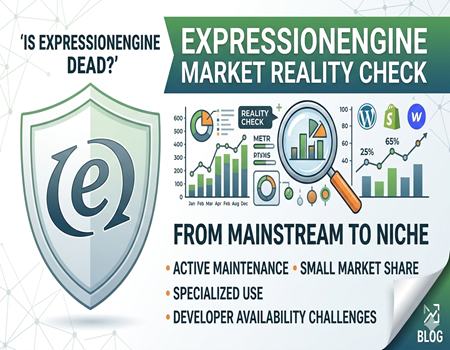
If you search online for ExpressionEngine today, you will quickly notice a common question: “Is ExpressionEngine dead?” This question appears in forums, developer discussions, Reddit threads, and agency conversations. It is not coming from beginners. It is usually asked by business owners, marketers, and developers who are seriously evaluating the future of their websites.
The concern is understandable. Over the last decade, the CMS market has changed dramatically. WordPress dominates globally. New SaaS platforms like Webflow, Shopify, and Squarespace have grown rapidly. Headless CMS solutions are becoming popular. In comparison, ExpressionEngine does not appear in mainstream CMS discussions as often as it once did.
But does lower visibility mean the platform is dead? Not necessarily.
In this detailed market reality check, we will examine ExpressionEngine’s history, current market position, developer adoption, maintenance status, and future outlook. By the end, you will have a clear and practical understanding of whether ExpressionEngine is truly dead or simply evolving into something different.
A Quick History of ExpressionEngine
ExpressionEngine was launched in the early 2000s by EllisLab. At that time, it was considered one of the most flexible and developer-friendly CMS platforms available. Unlike many other systems, it allowed full control over templates. Developers could write clean, custom HTML without being locked into rigid themes.
During its peak years, ExpressionEngine became popular among agencies and enterprise clients. It was known for its powerful channel system, flexible custom fields, and strong security reputation. Many government websites and large corporate sites were built using it.
However, ExpressionEngine originally followed a paid licensing model. While this was acceptable at the time, the rise of free and open-source platforms like WordPress changed the competitive landscape. Over time, ExpressionEngine transitioned to an open-source model, but by then WordPress had already captured massive market share.
Ownership changes and strategic shifts also influenced its ecosystem. Some developers moved to other platforms, and the community gradually became smaller. Even so, the platform continued evolving with new updates and improvements.
Understanding this history helps us see that ExpressionEngine did not disappear overnight. It slowly moved from mainstream popularity to niche relevance.
Current Market Share Reality
Let us look at the numbers realistically.
WordPress now powers more than 40 percent of all websites globally. It dominates the CMS market with a massive plugin ecosystem and global community. Platforms like Shopify and Wix also hold significant portions of the market.
ExpressionEngine, on the other hand, holds a very small percentage of total CMS usage today. It is not among the top five most used CMS platforms anymore. Search trend data also shows that interest in ExpressionEngine has declined over the years compared to its peak.
Job market data tells a similar story. There are far fewer job postings for ExpressionEngine developers compared to WordPress or modern JavaScript-based CMS solutions.
However, low market share does not automatically mean a platform is dead. It simply means it is not mainstream.
ExpressionEngine today operates in a niche space. It is used by specific agencies, long-term enterprise clients, and legacy websites that were built during its strong years. The platform still exists, receives updates, and supports production websites.
So the honest answer here is that ExpressionEngine is not dead, but it is no longer a major player in the CMS market.
Why Many Developers Moved Away
To understand market perception, we need to examine why many developers shifted to other platforms.
One reason is ecosystem size. WordPress has thousands of plugins and themes. This makes development faster and more scalable. ExpressionEngine relies more heavily on custom development and fewer third-party extensions.
Another factor is hiring difficulty. Businesses often prefer platforms with a large talent pool. Finding WordPress developers is relatively easy. Finding experienced ExpressionEngine developers is harder.
Cost perception also played a role in earlier years when ExpressionEngine required paid licenses. Even though it later became open source, the early reputation influenced adoption.
Modern CMS trends also shifted toward headless systems, API-first architectures, and JavaScript frameworks. Many developers moved toward platforms that integrated more naturally with these technologies.
It is important to note that this shift was not necessarily because ExpressionEngine failed technically. It was largely due to market dynamics and ecosystem growth elsewhere.
Is ExpressionEngine Still Actively Maintained?
A common concern is whether ExpressionEngine still receives updates.
The answer is yes. The platform continues to receive core updates and security patches. The open-source community contributes improvements, and the development team maintains the core system.
Documentation remains available. Community discussions continue, though at a smaller scale than before.
The add-on ecosystem is not as large as it once was, but essential extensions still exist. Agencies that specialize in ExpressionEngine continue supporting client projects.
This means ExpressionEngine is alive from a technical standpoint. It simply operates within a smaller and more focused community.
Who Still Uses ExpressionEngine Today?
ExpressionEngine is often used by organizations that built their websites during its peak years and have stable infrastructure.
Government agencies and enterprise organizations sometimes prefer it because of custom-built architectures that are deeply integrated into their systems.
Some digital agencies still specialize in ExpressionEngine and maintain long-term client relationships. For businesses that do not require frequent feature expansion, staying on ExpressionEngine can be practical.
Legacy systems are another major group. Companies with complex custom builds may find migration expensive and risky. In such cases, maintaining the existing system makes sense.
Real Problems Businesses Face with ExpressionEngine
Even though ExpressionEngine is not dead, businesses do face real challenges.
The biggest challenge is developer availability. Hiring experienced ExpressionEngine developers can be difficult in many regions.
Upgrade complexity is another issue. Older installations may require careful handling during version updates.
Integration limitations can also create challenges. Modern marketing tools, automation platforms, and SaaS integrations often offer stronger WordPress support out of the box.
Scalability concerns arise when businesses want to expand quickly or add advanced eCommerce features.
These challenges do not mean ExpressionEngine is unusable. They simply mean long-term strategic planning becomes important.
Should You Stay or Move? A Practical Decision Framework
Instead of asking whether ExpressionEngine is dead, a better question is whether it is right for your future goals.
You may choose to stay if your website is stable, secure, and not requiring major feature expansion. If you already have a dedicated developer who understands your system, staying could be cost-effective.
However, you may consider moving if you are planning a major redesign, struggling to hire developers, or needing stronger integration with marketing tools and plugins.
If you are already evaluating your long-term strategy, exploring professional ExpressionEngine to WordPress Migration services can help you assess risks and opportunities before making a decision. Migration is not about panic. It is about future-proofing your digital presence.
The decision should always be based on business goals, not fear.
ExpressionEngine vs WordPress: An Honest Comparison
When comparing ExpressionEngine and WordPress, context matters.
WordPress offers massive community support, thousands of plugins, and easier hiring. It is suitable for businesses that want flexibility without heavy custom coding.
ExpressionEngine offers clean template control and structured content flexibility. It is developer-focused and powerful when custom architecture is required.
WordPress dominates in terms of market share, ecosystem, and third-party integrations. ExpressionEngine offers stability for existing custom builds.
Neither platform is automatically better for every situation. The right choice depends on your business needs, internal resources, and growth plans.
The Future of ExpressionEngine
Looking ahead, ExpressionEngine is unlikely to regain mainstream dominance. The CMS market is highly competitive, and WordPress continues expanding globally.
However, ExpressionEngine is likely to survive as a niche CMS. It may remain strong within certain agency circles and legacy enterprise projects.
Its open-source status provides stability. As long as there is a committed community and development team, it will not disappear suddenly.
The future may not be explosive growth, but it can be steady and sustainable within a smaller ecosystem.
Migration Trends in 2026
Many businesses are consolidating their digital platforms. Instead of maintaining niche systems, they are moving toward platforms with broader ecosystems.
Agencies increasingly offer migration services as part of redesign strategies. SEO performance, plugin availability, and ease of content management are common drivers.
Migration today is usually strategic rather than reactive. Companies evaluate long-term costs, developer availability, and scalability before deciding.
ExpressionEngine users who migrate typically do so during redesign phases or technology upgrades rather than emergency situations.
Final Verdict: Is ExpressionEngine Dead?
The simple answer is no. ExpressionEngine is not dead.
It is not abandoned. It still receives updates. It still powers real websites. It still has a committed user base.
However, it is no longer a mainstream CMS. Its market share is small. Its developer community is limited compared to WordPress.
For some businesses, staying with ExpressionEngine makes perfect sense. For others, planning a transition may be smarter for long-term growth.
Instead of asking whether ExpressionEngine is dead, ask whether it aligns with your business goals for the next five to ten years. That question will give you a much clearer answer.