Migrating from DNN Without Breaking SEO
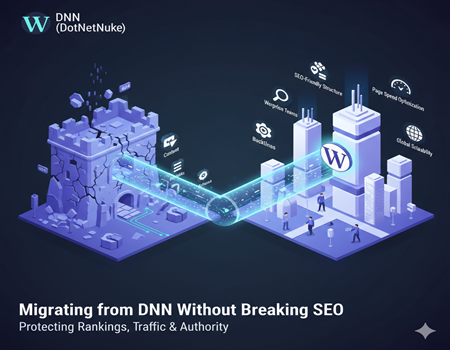
Migrating a website is one of the most sensitive operations for any enterprise, and when SEO is involved, the risks multiply. For organizations using DNN, the fear of losing hard-earned rankings, organic traffic, and lead flow often delays necessary modernization. However, delaying migration can be just as damaging as executing it poorly.
In 2026, enterprises are moving away from legacy CMS platforms to improve performance, flexibility, and cost efficiency. At the same time, search engines have become far more sophisticated. Even small technical mistakes during migration—such as broken redirects or missing metadata—can cause sudden ranking drops that take months to recover from.
The good news is that migrating from DNN without breaking SEO is completely achievable with the right planning and execution. SEO losses are not inevitable; they are usually the result of shortcuts or lack of preparation.
This guide is designed for enterprise decision-makers, marketers, and IT teams who want to modernize their CMS while protecting visibility, authority, and traffic. It explains what to prepare, what to preserve, and what to optimize—so your migration strengthens your SEO instead of damaging it.
Understanding SEO Risks in DNN Migration
A CMS migration impacts nearly every technical and content-related SEO factor. When moving away from DNN, risks typically arise from changes that search engines interpret as signals of content loss or site restructuring.
Common SEO risks include:
- Changes in URL structure that break existing rankings
- Loss of metadata such as titles and descriptions
- Incorrect handling of canonical URLs
- Broken internal links
- Missing or altered structured data
DNN websites often rely on module-generated URLs and dynamic content rendering. If these URLs are not mapped correctly during migration, search engines may treat new pages as entirely different entities. This results in lost authority, dropped rankings, and reduced crawl efficiency.
Understanding these risks early allows teams to build safeguards into the migration plan rather than reacting after traffic declines.
Pre-Migration SEO Audit: The Foundation
A successful SEO-safe migration always begins with a comprehensive SEO audit. This audit acts as a baseline, ensuring nothing valuable is lost during the transition.
Start by creating a full inventory of:
- All live URLs
- High-traffic pages
- Ranking keywords
- Backlinks and referring domains
- Media files and downloadable assets
Analyze performance data to identify pages driving the most organic traffic and conversions. These pages deserve special attention during migration.
Technical elements such as page speed, mobile usability, indexation status, and crawl errors should also be documented. This baseline allows you to compare pre- and post-migration performance accurately.
Enterprises that skip this step often struggle to diagnose issues after launch because they lack a clear reference point.
URL Mapping & Redirect Strategy (301 Redirects)
URL preservation is one of the most critical factors in protecting SEO during migration. Ideally, high-value URLs should remain unchanged. When changes are unavoidable, 301 redirects must be implemented correctly.
Best practices include:
- Creating a one-to-one URL mapping spreadsheet
- Redirecting every old DNN URL to its closest equivalent
- Avoiding redirect chains and loops
- Ensuring redirects are server-side, not JavaScript-based
Legacy DNN URLs often include parameters or folder structures that differ from modern CMS setups. Each of these must be mapped carefully to prevent crawl errors and ranking losses.
When done correctly, redirects transfer authority and signals seamlessly, allowing search engines to recognize continuity rather than disruption.
Content Migration Without SEO Loss
Content is the heart of SEO, and migrating it incorrectly can erase years of optimization. During migration, content should not simply be copied—it should be preserved and improved.
Key elements to maintain include:
- Heading hierarchy (H1–H6)
- Keyword placement
- Internal links
- Image ALT attributes
Dynamic or module-based DNN content requires special handling. Ensure that rendered HTML content remains accessible and indexable after migration.
Migration also presents an opportunity to remove outdated or duplicate content. However, any removed pages must be redirected appropriately to avoid SEO gaps.
Metadata, Schema & On-Page SEO Preservation
Metadata is often overlooked during migration, yet it plays a major role in click-through rates and rankings.
Ensure the migration preserves:
- Title tags
- Meta descriptions
- Canonical tags
- Open Graph metadata
Structured data (schema markup) should be transferred or reimplemented accurately. Losing schema can impact rich results, visibility, and SERP appearance.
Internal linking structures should also remain intact. Broken internal links weaken crawlability and reduce page authority flow across the site.
Technical SEO Considerations During Migration
Technical SEO determines how efficiently search engines crawl and index your new site. During migration, special attention should be paid to:
- XML sitemaps: Regenerate and submit updated versions
- Robots.txt: Ensure important pages are not blocked
- Page speed: Optimize assets and hosting
- Mobile responsiveness: Maintain or improve mobile UX
- Core Web Vitals: Avoid regressions
DNN sites often suffer from performance limitations. Migration allows enterprises to improve load times and technical health—both of which positively impact SEO when handled correctly.
Post-Migration SEO Testing & Monitoring
SEO work does not end at launch. The post-migration phase is where issues are identified and resolved quickly.
Critical steps include:
- Running crawl audits on the live site
- Monitoring Google Search Console for errors
- Tracking rankings for priority keywords
- Comparing traffic trends against pre-migration benchmarks
Temporary fluctuations are normal, but sustained drops indicate unresolved issues. Early intervention minimizes long-term damage.
Enterprises that actively monitor SEO in the first 30–60 days after migration recover faster and often see improvements beyond previous performance.
Why WordPress Is SEO-Friendly After DNN Migration
WordPress is widely regarded as one of the most SEO-friendly CMS platforms available today. Its flexibility allows enterprises to control URLs, metadata, schema, and performance without excessive development overhead.
Key SEO advantages include:
- Clean URL structures
- Easy metadata management
- Strong plugin ecosystem for SEO
- Performance optimization options
- Editorial SEO control for content teams
Compared to DotNetNuke, WordPress enables faster SEO iterations and better collaboration between marketing and technical teams—making it a strong post-migration platform.
When to Consider Professional Migration Support
Enterprise migrations involve complex SEO, content, and infrastructure challenges. If your site includes thousands of URLs, custom modules, or high organic revenue dependency, professional support becomes essential.
A structured approach to Convert Website from DotNetNuke To WordPress helps enterprises protect SEO equity while accelerating modernization. Professional teams handle audits, redirects, testing, and validation—reducing risk and downtime.
For many organizations, expert support turns migration from a threat into a growth opportunity.
Common DNN Migration SEO Mistakes to Avoid
Some mistakes repeatedly cause SEO losses during DNN migration:
- Launching without full redirect coverage
- Forgetting metadata transfer
- Blocking crawlers accidentally
- Skipping post-launch monitoring
Avoiding these mistakes requires discipline, documentation, and cross-team coordination. SEO should be involved at every stage—not added at the end.
Timeline & Checklist for SEO-Safe DNN Migration
A realistic migration timeline includes:
Pre-Migration (4–6 weeks):
- SEO audit
- URL mapping
- Content inventory
Migration Phase (2–4 weeks):
- Content transfer
- Redirect implementation
- Technical validation
Post-Migration (4–8 weeks):
- Monitoring
- Fixes and optimization
This phased approach reduces pressure and improves outcomes.
Conclusion: Migrating from DNN Without Losing Rankings
Migrating from DNN does not have to mean sacrificing SEO. With proper planning, detailed audits, careful execution, and post-launch monitoring, enterprises can modernize their CMS while preserving—and even improving—their search visibility.
In 2026, SEO-safe migration is not a luxury; it is a necessity. Organizations that treat migration as a strategic initiative rather than a technical task position themselves for long-term digital growth.