What Happens to Custom DNN Modules After Migration?
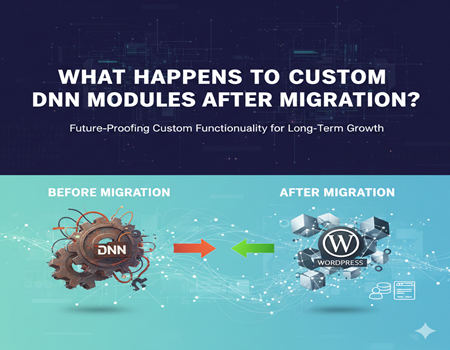
For enterprises using DNN, custom modules are often the most critical and sensitive part of the platform. Over time, organizations invest heavily in building tailored modules to support internal workflows, integrations, dashboards, data processing, and role-based functionality. These modules are rarely cosmetic; they directly support business operations, making them difficult to replace or ignore.
When enterprises begin planning a CMS migration, the conversation almost always turns to custom modules. Stakeholders worry about losing functionality, disrupting internal users, or having to rebuild years of work from scratch. This fear often delays modernization decisions and keeps organizations locked into legacy platforms longer than they should be.
However, in 2026, holding onto outdated systems purely because of custom modules is increasingly risky. Rising maintenance costs, security concerns, and limited flexibility eventually outweigh the perceived safety of staying put. Migration does not automatically mean losing functionality—it means reassessing how that functionality should exist in a modern, scalable environment.
This blog explains what truly happens to custom DNN modules after migration. It clarifies what can be reused conceptually, what must be rebuilt or replaced, and how enterprises can move forward confidently without compromising business continuity or long-term growth.
What Are Custom DNN Modules?
Custom DNN modules are purpose-built software components developed specifically for a DNN-based website to meet unique business requirements. Unlike core DNN modules or third-party extensions, custom modules are written from scratch using the DNN framework and .NET technologies.
Enterprises typically build custom modules when standard features are insufficient. Common examples include advanced data collection forms, internal approval workflows, employee portals, role-based dashboards, reporting tools, and integrations with CRM, ERP, or other enterprise systems. These modules often interact directly with DNN’s authentication, database structure, and business logic layers.
Over time, custom modules become deeply embedded in daily operations. While they deliver significant value, they also increase platform dependency. Documentation is often limited, and institutional knowledge may reside with a small number of developers or vendors.
This tight coupling between custom modules and the DNN platform is what makes migration challenging. Understanding the role and scope of these modules is essential before planning any transition to a modern CMS.
Why Custom Modules Make DNN Migration Complex
Custom DNN modules increase migration complexity because they are tightly coupled with the DNN architecture. Most rely on DNN-specific APIs, authentication mechanisms, database schemas, and rendering logic. This means they cannot simply be “copied” into another CMS.
Another challenge is dependency mapping. A single module may depend on multiple other modules, third-party systems, or specific user roles. These dependencies are not always documented, making them difficult to identify without thorough analysis.
Version compatibility is another issue. Many enterprises run older DNN versions because upgrading custom modules is risky or expensive. As a result, the codebase may include outdated patterns that do not align with modern development standards.
There is also the issue of knowledge gaps. Original developers may no longer be available, and documentation may be incomplete. This increases uncertainty and perceived risk during migration planning.
Despite these challenges, complexity does not mean migration should be avoided. It means migration must be approached strategically, with realistic expectations and a clear focus on preserving business functionality rather than legacy code.
Pre-Migration Assessment of Custom DNN Modules
A structured pre-migration assessment is the most important step in handling custom DNN modules successfully. Without it, enterprises risk cost overruns, delays, and functional gaps.
The process starts with creating a complete inventory of all custom modules. Each module should be reviewed to understand its purpose, business value, usage frequency, and technical dependencies. Modules should then be categorized as business-critical, important, or optional.
Next comes technical evaluation. Enterprises should assess code quality, security risks, performance impact, and compatibility with modern systems. This step often reveals modules that are outdated, redundant, or no longer actively used.
The assessment should also identify opportunities for simplification. Many custom modules exist to solve problems that modern CMS platforms now handle natively or through plugins. Retiring such modules reduces migration scope and long-term maintenance.
Finally, decisions must be made: which modules should be rebuilt, which can be replaced, and which should be retired entirely. This clarity transforms migration from a risky unknown into a controlled, predictable process.
Can Custom DNN Modules Be Migrated Directly?
In most enterprise scenarios, custom DNN modules cannot be migrated directly at the code level. DNN and modern CMS platforms use fundamentally different architectures, APIs, and data handling models. Attempting to port code usually leads to unstable systems and long-term technical debt.
However, this does not mean that functionality is lost. Migration focuses on preserving what the module does, not how it was originally built. This concept is known as functional migration.
By documenting business requirements and expected outcomes, enterprises can recreate module behavior using modern tools and frameworks. In many cases, the rebuilt functionality is more efficient, secure, and scalable than the original.
Accepting early that direct code migration is unrealistic helps align expectations, reduce frustration, and enable better planning.
Rebuilding Custom DNN Modules in WordPress
WordPress offers flexible and modern ways to rebuild custom functionality without replicating legacy complexity. Instead of monolithic modules, functionality can be distributed across custom plugins, custom post types, and APIs.
Business logic can be implemented through lightweight custom plugins, while structured data can be handled using custom post types and taxonomies. Integrations with external systems can leverage REST APIs and webhooks, making them easier to maintain and extend.
Rebuilding also provides an opportunity to clean up inefficient logic. Many DNN modules accumulate features over time that are no longer needed. Rebuilding allows enterprises to focus only on current business requirements.
From a long-term perspective, rebuilt functionality in WordPress is easier to document, test, and enhance. It reduces reliance on niche skills and improves collaboration between development and marketing teams.
Replacing DNN Modules with WordPress Plugins
Many custom DNN modules were originally built because suitable alternatives did not exist at the time. Enterprises needed features such as advanced forms, SEO control, workflow automation, analytics, and role-based access, and custom development was the only option available.
Today, WordPress offers one of the largest and most mature plugin ecosystems in the CMS space. Most common enterprise requirements can now be met using well-supported plugins that are actively maintained and widely adopted. This includes functionality for forms, SEO optimization, user permissions, integrations, reporting, and automation.
Replacing custom DNN modules with WordPress plugins significantly reduces development effort. Instead of rebuilding complex logic from scratch, enterprises can configure and extend existing solutions to meet their needs. This also lowers long-term maintenance costs, as updates, security patches, and compatibility improvements are handled by plugin developers.
Enterprises can choose between free plugins, premium enterprise-grade plugins, or custom-extended plugins depending on performance, security, and compliance needs. This flexibility allows teams to balance cost, control, and scalability without recreating legacy complexity.
Whenever possible, replacing rather than rebuilding is one of the most effective ways to simplify migration and reduce future technical debt.
Handling Complex Enterprise DNN Modules
Some custom DNN modules are genuinely complex and require careful handling. These include CRM and ERP integrations, authentication systems, workflow engines, and multi-site or multi-language functionality.
In modern architectures, these capabilities are often handled by external services rather than being tightly embedded in the CMS. Identity providers manage authentication, APIs handle data exchange, and automation platforms manage workflows.
This separation of concerns improves scalability, security, and maintainability. After migration, enterprises often find that complex systems are easier to manage and evolve when decoupled from the CMS.
Careful planning and testing are essential, but the end result is a more flexible and future-ready platform.
Security, Performance & Compliance After Migration
Custom DNN modules are often the most vulnerable part of a legacy CMS. Over time, many modules are built quickly to solve immediate business needs and are rarely revisited for security hardening or performance optimization. After migration, this risk can be significantly reduced when functionality is rebuilt or replaced using modern development standards.
Modern CMS platforms encourage secure coding practices, regular updates, and modular architectures. Rebuilding custom functionality allows enterprises to remove outdated libraries, close security gaps, and follow current compliance requirements such as data protection and access control standards. Authentication, authorization, and data handling can be aligned with enterprise security policies rather than legacy constraints.
Performance also improves after migration. Legacy DNN modules often carry unnecessary logic and database queries that slow down page load times. Modern implementations are lighter, more efficient, and better optimized for caching and scalability. This results in faster response times and improved user experience.
From a compliance perspective, migration enables better documentation, auditability, and monitoring. Enterprises gain clearer visibility into how data is processed and stored, making regulatory compliance easier to manage. Overall, migration strengthens security, improves performance, and reduces long-term compliance risk.
Cost Impact of Custom Module Migration
The cost impact of migrating custom DNN modules is often misunderstood. Many enterprises focus only on the upfront redevelopment effort and overlook the long-term financial benefits that follow migration. While rebuilding or replacing custom modules requires an initial investment, it frequently results in significant cost savings over time.
Legacy DNN modules typically demand ongoing maintenance, specialized .NET expertise, and careful handling during upgrades. These factors increase operational costs year after year. After migration, rebuilt functionality is usually simpler, better documented, and easier to maintain. This reduces dependency on niche developers and lowers support expenses.
Modern CMS platforms also reduce upgrade-related costs. Updates are smoother, compatibility issues are fewer, and security patches are applied more efficiently. Enterprises spend less time fixing issues and more time improving features that support business growth.
Additionally, replacing custom modules with standard plugins or services can eliminate licensing fees and reduce custom development hours. Over time, the total cost of ownership becomes more predictable and easier to manage.
In most cases, enterprises recover migration costs through reduced maintenance, faster development cycles, improved performance, and lower technical debt. From a financial perspective, custom module migration is not an expense—it is an investment in long-term efficiency and scalability.
When to Use Professional Migration Services
Professional migration services become essential when an enterprise website relies heavily on custom DNN modules, complex integrations, or business-critical functionality. While smaller or simpler sites may be migrated internally, large-scale enterprise platforms carry higher risk and require specialized expertise to avoid disruption.
If your DNN site includes custom workflows, CRM or ERP integrations, advanced authentication systems, or high organic traffic dependency, professional support helps manage complexity. Migration specialists begin with detailed audits, identifying hidden dependencies, SEO risks, and security concerns that are often overlooked during internal planning.
Another indicator is limited internal documentation or knowledge gaps. When original developers are unavailable, migration professionals help reverse-engineer functionality and translate business logic into modern, maintainable solutions. This prevents functionality loss and unexpected downtime.
Professional teams also reduce timeline risk. They follow structured processes for assessment, rebuilding, testing, and validation, ensuring the migration stays on schedule. Extensive testing across staging and production environments minimizes post-launch issues.
Enterprises often choose professional services to safely Migrate Website from DotNetNuke To WordPress while protecting performance, security, and business continuity. In complex environments, professional migration support is not an added cost—it is risk management that ensures a smooth transition and long-term platform stability.
Common Mistakes Enterprises Make with Custom Modules
One of the most common mistakes enterprises make during migration is trying to replicate the DNN architecture exactly on a new CMS. This approach carries legacy complexity forward instead of modernizing it, leading to higher costs and technical debt. Migration should focus on functionality, not copying old structures.
Another frequent mistake is over-customization. Some organizations rebuild every custom module from scratch even when equivalent plugins or native features already exist. This increases development time and long-term maintenance without adding real value.
Enterprises also underestimate documentation gaps. When custom modules lack proper documentation, teams may miss hidden dependencies or business logic, resulting in functionality issues after launch. Skipping thorough testing is another critical error. Custom modules must be validated across workflows, user roles, and integrations before going live.
Finally, many organizations treat migration as a purely technical task and exclude business stakeholders. Without understanding how modules are actually used, teams risk rebuilding features that no longer serve the business. Avoiding these mistakes requires planning, collaboration, and a clear modernization mindset.
Conclusion: Future-Proofing Custom Functionality After DNN
Migrating away from DNN does not mean losing the custom functionality that enterprises rely on every day. Instead, it provides an opportunity to rethink how that functionality should operate in a modern, scalable, and maintainable environment. Custom DNN modules often reflect years of quick fixes and platform limitations, and migration allows organizations to address these issues thoughtfully.
By assessing, rebuilding, or replacing custom modules strategically, enterprises reduce technical debt and create systems that are easier to maintain and extend. Modern CMS platforms support cleaner architectures, better security practices, and faster innovation cycles, enabling teams to respond more quickly to changing business needs.
The key to future-proofing is focusing on business outcomes rather than legacy code. When functionality is rebuilt with clear requirements, proper documentation, and modern standards, it becomes more resilient to future changes. Enterprises also benefit from lower maintenance costs, improved performance, and reduced dependency on niche skill sets.
Ultimately, successful migration transforms custom functionality from a constraint into an advantage. With the right planning and execution, enterprises emerge with a platform that supports growth, flexibility, and long-term digital stability.