Sitecore Licensing Costs Explained
Understanding the licensing cost of an enterprise CMS is one of the most important decisions for modern businesses. When companies evaluate Sitecore, they often focus on features like personalization, scalability, and digital experience capabilities—but the real challenge comes when they try to understand the actual cost structure behind it.
Sitecore is not a simple fixed-price software. Instead, it follows an enterprise licensing model where pricing depends on multiple factors such as website scale, traffic volume, required features, number of users, and deployment type. This makes it difficult for many organizations to estimate the total cost in advance.
For enterprise marketing and IT teams, the confusion usually starts when they realize that licensing is only one part of the total investment. Along with the license fee, there are additional costs for hosting, implementation, customization, integrations, and long-term maintenance. This often makes Sitecore a significantly expensive solution compared to other CMS platforms.
At the same time, businesses today are under pressure to reduce operational costs while improving digital agility. This is why many organizations begin exploring alternatives and even consider Sitecore to WordPress Migration Services to optimize long-term expenses and simplify content management operations.
In this guide, we will break down Sitecore licensing costs in a simple, practical, and non-technical way. You will understand what you are actually paying for, where the hidden costs come from, and whether Sitecore is truly worth the investment for your business.
What is Sitecore Licensing?
To understand the real cost of Sitecore, it is important to first understand how its licensing model works. Sitecore follows an enterprise licensing structure, which means there is no simple “one-price-for-all” plan like many traditional CMS platforms.
Instead, Sitecore pricing is customized based on business requirements. This includes factors such as the size of the organization, number of websites, expected traffic, hosting setup, and the level of digital experience features needed. Because of this, two companies using Sitecore may end up paying very different amounts.
Sitecore offers different product editions and solutions such as Sitecore Experience Platform (XP) and Sitecore Experience Manager (XM). Each version comes with its own capabilities, and licensing costs increase as more advanced features like personalization, analytics, and automation are added.
Another important part of Sitecore licensing is that it is typically sold through enterprise agreements or certified partners, rather than direct self-service pricing. This means businesses usually need consultation, proposal discussions, and technical assessment before getting an exact cost estimate.
Unlike open-source platforms, Sitecore also includes ongoing licensing commitments. Companies often pay annual fees that cover usage rights, updates, and support depending on their contract terms.
Because of this layered structure, many organizations find Sitecore licensing complex and difficult to predict in advance. It is not just a software cost—it is a full enterprise investment decision.
This complexity is one of the reasons why some businesses start exploring Sitecore to WordPress Migration Services when they want a more transparent and predictable CMS cost structure.
Key Components of Sitecore Licensing Costs
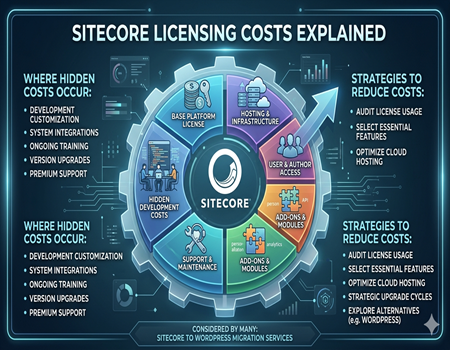
When businesses evaluate the real investment behind Sitecore, they quickly realize that licensing is not a single fixed fee. Instead, it is a combination of multiple cost components that together form the total ownership cost of the platform. Understanding these components is important for making an informed decision.
1. Core Platform License Cost
The primary cost in Sitecore is the core platform license. This is the base fee that gives businesses access to the CMS and digital experience capabilities. The pricing is usually customized based on business size, traffic volume, number of sites, and required features. Larger enterprises naturally fall into higher pricing tiers because they require more scalability and performance.
2. Hosting and Infrastructure Costs
Sitecore requires a strong hosting environment, especially for enterprise-level traffic. Businesses often choose cloud hosting or managed infrastructure solutions, which adds a significant ongoing cost. High availability setups, load balancing, and performance optimization further increase infrastructure expenses.
3. User and Content Author Licensing
In many Sitecore agreements, pricing can also depend on the number of users or content authors accessing the system. Large marketing teams or global organizations managing multiple contributors may face higher licensing tiers due to expanded user access requirements.
4. Add-ons and Modules
Sitecore is a modular platform, meaning advanced features such as personalization, analytics, automation, and commerce capabilities may require additional licensing. These add-ons significantly increase the total cost, especially for enterprises using the full Sitecore Experience Platform.
5. Support and Maintenance Fees
Enterprise licenses typically include support and maintenance agreements. These cover updates, patches, and technical assistance. However, premium support levels come at an additional cost, especially for businesses requiring faster response times or dedicated support services.
6. Upgrade and Scaling Costs
As businesses grow, they often need to upgrade their Sitecore environment. Scaling infrastructure, adding new features, or migrating to newer versions can lead to additional licensing and implementation expenses.
Overall, Sitecore’s licensing structure is designed for flexibility but results in multiple cost layers that can be difficult to predict. This is why many organizations start exploring Sitecore to WordPress Migration Services to move toward a more cost-transparent and easier-to-manage CMS ecosystem.
Hidden Costs in Sitecore Implementation
When businesses evaluate Sitecore, most of the attention goes to the licensing fee. However, the real budget impact often comes from hidden costs that are not clearly visible at the beginning of the project. These costs can significantly increase the total investment over time.
1. Development and Customization Costs
Sitecore is a highly advanced enterprise platform, but it is not plug-and-play. Most organizations require extensive customization to match their branding, workflows, and customer experience goals. This means hiring experienced developers or certified Sitecore partners, which can be expensive. Even small changes in design or functionality often require technical support.
2. Integration Costs
Enterprise businesses usually connect Sitecore with multiple systems such as CRM, ERP, marketing automation tools, and analytics platforms. These integrations are complex and require skilled development work. The more systems you connect, the higher the implementation cost becomes.
3. Upgrade and Version Migration Costs
Sitecore regularly releases updates and new versions. However, upgrading is not always simple. Many enterprises need additional development work, testing, and compatibility fixes before moving to a new version. This process can be time-consuming and costly.
4. Training and Onboarding Costs
Because Sitecore has a steep learning curve, marketing and content teams often require training. Enterprises may need workshops, documentation, and onboarding sessions to ensure teams can use the platform efficiently. This adds both time and financial investment.
5. Maintenance and Technical Support
Even after implementation, Sitecore requires ongoing maintenance. Businesses often rely on external agencies or in-house technical teams to manage performance, security updates, and bug fixes. Premium support plans can further increase recurring expenses.
6. Opportunity Cost (Slower Marketing Execution)
While not a direct financial cost, slower campaign execution due to technical dependencies can impact revenue. Delays in launching campaigns or updating content can reduce marketing efficiency.
Because of these hidden costs, many organizations reassess their CMS strategy and consider Sitecore to WordPress Migration Services to achieve better cost control, faster execution, and reduced technical dependency.
Why Sitecore is Expensive for Enterprises
One of the biggest concerns businesses face with Sitecore is its high overall cost. While the platform offers powerful enterprise features, its pricing structure and operational requirements make it one of the more expensive CMS solutions in the market.
1. Enterprise-Grade Architecture
Sitecore is built for large-scale enterprises that require advanced digital experience management, personalization, and multi-site control. This enterprise-level architecture demands high-performance infrastructure, complex backend systems, and continuous optimization. These technical requirements naturally increase both setup and long-term operational costs.
2. Vendor Lock-In Effect
Once a company fully adopts Sitecore, it often becomes heavily dependent on its ecosystem, certified developers, and specialized agencies. This dependency reduces flexibility and increases costs over time, as businesses cannot easily switch or scale without additional investment.
3. Skilled Resource Requirement
Sitecore is not a beginner-friendly platform. It requires trained developers, solution architects, and certified professionals to manage implementation and maintenance. Hiring or retaining such talent is expensive, especially for long-term projects.
4. Continuous Maintenance and Upgrades
Unlike lightweight CMS platforms, Sitecore requires ongoing maintenance, version upgrades, and system optimization. Each upgrade cycle may involve additional development work, testing, and compatibility fixes, which adds to recurring expenses.
5. Complex Licensing Structure
Sitecore’s licensing is not transparent or fixed. It is based on multiple factors like usage, traffic, features, and enterprise agreements. This makes cost prediction difficult and often leads to higher-than-expected long-term spending.
6. Slower ROI for Marketing Teams
Because of technical dependencies and longer implementation cycles, marketing teams may experience delays in campaign execution. This indirectly impacts ROI, as time-to-market becomes slower compared to more agile platforms.
Due to these combined factors, many organizations begin evaluating alternatives and consider Sitecore to WordPress Migration Services to reduce costs, improve agility, and gain better control over their digital marketing operations.
Sitecore Pricing vs Other CMS Platforms
To truly understand whether Sitecore is expensive or justified, it is important to compare it with other popular content management systems in the market. Pricing differences become very clear when we look at enterprise CMS alternatives like WordPress and Adobe Experience Manager.
Sitecore vs WordPress
WordPress is an open-source CMS, which means there is no mandatory licensing fee. Businesses mainly pay for hosting, premium plugins, themes, and development services. This makes WordPress significantly more cost-effective compared to Sitecore.
Sitecore, on the other hand, comes with enterprise licensing fees, infrastructure requirements, and specialized developer costs. While Sitecore offers advanced personalization and digital experience features, WordPress provides enough flexibility for most enterprise marketing needs at a much lower total cost.
Sitecore vs Adobe Experience Manager (AEM)
Another enterprise competitor is Adobe Experience Manager. Like Sitecore, AEM also follows a high-cost enterprise licensing model. Both platforms are designed for large organizations with complex digital ecosystems. However, Sitecore is often considered slightly more flexible in customization, while AEM is deeply integrated into Adobe’s ecosystem.
Still, both platforms sit in the premium pricing category, making them expensive choices for long-term CMS ownership.
Why Sitecore Feels More Expensive
Even when compared to other enterprise tools, Sitecore often feels costly due to its multiple pricing layers—license fees, infrastructure, developers, integrations, and maintenance. These combined expenses make it difficult for businesses to predict total ownership cost accurately.
Key Takeaway
While Sitecore delivers strong enterprise capabilities, its pricing structure is significantly higher than most CMS platforms. This is why many organizations reassess their digital strategy and explore Sitecore to WordPress Migration Services to achieve better cost efficiency, simpler management, and improved marketing agility.
Who Should Invest in Sitecore Licensing?
Despite its high cost structure, Sitecore is not meant for every type of business. It is specifically designed for large enterprises that require advanced digital experience management, strong governance, and complex personalization capabilities at scale.
1. Large Enterprise Organizations
Sitecore is best suited for global companies managing multiple websites, regions, and customer segments. These organizations often need centralized control, advanced workflows, and structured content management across different markets.
2. Businesses with High Personalization Needs
Companies that rely heavily on personalized customer journeys—such as showing different content based on user behavior, location, or preferences—can benefit from Sitecore’s advanced personalization engine. This is especially useful in industries like retail, travel, and financial services.
3. Regulated Industries
Sectors such as banking, insurance, healthcare, and government organizations often choose Sitecore because of its strong security features, compliance support, and controlled publishing workflows. These industries cannot afford risks in content governance or data handling.
4. Organizations with Dedicated Technical Teams
Sitecore works best when companies have in-house developers, solution architects, or long-term technical partners. Without technical support, managing the platform can become complex and expensive.
Final Insight
While Sitecore offers powerful enterprise capabilities, it is not ideal for businesses looking for agility, low cost, or fast marketing execution. Companies that find it too complex or expensive often evaluate Sitecore to WordPress Migration Services to move toward a more flexible and cost-efficient CMS environment.
How Businesses Can Reduce Sitecore Costs
Managing expenses for Sitecore can be challenging, but there are several practical strategies that enterprises can use to reduce overall cost without completely changing their digital ecosystem.
1. Optimize License Usage
Many organizations pay for unused features or higher-tier licenses than they actually need. A proper audit of current usage can help businesses downgrade unnecessary modules and align licensing with real requirements.
2. Avoid Unnecessary Add-ons
Sitecore offers multiple add-ons like personalization, analytics, and commerce tools. However, not every business needs the full suite. Carefully selecting only essential features can significantly reduce licensing and operational costs.
3. Improve Infrastructure Efficiency
Hosting and infrastructure are major cost contributors. Moving to optimized cloud environments, improving caching strategies, and reducing server over-provisioning can help lower ongoing expenses.
4. Control Custom Development
Heavy customization increases both development and maintenance costs. Using standard Sitecore features wherever possible instead of custom builds can reduce long-term technical dependency.
5. Plan Upgrade Cycles Strategically
Frequent upgrades can become expensive. Planning upgrades in longer cycles and ensuring proper version compatibility can reduce repeated development and testing costs.
6. Evaluate Long-Term CMS Strategy
Sometimes the biggest savings come from reassessing whether Sitecore is still the right fit. Many enterprises discover that their marketing needs can be met more efficiently on simpler platforms.
Because of these cost pressures, many organizations eventually explore Sitecore to WordPress Migration Services as a long-term strategy to reduce complexity, lower maintenance expenses, and improve marketing agility while maintaining scalability.
Final Thoughts: Is Sitecore Worth Its Cost?
Deciding whether Sitecore is worth its cost depends entirely on the size, goals, and digital maturity of a business. It is a powerful enterprise CMS built for organizations that need advanced personalization, complex integrations, and strict content governance across multiple platforms.
However, the reality is that Sitecore comes with a high total cost of ownership. Licensing fees, infrastructure requirements, developer dependency, and ongoing maintenance all add up quickly. For large enterprises with strong technical teams and high-budget digital strategies, this investment can be justified because of the platform’s enterprise-grade capabilities.
On the other hand, many businesses today are prioritizing speed, flexibility, and cost efficiency in their marketing operations. In such cases, Sitecore may feel overly complex and expensive compared to modern CMS alternatives. This is where companies start rethinking their long-term digital strategy.
For organizations struggling with high costs and operational complexity, exploring Sitecore to WordPress Migration Services can be a practical step toward modernization. It allows businesses to reduce licensing burden, simplify content management, and give marketing teams more independence.