Sitecore vs WordPress for Enterprise Marketing Teams
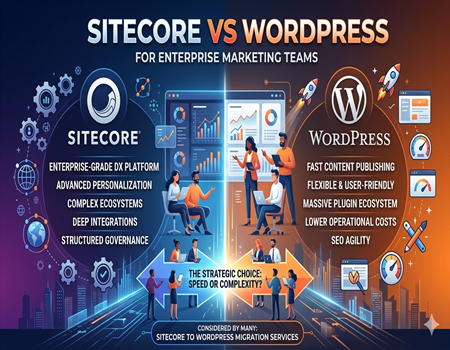
Choosing the right content management system (CMS) has become a major decision for enterprise marketing teams. Modern businesses need more than just a platform to publish content. They need a system that supports fast campaign launches, personalized customer experiences, SEO performance, scalability, and smooth collaboration between marketing and development teams. This is why many enterprises compare Sitecore and WordPress when planning their digital growth strategy.
Sitecore is known for its enterprise-level personalization, advanced integrations, and powerful digital experience capabilities. Large organizations often use it to manage complex websites and customer journeys. On the other hand, WordPress has become a leading CMS because of its flexibility, user-friendly dashboard, massive plugin ecosystem, and lower operational costs.
For enterprise marketing teams, the choice is not only about technology. It is also about speed, efficiency, budget, content control, and long-term scalability. Marketing departments today want the freedom to create and optimize campaigns without depending heavily on developers for every update.
As digital requirements continue to evolve, many organizations are also exploring Sitecore to WordPress Migration Services to simplify website management, improve SEO flexibility, and reduce ongoing maintenance complexity. Understanding the strengths and limitations of both platforms can help enterprises make a smarter long-term CMS investment.
Understanding Sitecore and WordPress
What is Sitecore?
Sitecore is an enterprise-level digital experience platform designed for large organizations that need advanced personalization, customer journey tracking, and integration capabilities. It is commonly used by enterprises managing multiple websites, regional platforms, and complex digital ecosystems. Sitecore combines content management with marketing automation, analytics, and customer data tools, making it suitable for businesses that focus heavily on personalized customer experiences.
One of Sitecore’s biggest strengths is its ability to deliver tailored content to different audience segments. Enterprise companies in industries like finance, healthcare, manufacturing, and retail often choose Sitecore because of its scalability and enterprise-grade architecture. However, the platform usually requires experienced developers, ongoing maintenance, and higher implementation costs, which can make content management slower for non-technical marketing teams.
What is WordPress?
WordPress is the world’s most widely used content management system and powers millions of websites globally. Unlike traditional enterprise CMS platforms, WordPress is open-source, flexible, and easier to manage for both marketers and developers. Businesses can quickly create pages, publish blogs, optimize SEO, and manage campaigns without dealing with complex backend processes.
The platform also offers a massive ecosystem of plugins, themes, and third-party integrations that support SEO, security, analytics, automation, and performance optimization. Over the years, WordPress has evolved far beyond blogging and is now widely used by enterprise brands looking for faster content publishing and greater marketing flexibility.
Because of these advantages, many organizations now consider Sitecore to WordPress Migration Services when modernizing their digital platforms and improving marketing efficiency.
Sitecore vs WordPress: Core Feature Comparison
When comparing Sitecore and WordPress, enterprise marketing teams should focus on features that directly impact daily operations, campaign execution, scalability, and content management efficiency. Both platforms are powerful, but they serve businesses in different ways.
Ease of Use
WordPress is widely known for its simple and user-friendly dashboard. Marketing teams can easily create pages, publish blogs, update content, and optimize SEO without needing technical expertise. The learning curve is relatively low, which allows teams to work faster and independently.
Sitecore, on the other hand, offers advanced enterprise capabilities but comes with a more complex interface. Many tasks require developer involvement or technical training, which can slow down marketing workflows and increase dependency on IT teams.
Customization and Flexibility
Sitecore provides deep customization options and enterprise-level personalization features. Businesses with highly specific digital experience requirements may benefit from its advanced architecture and integration capabilities.
WordPress also offers strong flexibility through thousands of plugins, themes, and custom development options. Enterprises can integrate CRM platforms, analytics tools, marketing automation software, and eCommerce systems without extensive development time.
Content Publishing Workflow
For enterprise marketing teams, content speed matters. WordPress makes publishing and editing content quick and straightforward. Teams can launch campaigns faster, manage blogs efficiently, and collaborate more easily across departments.
Sitecore supports structured workflows and enterprise governance, but content publishing processes can sometimes become slower because of technical complexity and approval structures.
Scalability
Both platforms can support large enterprise websites. Sitecore is built specifically for large-scale digital ecosystems and complex customer experiences. It performs well for organizations managing multiple regional sites and advanced personalization strategies.
WordPress has also become highly scalable when paired with proper hosting, optimization, and enterprise-grade infrastructure. Many global brands now use WordPress successfully for high-traffic websites and enterprise content operations.
Security and Integrations
Sitecore provides enterprise-grade security and centralized management features that appeal to highly regulated industries. It also supports deep integrations with enterprise software platforms.
WordPress offers strong security as well, especially when businesses use managed hosting, security plugins, and regular updates. Its large ecosystem makes third-party integrations easier and more affordable.
Because of the balance between flexibility, usability, and cost efficiency, many enterprises today explore Sitecore to WordPress Migration Services to create a more agile and marketing-friendly digital environment.
Cost Comparison: Sitecore vs WordPress
For enterprise businesses, cost plays a major role when selecting a content management system. While both Sitecore and WordPress can support large-scale websites, their overall ownership costs are very different.
Sitecore is known for its enterprise-grade capabilities, but it also comes with significant licensing expenses. Businesses often need to pay high annual licensing fees along with costs for implementation, infrastructure, developer support, upgrades, and ongoing maintenance. Since the platform is technically complex, enterprises usually require dedicated development teams or certified Sitecore partners to manage daily operations and customizations.
In comparison, WordPress is open-source, which means there are no expensive licensing fees. Businesses mainly invest in hosting, premium plugins, security tools, and custom development based on their requirements. This makes WordPress a more cost-effective option for many organizations, especially those looking to scale content marketing efforts without dramatically increasing operational expenses.
Development timelines also tend to be faster with WordPress because of its large plugin ecosystem and easier customization process. Marketing teams can often make updates and launch campaigns without depending heavily on developers, reducing both time and resource costs.
Another important factor is long-term maintenance. Sitecore upgrades and integrations can become expensive over time, particularly for organizations managing multiple enterprise websites. Because of these growing costs, many companies now explore Sitecore to WordPress Migration Services to simplify their digital infrastructure, reduce maintenance expenses, and gain more flexibility in managing enterprise content operations.
Which Platform is Better for Marketing Teams?
For enterprise marketing teams, the choice between Sitecore and WordPress is not just about features—it’s about how efficiently teams can execute campaigns, manage content, and respond to business needs.
In most real-world marketing environments, speed and independence matter the most. WordPress gives marketing teams a major advantage here. Its simple interface allows marketers to create landing pages, publish blogs, update website content, and run SEO optimizations without waiting for developer support. This reduces delays in campaign launches and improves overall productivity. Teams can react quickly to market trends, seasonal campaigns, and customer behavior changes.
Sitecore, while powerful, often introduces more structured and technical workflows. Marketing teams usually need to coordinate with developers or technical specialists for changes, integrations, or even minor design updates. This can slow down execution and reduce agility, especially in fast-moving industries like eCommerce, media, and digital services.
Another important factor is campaign management flexibility. WordPress offers a wide range of plugins for email marketing, analytics, A/B testing, and SEO, allowing marketers to build and manage campaigns independently. Sitecore provides strong personalization and enterprise marketing automation, but it often requires deeper configuration and technical setup.
From a usability perspective, WordPress reduces operational friction. Teams can focus more on strategy and content creation instead of technical dependencies. Sitecore, on the other hand, is better suited for organizations with dedicated technical teams and complex personalization requirements.
This difference is why many enterprises today reconsider their CMS strategy and explore Sitecore to WordPress Migration Services to empower marketing teams with faster workflows, better control, and improved digital agility.
SEO and Performance Comparison
Search visibility and website performance are critical factors for enterprise marketing success. A CMS should not only help manage content but also support strong SEO performance, fast loading speed, and excellent user experience.
WordPress has a clear advantage when it comes to SEO flexibility. It offers powerful plugins like Yoast SEO and Rank Math that help marketing teams optimize meta titles, descriptions, internal linking, schema markup, and keyword usage without deep technical knowledge. This makes it easier for content teams to follow SEO best practices and improve rankings consistently. WordPress also supports fast content publishing, which helps enterprises stay active with fresh content—an important ranking factor.
On the other hand, Sitecore provides strong SEO capabilities at an enterprise level, especially for structured content management and personalization. It allows businesses to deliver targeted content experiences based on user behavior, location, and customer data. However, SEO changes and optimizations often require technical involvement, which can slow down execution for marketing teams.
In terms of performance, both platforms can deliver fast websites when properly optimized. WordPress performance depends heavily on hosting, caching, and optimization plugins, but it can achieve excellent Core Web Vitals scores with the right setup. Sitecore is designed for enterprise-scale performance, handling complex digital ecosystems and large traffic volumes efficiently, but it often requires more infrastructure management.
Overall, WordPress offers more flexibility and speed for SEO execution, while Sitecore provides structured enterprise-level control. This difference is one of the key reasons many businesses consider Sitecore to WordPress Migration Services to improve SEO agility and website performance.
Why Enterprises Are Moving from Sitecore to WordPress
In recent years, many enterprises have started rethinking their content management strategy and shifting away from highly complex platforms like Sitecore toward more flexible and cost-efficient solutions like WordPress. This shift is not just a trend—it is driven by practical business needs, especially in marketing teams that demand speed, simplicity, and better control over digital assets.
One of the biggest reasons for this migration is cost reduction. Sitecore requires high licensing fees, specialized developers, and continuous maintenance, which increases the total cost of ownership. For many enterprises, this becomes difficult to justify when marketing budgets need to be optimized.
Another major factor is agility. Modern marketing teams need to launch campaigns quickly, update landing pages instantly, and optimize content in real time. WordPress allows teams to do all of this without heavy technical dependency. This reduces delays and improves overall campaign performance.
Ease of use is also a key driver. Sitecore’s advanced structure often requires technical training, while WordPress empowers marketing teams to manage most tasks independently. This improves productivity and reduces reliance on IT departments.
Additionally, the large ecosystem of plugins and integrations in WordPress makes it easier for enterprises to connect CRM tools, analytics platforms, SEO tools, and automation systems without complex development work. This flexibility is highly valuable in today’s fast-moving digital environment.
Performance and SEO control also play a role. WordPress offers faster content updates and easier SEO optimization, which helps enterprises stay competitive in search rankings.
Because of these combined benefits, many organizations are actively considering Sitecore to WordPress Migration Services to modernize their digital infrastructure, reduce operational complexity, and create a more marketing-friendly environment that supports faster growth and better user experiences.
When Sitecore Might Still Be the Better Choice
Even though many businesses are moving toward WordPress, there are still situations where Sitecore remains a strong and suitable choice for enterprise organizations.
Sitecore is particularly valuable for large enterprises that operate in highly complex digital ecosystems. If a company needs advanced customer journey mapping, deep personalization based on real-time behavioral data, and tightly controlled content governance across multiple global websites, Sitecore can deliver that level of sophistication effectively.
Industries like banking, insurance, healthcare, and large-scale manufacturing often prefer Sitecore because they require strict security standards, compliance requirements, and centralized control over content and customer data. Sitecore’s built-in digital experience tools also help enterprises deliver highly personalized content at scale, which can significantly improve customer engagement in data-driven environments.
Another advantage is its ability to integrate deeply with enterprise-grade systems like CRM, ERP, and marketing automation platforms, making it suitable for organizations with complex IT infrastructures.
However, it’s important to note that these advantages come with higher cost and complexity. Sitecore works best when an organization has strong technical teams and long-term investment capability.
So, while WordPress is often preferred for flexibility and speed, Sitecore still holds value for enterprises with advanced personalization, security, and large-scale digital experience requirements.
Final Verdict: Which CMS Should Enterprise Teams Choose?
Choosing between Sitecore and WordPress ultimately depends on an enterprise’s goals, budget, technical resources, and marketing priorities. Both platforms are powerful, but they serve different types of organizations and digital strategies.
If your enterprise focuses on highly complex customer journeys, advanced personalization, and deep integration with enterprise systems, Sitecore can be a strong fit. It is designed for large organizations that have dedicated technical teams and require strict governance, security, and structured digital experience management. However, this power comes with higher costs, longer development cycles, and heavier dependence on IT teams.
On the other hand, WordPress is a more flexible and marketing-friendly solution. It empowers marketing teams to work independently, publish content faster, optimize SEO easily, and launch campaigns without long technical delays. It is also more cost-effective and scalable for enterprises that want agility and faster time-to-market.
In today’s fast-moving digital landscape, many enterprises are prioritizing speed, simplicity, and marketing autonomy. That is why a growing number of organizations are considering Sitecore to WordPress Migration Services to modernize their CMS infrastructure and improve operational efficiency.
Final takeaway:
- Choose Sitecore if you need deep enterprise personalization and complex digital ecosystems.
- Choose WordPress if you want flexibility, faster execution, better SEO control, and lower maintenance costs.
The right CMS is not about popularity—it is about aligning technology with your marketing and business growth strategy.