SEO Issues with Liferay Portals
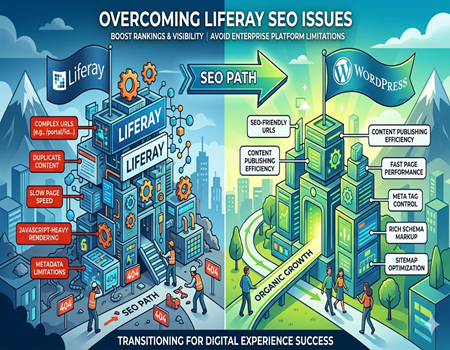
Liferay is widely used by enterprises for building digital experiences, intranets, and large-scale web portals. It offers strong control over content management, user roles, and enterprise integrations, making it a powerful platform for complex business needs. However, despite its technical strength, SEO often becomes a hidden challenge for many organizations using Liferay portals.
In today’s digital world, ranking on search engines is not optional. Businesses depend heavily on organic traffic to generate leads, build visibility, and compete online. If a website is not SEO-friendly, even high-quality content may fail to reach the target audience. This is where many Liferay-based websites struggle.
Most Liferay portals are designed with functionality first, not search engine optimization. As a result, issues like complex URL structures, slow page performance, and limited SEO flexibility often reduce visibility on Google. These challenges directly impact rankings and organic growth.
Understanding SEO issues in Liferay portals is important for businesses that want long-term success online. Without proper optimization, even a powerful enterprise system can fail to deliver digital marketing results and organic reach.
What is Liferay and How It Handles SEO
Liferay is an enterprise-grade digital experience platform used to build websites, customer portals, intranets, and large-scale web applications. It is especially popular among organizations that need complex user management, workflow automation, and highly customized digital experiences. Unlike traditional CMS platforms, Liferay focuses more on enterprise functionality than marketing or SEO-first design.
From an SEO perspective, Liferay does provide some basic built-in capabilities. It allows users to configure meta titles, meta descriptions, and friendly URLs. It also supports sitemap generation and offers options to manage page indexing. These features give developers a starting point for making pages search-engine friendly.
However, Liferay’s SEO handling is not as straightforward as modern CMS platforms. Most SEO configurations depend heavily on technical setup and developer intervention. Marketing teams often find it difficult to make quick SEO changes without technical support. This slows down optimization efforts and reduces flexibility.
Another important aspect is how Liferay generates content. Since it is a portal-based system, many pages are dynamically created. While this helps in scalability, it can sometimes lead to less control over SEO structure compared to traditional content management systems.
Overall, Liferay provides the foundation for SEO, but it does not fully support advanced optimization out of the box. Businesses often need additional customization and technical expertise to make their portals truly SEO-friendly and competitive in search rankings.
Major SEO Issues in Liferay Portals
Poor URL Structure
One of the biggest SEO issues in Liferay portals is the complex and non-SEO-friendly URL structure. Many pages are generated with long dynamic URLs that include parameters and session IDs. These URLs are difficult for search engines to understand and users also find them less readable, which negatively impacts click-through rates and indexing performance.
Duplicate Content Issues
Liferay portals often generate multiple versions of the same page due to dynamic content rendering. This leads to duplicate content problems, where search engines find similar or identical pages under different URLs. This confuses crawlers and can reduce the ranking potential of important pages across the website.
Slow Page Speed Performance
Page speed is a critical SEO factor, and Liferay portals sometimes suffer from heavy backend processing and large resource loading. Because enterprise portals include multiple scripts, components, and integrations, page load times increase, leading to poor user experience and lower search rankings.
JavaScript-Heavy Rendering Issues
Liferay relies heavily on JavaScript-based rendering for dynamic content delivery. While this improves functionality, it can create crawling difficulties for search engines. If content is not properly rendered on the server side, Google bots may struggle to fully index important page elements.
Metadata Configuration Limitations
Although Liferay allows basic SEO metadata setup, managing it across large portals becomes complex. In many cases, meta titles and descriptions are not consistently optimized. This inconsistency reduces the overall SEO strength of the website and affects visibility on search engine results pages.
Indexing and Sitemap Challenges
Search engines depend on proper sitemap structure and indexing signals. In Liferay portals, sitemap generation may not always reflect all important pages accurately. As a result, some pages remain unindexed, limiting organic traffic potential and reducing content discoverability.
Pagination and Parameter-Based URLs
Many Liferay portals use parameter-based navigation for pagination and filtering. This creates multiple URL variations for similar content, which can dilute SEO value. Search engines may treat these pages as low-value or redundant, affecting overall ranking performance.
Weak Internal Linking Structure
Internal linking in Liferay portals is often not strategically optimized. Pages may exist in silos without strong contextual linking between them. This reduces link equity flow across the website and makes it harder for search engines to understand site hierarchy and priority pages.
Technical SEO Limitations in Liferay
Liferay is a powerful enterprise platform, but when it comes to technical SEO, it has several limitations that can affect overall search performance. These issues are not always visible at the surface level but play a major role in how search engines crawl, index, and rank a website.
One of the key challenges is limited crawlability control. Search engines like Google rely on clean and accessible HTML structures. In Liferay portals, pages are often dynamically generated, which can make it harder for bots to efficiently crawl all important content, especially when proper rendering is not optimized.
Another limitation is the lack of advanced SEO plugin ecosystem. Unlike modern CMS platforms, Liferay does not offer flexible SEO tools that marketers can easily install and manage. This means most SEO improvements require manual development work, slowing down optimization efforts.
Schema markup implementation is also more complex in Liferay. Structured data is essential for rich results in search engines, but adding and managing schema often requires technical customization. This creates dependency on developers and reduces agility for SEO teams.
The platform’s complex site architecture is another technical barrier. Liferay is designed around portals, pages, and portlets, which can lead to deep and complicated navigation structures. If not properly optimized, this can dilute page authority and make it difficult for search engines to understand content hierarchy.
Additionally, on-page SEO flexibility is limited in many cases. Simple tasks like adjusting headings, optimizing metadata at scale, or controlling page-level SEO elements may not be as straightforward as in other CMS platforms.
Overall, while Liferay is strong in enterprise functionality, its technical SEO limitations can restrict organic growth if not properly managed with expert optimization strategies.
Impact of These SEO Issues on Business
SEO issues in Liferay portals don’t just remain technical problems—they directly affect business performance and digital growth. When a website fails to rank properly on search engines, it loses organic visibility, which is one of the most cost-effective sources of traffic for any business.
One of the biggest impacts is reduced organic traffic. If pages are not indexed correctly or are competing with duplicate versions, search engines struggle to rank them. As a result, fewer users discover the website naturally through Google searches.
Another major issue is poor keyword rankings. Even if a business targets the right keywords, technical SEO limitations like slow page speed, weak internal linking, or complex URLs prevent those pages from reaching top positions. This reduces overall search visibility and brand exposure.
User experience is also affected. Slow-loading pages and poor navigation increase bounce rates, meaning visitors leave the website quickly without exploring further. This signals to search engines that the site is not delivering a good experience, which can further harm rankings.
From a marketing perspective, Liferay SEO challenges also create dependency on technical teams. Small SEO updates like meta tag changes or content adjustments often require developer involvement, slowing down campaign execution and reducing flexibility for marketing teams.
Ultimately, these issues lead to missed business opportunities, as competitors with better-optimized platforms capture more traffic, leads, and conversions. Over time, this can significantly impact revenue and digital growth potential for enterprises relying heavily on Liferay portals.
Why Businesses Consider Migration from Liferay
Many businesses start noticing that while Liferay is strong for enterprise portal management, it becomes restrictive when it comes to SEO growth and marketing flexibility. Over time, teams realize that managing search visibility, content updates, and optimization tasks requires more effort compared to modern CMS platforms, which slows down digital performance.
Another major reason for considering migration is the lack of agility in content management. Marketing teams often depend on developers for even small SEO or content changes. This delay affects campaign execution speed and makes it difficult to respond quickly to market trends or keyword opportunities.
Businesses also struggle with scaling SEO strategies on Liferay portals. As websites grow, technical limitations like complex architecture, weak URL control, and limited SEO plugins start creating bottlenecks. This directly impacts organic growth and reduces competitiveness in search rankings.
Because of these challenges, many organizations explore better alternatives that offer stronger SEO control and ease of use. This is where solutions like Liferay to WordPress Migration Services become highly relevant, helping businesses move to a more flexible, SEO-friendly, and performance-optimized platform for long-term digital success.
Liferay vs WordPress SEO Comparison
When comparing Liferay and WordPress from an SEO perspective, the difference becomes quite clear in terms of flexibility, ease of use, and optimization control. Both platforms serve different purposes, but for organic growth, their capabilities vary significantly.
Liferay is primarily designed for enterprise-level portals and complex business systems. It offers strong security, user management, and workflow features. However, its SEO capabilities are limited and often require technical involvement. Tasks like URL optimization, metadata management, and schema implementation are not very user-friendly, which slows down SEO execution.
On the other hand, WordPress is built with content publishing and SEO in mind. It provides a wide range of plugins such as Yoast SEO and Rank Math, which make optimization simple even for non-technical users. Marketers can easily manage titles, descriptions, sitemaps, and structured data without relying heavily on developers.
In terms of performance, WordPress also offers better flexibility through caching plugins and lightweight themes, which helps improve page speed—a major ranking factor. Liferay portals, due to their heavy enterprise architecture, often struggle with speed optimization unless extensively customized.
Another major difference is content management freedom. WordPress allows quick publishing, editing, and optimization, making it ideal for SEO-driven strategies. Liferay, however, is more rigid and requires structured workflows, which can slow down content updates.
Overall, while Liferay is powerful for enterprise operations, WordPress clearly provides a more SEO-friendly environment, making it a preferred choice for businesses focused on organic growth and search visibility.
How Liferay SEO Issues Can Be Fixed (If Migration Not Done)
Even though Liferay has several SEO limitations, some improvements can still be made without migrating the platform. However, these fixes require continuous effort and technical support to maintain long-term performance.
One of the first steps is URL optimization. Developers can configure friendly URLs to replace long dynamic links with clean, readable structures. This helps search engines understand page hierarchy better and improves click-through rates.
Another important improvement is page speed optimization. By enabling caching, compressing assets, and reducing heavy script loading, overall performance can be improved. Faster pages lead to better user experience and stronger SEO signals.
Proper meta tag management is also essential. Ensuring that every page has unique and optimized titles and descriptions helps reduce duplication issues and improves relevance for targeted keywords.
Creating and maintaining an accurate XML sitemap is another key step. This ensures that search engines can discover and index important pages more effectively.
However, despite these optimizations, Liferay still has structural limitations that cannot be fully resolved. Features like flexible SEO plugins, advanced schema control, and complete marketing autonomy are still missing.
Because of this, many businesses see these fixes as temporary solutions rather than a long-term SEO strategy.
Best Solution: Liferay to WordPress Migration Approach
When SEO limitations in Liferay start affecting business growth, many organizations consider moving to a more flexible and SEO-friendly platform. One of the most effective solutions is migrating to WordPress, which is widely known for its strong SEO ecosystem, ease of use, and content management flexibility.
WordPress allows businesses to take full control of their SEO strategy without heavy technical dependency. From URL structure optimization to metadata control and schema implementation, everything can be managed through user-friendly tools and plugins. This makes it much easier for marketing teams to execute SEO campaigns efficiently.
The migration process typically involves careful planning to ensure no data or SEO value is lost. It includes transferring content, maintaining URL redirects, preserving metadata, and ensuring proper site structure is rebuilt on the new platform. A well-planned migration also helps retain existing search rankings while improving long-term performance.
One of the biggest advantages of switching to WordPress is improved scalability. Businesses can easily expand their content strategy, optimize pages faster, and implement SEO best practices without waiting for developer support.
This is where professional support becomes important. Choosing expert-level Liferay to WordPress Migration Services ensures that the transition is smooth, secure, and SEO-safe. It helps businesses protect their existing traffic while unlocking better visibility and growth opportunities on search engines.
Overall, migration is not just a technical shift—it is a strategic move toward stronger digital performance and sustainable organic growth.
Conclusion: SEO Growth After Fixing Liferay Limitations
SEO challenges in Liferay portals are common, especially for enterprises that prioritize functionality over search visibility. Issues like complex URLs, slow performance, limited SEO control, and indexing difficulties can significantly impact organic growth and reduce overall digital reach.
However, understanding these problems is the first step toward improvement. Businesses can apply basic optimizations within Liferay, but these solutions are often limited and require continuous technical support. Over time, it becomes clear that the platform itself restricts full SEO potential.
For long-term success, companies need a system that supports both performance and marketing flexibility. Migrating to a more SEO-friendly platform like WordPress helps remove these limitations and provides better control over content, structure, and optimization strategies.
With the right approach and proper execution, businesses can regain lost rankings, improve visibility, and achieve sustainable organic growth. In the end, choosing the right platform plays a crucial role in determining how effectively a website performs in search engines.